Why Does Your Walk-in Bath Take So Long to Drain? The Upgrade Most People Don’t Know About
Bath drainage is one of those things nobody thinks about until it stops working.
Then it’s all you think about.
You’ve probably already tried the obvious fixes. Cleaned around the plug. Poured something chemical down there. Maybe reached for the plunger. It cleared – briefly – and then the water started sitting again, ankle-deep, going nowhere in particular.
Here’s the thing. Most slow-draining baths aren’t fixed by surface solutions because most slow-draining baths don’t have a surface cause. The real reasons tend to be structural – in the pipework behind the wall, or beneath the floor, or somewhere you can’t see and didn’t install.
This article explains what’s actually happening, which fixes genuinely work, and – for anyone considering a walk-in bath – why drainage speed is an engineering decision, not a lucky coincidence.
How a Bath Drain Actually Works

Water leaves a bath through a single waste outlet at the base, passes through a trap – a U-shaped section of pipe that holds a water seal to stop sewer gases returning – and travels along a waste pipe to the soil stack on the exterior of your home. The whole journey relies on gravity.
Specifically, it relies on the waste pipe maintaining a consistent downward slope from the bath to the soil stack. Plumbers refer to this angle as “fall” or gradient. According to the Building Regulations (Part H, which covers drainage and waste disposal), residential waste pipes require a minimum fall to function correctly. Without sufficient gradient, water slows, stalls, and leaves deposits in low points where it pools.
Worth noting: the visible chrome waste cap in your bath conceals two things – a removable hair trap that catches debris, and the trap itself. Most people clean neither very often. They’re different components, and they both need attention.
A standard bath has one waste outlet, typically 40mm in diameter. Everything goes through that single opening. If anything restricts it – inside the pipe or along its path – the whole system slows down.
The Real Causes of a Slow-Draining Bath
There isn’t one answer to this. There’s a hierarchy.
1. A blocked hair trap
This is the most common cause by some distance. The chrome waste cap pulls out – or unscrews, depending on your fitting – and beneath it sits a removable hair trap that collects everything that goes down the drain. Hair, soap residue, debris. It fills silently over weeks and months, and once it’s full enough, drainage slows noticeably.
Cleaning it takes about two minutes. No tools, no chemicals, no plumber.
This fixes the problem immediately in most households. The catch is that it fills again, so monthly maintenance is the real solution rather than a one-time intervention.
2. Incorrect waste pipe gradient
This is what plumbers consistently identify as the root cause of recurring slow drainage – the kind that keeps coming back no matter how many times you clear the trap or pour something down it.
If the waste pipe was installed without adequate fall – or if fittings have shifted over time, or if the pipe sags between supports – water physically cannot move at a normal pace. There will be low points where it pools. Residue accumulates there. The problem compounds slowly over years.
A chemical drain cleaner cannot fix a gradient problem. The cleaner affects what’s in the pipe; it cannot change the path the pipe takes.
This requires a plumber to assess. In some cases, a section of pipework needs re-routing.
3. A sagging flexible waste hose
Less well-known, but a consistent culprit – particularly in shower cabin installations and some bath setups where a flexible hose connects the waste outlet to the house waste pipe.
If that hose is too long, or unsupported across its run, it sags and creates a low-point dip. Think of it like a hosepipe left in a loop on the ground – water sits in the bottom of the loop rather than flowing through. The hose must run consistently downhill, with no dips, from the outlet all the way to the connection point.
4. A venting problem
This one surprises people.
Waste pipes need air to flow freely as water drains – otherwise negative pressure builds up behind the moving water and slows the whole system down. If the vent stack is blocked, undersized, or incorrectly installed, you’ll notice drainage slowing across multiple fixtures.
The clearest sign of a venting issue is water appearing in the bath when a nearby toilet flushes. That’s negative pressure pulling water through the trap from a connected fixture.
This always requires a professional assessment.
5. A single, undersized outlet
One 40mm waste outlet has a fixed maximum flow rate. In baths fitted with high-flow taps – which fill quickly – that single channel can become a bottleneck, especially if there’s any additional restriction anywhere in the pipe run.
The engineering answer here isn’t a wider pipe. It’s a second outlet.
Which Fixes Actually Work – and Which Make It Worse
Start with the hair trap. Always. It’s the most common cause, it costs nothing to check, and it takes two minutes. If cleaning it fixes the problem – great. If it comes back within a few weeks, you’ve learned that the cause is elsewhere.
Plunging is a reasonable second step if the trap is clear but drainage remains slow. It can dislodge soft blockages sitting just below the trap. It won’t help with gradient issues or venting problems.
Chemical drain cleaners are more nuanced than their packaging suggests. They can dissolve grease and soap buildup in the short term, and in a relatively new installation with good pipework, they’ll help. But used repeatedly on older or degraded plastic waste pipes, they can accelerate corrosion over time – trading a slow drain today for a deteriorating pipe over the next few years. They also cannot fix a gradient problem. They affect what’s in the pipe, not where the pipe goes.
Professional rodding – using flexible rods to clear deeper blockages – is effective when there’s a solid obstruction further down the system. A drainage specialist can do this without major disruption, and it’s worth doing before assuming a structural cause.
But what if it keeps coming back?
If the same drain clears and then slows again within weeks, the cause is almost certainly structural – gradient, venting, or pipe condition. At that point, the cost of professional assessment is considerably less than the cost of what comes next.
Left until slow drainage causes undetected damp or structural damage, a problem that could have been resolved with a plumber’s visit can escalate into a considerably more significant repair. The Chartered Institute of Plumbing and Heating Engineering (CIPHE) maintains a register of qualified plumbers at ciphe.org.uk – a useful starting point when you need someone with the right credentials to assess drainage work.
Why Drainage Speed Matters More in a Walk-In Bath
In a standard bath, slow drainage is an inconvenience. You step out whenever you like.
In a walk-in bath, the situation is fundamentally different.
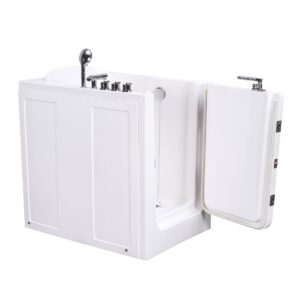
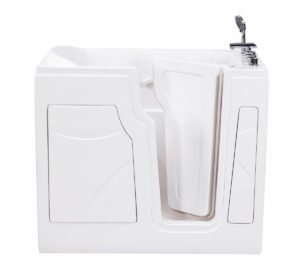
The door seals before filling – which is the point of the design. It can’t be opened until the water level drops far enough that opening it won’t cause a flood. Which means you’re inside, seated, waiting. And if the drainage is slow, that wait is longer – in water that’s cooling, in a bath you can’t exit until the system lets you.
This isn’t a niche concern. It’s consistently one of the first anxieties raised by people researching walk-in baths. And it’s sometimes used – unfairly – to suggest that slow drainage is simply an inherent feature of the product category.
Let’s be clear: it isn’t.
Slow drainage in a walk-in bath is a design choice – or rather, a failure to make a better one. The “trapped and cold” problem doesn’t come from the concept of a walk-in bath. It comes from fitting one with a single waste outlet and calling it done.
The Vidalux Approach – Twin Waste Engineering
Every Vidalux walk-in bath is fitted with twin 40mm fast-flow waste outlets as standard. That’s not an upgrade on selected models – it’s the starting point across the entire range, including the base models.
Two outlets draining simultaneously instead of one. The result is a significantly faster drain – so the wait between wanting to exit and being able to open the door is meaningfully shorter.
Where your installation allows, your plumber will connect both outlets to separate outgoing waste connections into the home’s soil stack, giving maximum flow. The system uses standard plumbing connections throughout – any competent bathroom installer can fit it, with no specialist skills required.
Combined with high-flow mixer taps – which are also standard across the range – the logic is straightforward. Fast filling reduces time spent waiting for the bath to reach temperature. Fast draining reduces time spent waiting to exit. Both matter equally.
Twin 40mm fast-flow wastes are, in a very practical sense, the primary warmth feature of Vidalux walk-in bath design. Getting you out of the bath before the water cools is a plumbing decision, not a luxury add-on. It was engineered this way because the alternative – a slow-draining walk-in bath – is genuinely uncomfortable and entirely avoidable.
So, Where Does That Leave You?
If your bath is draining slowly, the most likely culprit is a blocked hair trap. Check it first. Clean it monthly. That handles the majority of cases without any further intervention.
If the problem persists or keeps returning, the cause is almost certainly in the pipework – gradient, a sagging flexible hose, or a venting issue – and a qualified plumber is the right next step, not another bottle of drain cleaner.
And if you’re researching walk-in baths and drainage speed is one of your questions, it’s the right question to be asking. The answer is in the design of the bath you choose – specifically, whether it was built with drainage speed as a genuine priority from the start.
Review the full Vidalux walk-in bath range, including the twin waste system: https://vidalux.co.uk/walk-in-bathtubs/
Frequently Asked Questions
Q: Why is my bath draining so slowly?
A: The most common cause is a blocked hair trap beneath the waste cap – it fills silently over weeks and needs cleaning monthly. If clearing it doesn’t resolve the problem, the cause is likely a waste pipe gradient issue or a sagging flexible hose, both of which require a plumber.
Q: Why does my bath drain slowly even after I’ve unblocked it?
A: If drainage slows again quickly after clearing, the cause is almost certainly structural. The waste pipe may lack adequate fall, meaning water cannot move freely regardless of what’s in it. A plumber needs to assess – a surface fix won’t resolve a gradient problem.
Q: Do chemical drain cleaners fix a slow draining bath?
A: Short-term, they can dissolve soap and grease buildup. But they cannot fix a gradient or venting problem, and used repeatedly on older pipework they can accelerate corrosion. If the same drain keeps slowing, the cause is structural – not something a chemical will resolve.
Q: What is a venting problem in bath drainage?
A: A venting problem occurs when the vent stack is blocked or undersized, creating negative pressure that slows drainage. A tell-tale sign is water appearing in the bath when a nearby toilet flushes. This always requires a plumber to assess – it won’t resolve itself.
Q: Why do walk-in baths drain slowly?
A: Walk-in baths can drain slowly for the same reasons as any bath – poor waste pipe gradient, a blocked hair trap, or a single undersized outlet. Well-engineered designs address this at the build stage with twin fast-flow waste outlets, which significantly reduce waiting time before the door can be opened.
Q: What is a twin waste system on a walk-in bath?
A: Twin waste uses two 40mm outlets draining simultaneously rather than one, significantly increasing drainage speed. This reduces the time spent seated inside the bath waiting for the water to drop to a safe level before the door can be opened – the direct engineering answer to the “trapped and cold” concern.
Q: Do I need a specialist plumber to install a twin waste walk-in bath?
A: No. The twin fast-flow waste system uses standard plumbing connections throughout. Any competent bathroom installer can fit it – the configuration simply needs confirming the correct connection to your home’s soil stack. No specialist skills are required.
Q: How much does it cost to fix a slow draining bath?
A: Clearing a hair trap costs nothing. Professional rodding for a deeper blockage is typically a modest cost. If the waste pipe gradient needs re-routing, the investment rises – and if slow drainage has caused undetected damp or structural damage, repair costs can escalate considerably. Early diagnosis is always the more economical route.
- About the Author
- UK’s best-rated?

With over 22 years in the home spa industry, Andrew has overseen every stage of the journey—from initial product design and manufacturing to final installation. An author of multiple technical publications and scientific papers, he founded Vidalux to replace industry hype with engineering-led reliability. His focus remains on delivering gym-quality wellness through honest design and technical truth.
DISCLAIMER: All specifications, claims, and advice relating to any internal or external procedure, practise, product, or service were true at the time of writing. For more accurate and up-to-date details in relation to Vidalux services, please visit the relevant dedicated on-site page. For any product-related information, specifications, or guidance, the information on the product page should be considered the governing source.