Why Fast Drainage Matters: Nobody Wants to Wait 10 Minutes to Get Out of the Bath
You’ve finished your bath. You pull the plug. And then… you wait.
Not for a minute or two. Sometimes for a lot longer – sitting there wet, getting cold, watching the water level creep down while the door stays sealed shut. It’s one of those things people don’t think about until it happens to them. Then it becomes the single most frustrating thing about owning a walk-in bath.
Slow drainage isn’t a small annoyance. It shapes whether you actually enjoy using the bath – or quietly start avoiding it.
Let’s talk about why drainage speed matters more than most buyers realise, and what “fast draining” actually means in engineering terms.
Why Walk-in Baths Drain Slower Than Regular Baths
A walk-in bath typically takes 2-4 minutes to drain, depending on the plumbing setup and the waste configuration. Models with twin waste outlets drain roughly twice as fast as those with a single outlet.
Here’s the part that catches people off guard. Unlike a regular bath – where you can step out the moment you pull the plug – a walk-in bath keeps you inside until the water has completely drained.
That’s not a design flaw. It’s a safety requirement.
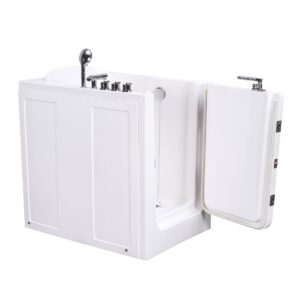
The door on a walk-in bath seals under water pressure. If it could open with water still inside, you’d have a flood. So the door stays locked until the bath is empty. You sit. You wait. You get cold.
How slow is slow?
Cheaper walk-in baths on the market use a single, standard-sized drain. With that configuration, you can easily be sitting there for six, eight, even ten minutes after pulling the plug – exposed, wet, waiting for the water to finally leave so you can open the door.
That’s the bit the glossy brochures don’t mention.
The Cold Wait Is the Hidden Problem
Here’s the thing. A bath is meant to be relaxing. And for the 20 or 30 minutes you’re in the warm water, it usually is.
But the moment you pull the plug, the clock starts.
Your body is wet. The air hits you. You’re sat on a moulded seat with your feet in draining water. Even the most patient person starts fidgeting after a couple of minutes.
Now extend that to ten. It isn’t just uncomfortable – it’s enough to put people off bathing entirely. We’ve heard from plenty of customers who told us they dreaded the cold wait in their old bath so much they’d switched to stand-up showers, or stopped bathing as often as they wanted to.
The risk isn’t just discomfort. According to RoSPA’s guidance on home safety, the bathroom is one of the most common settings for falls and cold-related incidents in older adults – and prolonged exposure to wet, cooling conditions makes both significantly more likely. Drain speed isn’t a luxury concern. It’s a practical one.
Won’t a towel or dressing gown fix it?
Only partly. A towel over your shoulders helps, but you still cannot open the door, still cannot move, still cannot get dry properly. The bath controls when you get out, not you. Until it’s empty, you’re staying put.
This is where engineering matters more than marketing. A bath that drains faster solves the problem at its source – and gives you back control over how your bath actually ends.
What “Fast Draining” Actually Means in a Walk-in Bath

The phrase gets thrown around loosely across the industry. So let’s be specific about what it means in engineering terms.
Fast draining isn’t a setting. It’s not a mode you switch on. It’s a decision made at the design stage about how water leaves the bath.
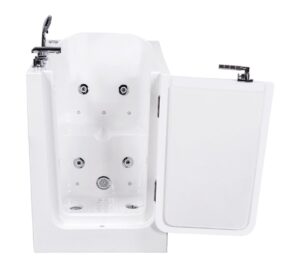
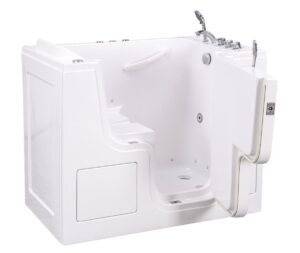
Every Vidalux walk-in bath is built with twin 40mm waste outlets, premoulded directly into the bath shell. Two drainage pathways instead of one. All models drain by gravity – there is no powered pump in the waste path, even on the whirlpool variants.
Think of it like a room with two exit doors instead of one. Water moves out along two routes simultaneously, which cuts the drain time compared to single-outlet designs.
On the fill side, every model ships with hi-flow mixer taps, pre-fitted at the factory. That shortens the wait at the start too – you’re not sitting in an empty bath watching warm water slowly arrive.
Put simply: the time between “stepping in” and “stepping out” shrinks at both ends.
Worth noting one more thing: the reinforced acrylic shell itself stays warm to the touch. Unlike cast iron or thin-walled baths, the surface doesn’t feel cold against your skin while you’re waiting.
Why Some Brands Skip This
If fast drainage is this obvious a feature, why don’t all walk-in baths have it?
The honest answer is cost. A single waste outlet is cheaper to tool and cheaper to fit. Twin outlets require more shell moulding, more pipework, and two waste traps instead of one. On a budget build, it’s the kind of thing that quietly gets cut.
It’s also the kind of thing you don’t notice when you’re comparing products online. Drain speed rarely makes it into a spec sheet. Buyers see the jet count, the seat style, the door configuration – but the waste outlet setup sits in the small print, if it’s listed at all.
That’s part of why we build every Vidalux walk-in bath the same way. Whether you choose a standard soaker or a full whirlpool upgrade, twin 40mm wastes are standard. Not an optional extra. Not reserved for the top of the range. Standard.
What Else to Look for in a Quality Walk-in Bath
Drain speed matters. But a bath you’ll rely on for years needs more than one good feature.
A fully watertight door system is non-negotiable – reinforced compression seals are what keep the water inside during use. A steel support frame underneath gives long-term structural stability, especially important if the bath is used while seated. Slip-resistant textured flooring reduces the risk of slipping when wet. An easy-grip door handle makes operation straightforward for people with reduced hand strength.
Most models in the Vidalux range include grab rails, positioned on the wall-side length where leverage is hardest to find from the bath edge. Not all models carry them, so check the specification of whichever model you’re considering.
For anyone who wants gentle hydromassage, whirlpool variants are available across the range. Selected models offer airspa or an inline heater where under-bath clearance allows. An inline heater maintains water temperature during longer sessions – it does not heat cold water from scratch, so the initial fill still comes from your home’s hot supply.
One thing to consider: parts availability years down the line. A walk-in bath isn’t a short-term purchase. Knowing replacement components are stocked long after the warranty period is the difference between a bath you keep and one you eventually give up on. Our walk-in bath guides go into more detail on what to check before buying.
The Vidalux Approach
Most walk-in baths look similar from the outside. The differences live inside – in the drainage system, the door engineering, the acrylic quality, and the support that sits behind the product after the sale.
Vidalux built the range to fix what’s wrong with cheaper walk-in baths: slow fills, slow drains, weak seals, and acrylic that yellows and cracks within a few years. Every model includes twin 40mm wastes premoulded into the shell, hi-flow mixer taps pre-fitted, reinforced premium acrylic, a steel support frame, and a fully watertight compression-sealed door. These aren’t optional upgrades. They’re standard.
Three principles drive the design: safety first, fast dignified bathing, and true engineering reliability. No gimmicks. No unnecessary complexity.
Explore the full range of walk-in baths to compare models.
Nobody wants to wait 10 minutes to get out of a bath. A fast-draining walk-in bath puts that time back where it belongs – in your day, not in the tub.
See the quality. Compare the details. Choose with confidence.
Frequently Asked Questions
Q: How long does a walk-in bath take to drain?
A: A walk-in bath typically takes 2-4 minutes to drain, depending on the plumbing setup and the waste configuration. Vidalux models feature twin 40mm waste outlets, which drain roughly twice as fast as single-outlet designs.
Q: Why do walk-in baths drain slower than regular baths?
A: Walk-in baths drain slower because the door must stay sealed until the water is fully out – it’s a safety requirement, not a fault. Single-outlet designs drain especially slowly, which is why twin-waste systems exist.
Q: Can you open a walk-in bath door while it’s still draining?
A: No – a walk-in bath door cannot be opened until the water has fully drained. The door seals under water pressure, and opening it early would cause flooding. This is a non-negotiable safety feature across all walk-in bath models.
Q: What is a twin-waste walk-in bath?
A: A twin-waste walk-in bath uses two 40mm drainage outlets premoulded into the bath shell instead of one. Splitting flow across two outlets is the primary engineering method for reducing drain time and shortening the cold wait.
Q: Are fast-draining walk-in baths worth the extra cost?
A: For most users, yes. Faster drainage means less time sitting cold, less fatigue, and a more comfortable routine overall. Since drain speed affects every bath you take, it’s one of the features most worth prioritising over aesthetic extras.
Q: Do Vidalux walk-in baths drain by gravity or with a pump?
A: All Vidalux walk-in baths drain by gravity, including the whirlpool variants – there is no powered pump in the waste path. Drainage speed comes from the twin 40mm outlet configuration, not from mechanical assistance.
- About the Author
- UK’s best-rated?

With over 22 years in the home spa industry, Andrew has overseen every stage of the journey—from initial product design and manufacturing to final installation. An author of multiple technical publications and scientific papers, he founded Vidalux to replace industry hype with engineering-led reliability. His focus remains on delivering gym-quality wellness through honest design and technical truth.
DISCLAIMER: All specifications, claims, and advice relating to any internal or external procedure, practise, product, or service were true at the time of writing. For more accurate and up-to-date details in relation to Vidalux services, please visit the relevant dedicated on-site page. For any product-related information, specifications, or guidance, the information on the product page should be considered the governing source.