Bathing with Dignity: How Walk-in Bath Design Supports Easier Hygiene Routines
Nobody talks about this bit.
Not the leaflets about continence pads. Not the GP. Not the occupational therapist who assessed the bathroom. The part where you’re kneeling beside the bath, trying to help someone you love wash properly after an accident – and neither of you can look each other in the eye.
If you’re searching for walk-in baths for incontinence, you already know what’s at stake. It’s not just about accessibility. It’s about preserving something far more personal – the feeling that bath time is still a normal, private, adult experience, not an emergency procedure.
This article is for you. And it starts with an honest look at why most bathrooms make this harder than it needs to be.
Why Incontinence Changes Everything About Bathing
It’s far more common than people realise. According to the Bladder & Bowel Community, urinary incontinence alone affects around 14 million people in the UK – yet bathrooms are still designed as if everyone can stand unaided, step over a high tub side, and wash independently.
When that’s no longer the case, everything shifts.
Standard baths require climbing in and out – risky when balance is poor, painful when joints are stiff, and genuinely dangerous when the floor is wet. Shower-over-bath setups assume the user can stand for extended periods. Controls are mounted at standing height. There’s no provision for seated, thorough hygiene care after a bowel or bladder episode.
What about the emotional cost?
It’s considerable. Many older adults begin avoiding bathing altogether – not because they don’t want to be clean, but because the process feels humiliating. Carers report that repeated incontinence cleanup in cramped, unsuitable bathrooms strains the relationship, creates guilt on both sides, and turns what should be a moment of care into something that feels clinical and cold.
The right bathroom setup doesn’t just make hygiene easier. It can help someone stay at home longer.

What Carers Actually Need From a Bathroom
Most accessible bathroom advice focuses on grab rails and raised toilet seats. Those help. But if you’re managing incontinence care, the real requirements go deeper.
You need seated access at a safe, stable height – no stepping over bath rims, no pivoting on wet surfaces. You need warm water arriving quickly, because nobody should sit exposed and cold waiting for a bath to fill. You need fast drainage, because sitting in cooling water waiting to get out is uncomfortable at best and distressing at worst.
You also need a way to clean gently with water – not just wiping. After a bowel episode, thorough but gentle water-based cleaning is more hygienic, less painful, and far less invasive than repeated wiping in an awkward position.
And the surfaces around the bath need to be non-porous and easy to sanitise, because accidents don’t always happen neatly inside the tub.
Think of it like the difference between mopping a tiled floor and trying to clean a carpet. Non-porous materials make hygiene straightforward. Porous ones trap what you’re trying to remove.
Disabled Facilities Grants can fund some adaptations, but many families find the budget doesn’t stretch – making the right core equipment all the more important.
How Walk-In Baths Support Dignified Hygiene Care
The design starts at the door. Literally.
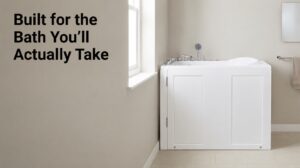
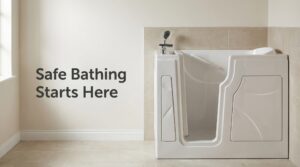
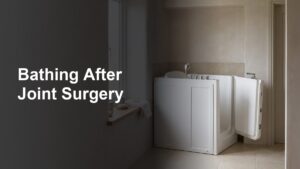
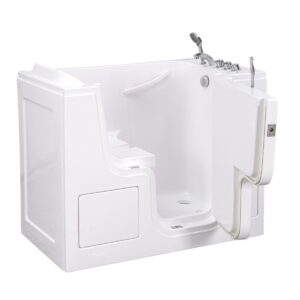
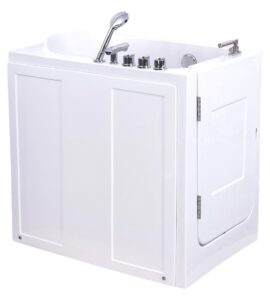
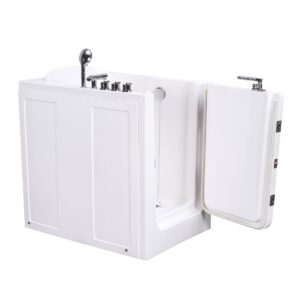
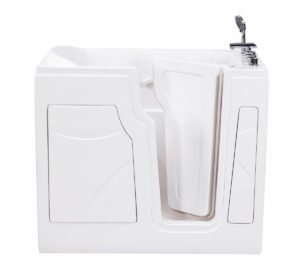
A walk-in bath with a low-threshold entry means no climbing, no pivoting, no lifting. The user steps through a wide-access door, sits on a built-in seat at a height optimised for stability, and the door seals watertight behind them. For someone managing incontinence, this alone removes the most dangerous part of the bathing routine.
But won’t they sit there cold while the bath fills?
Not if the engineering is right. Hi-flow mixer taps, pre-fitted as standard on every Vidalux walk-in bath, deliver the fastest possible fill times – getting warm water into the bath quickly, and getting the person comfortable sooner.
Draining is equally important. Dual waste outlets drain the bath significantly faster than a single outlet. That means less time sitting in cooling water after the bath is done – a detail that sounds minor until you’ve experienced the alternative.
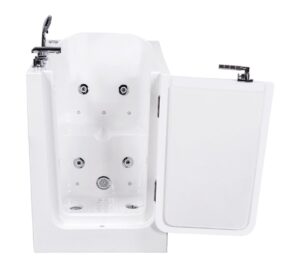
The bath interior matters too. Reinforced, non-porous acrylic is easy to clean and simple to sanitise after episodes. Slip-resistant base textures provide grip for seated users. And sanitation-friendly pipe routing means the plumbing itself is designed for hygiene – accessible, easy to maintain, and built to stay clean.
What about cleaning after an incontinence episode?
Most Vidalux walk-in bath models include a retractable shower head with an extendable hose, designed for seated use. It allows warm water to be directed gently and precisely – for washing hair, rinsing the bath, or cleaning skin after an accident. For carers managing incontinence, this is the difference between repeated wiping in an awkward position and calm, thorough, water-based hygiene care. More comfortable, more practical, and far more dignified.
For carer-assisted bathing specifically, the seated position and accessible layout mean the carer can help without unsafe stretching, leaning over tub edges, or awkward postures that risk back injury. The bath works with both people in the room, not against them.
Preserving the Relationship, Not Just the Routine
When the bathroom environment actually works – warm, quick, safe, hygienic – something quieter changes too.
Bath time starts to feel less like crisis management and more like normal adult hygiene. The carer can assist calmly rather than frantically. The person being bathed can sit safely, feel warm water, operate the door themselves – small acts of independence that carry real emotional weight.
Worth noting: dignity isn’t a luxury feature you add at the top of the range. It’s the entire point of accessible bathing design.
The Vidalux Approach – Engineered for Real Care Needs
Every Vidalux walk-in bath is built around three principles: safety first, fast dignified bathing, and true engineering reliability.
That’s not a slogan. It’s a design specification.
Every model – even the simplest in the range – includes a fully watertight door with an easy-grip handle, a built-in seat, slip-resistant internal surfaces, hi-flow mixer taps (pre-fitted), dual waste outlets, a reinforced acrylic shell on a steel support chassis, and sanitation-friendly internal pipe routing. Most models also include a retractable shower head with extendable hose for seated use.
For users who want gentle hydrotherapy comfort, whirlpool options are available across the range, with pump sizes properly matched to each bath. Airspa and inline heaters are offered on selected models where physical space allows – no false promises about features that don’t fit.
What about long-term reliability?
The range is designed for daily use over years. Reinforced acrylic resists cracking and yellowing. Steel frames prevent flexing. Spare parts are readily available. These aren’t short-life products dressed up for a brochure – they’re built to work, consistently, for a long time.
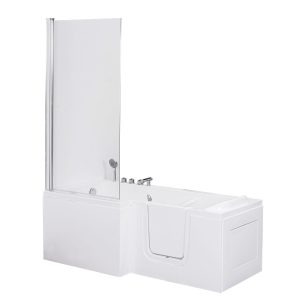
Various sizes and door positions are available to suit different bathroom layouts and mobility needs. Your installer will confirm the best configuration for the space.
A Calmer Way Forward
If you’ve read this far, you’re already doing something important. You’re looking for a better way – not just for the person you’re caring for, but for both of you.
The right walk-in bath won’t make incontinence disappear. But it can make the daily reality of managing it feel calmer, safer, and more respectful. That matters more than most product specifications ever will.
See the quality. Compare the details. Choose with confidence.
Frequently Asked Questions
Q: Can you bathe someone with incontinence in a walk-in bath?
A: Yes, walk-in baths are well suited to bathing someone with incontinence. Seated access, fast water delivery, and easy-clean non-porous surfaces make hygiene care safer and more thorough than standard baths.
Q: How do walk-in baths help with hygiene after incontinence episodes?
A: Walk-in baths support hygiene after incontinence episodes through a retractable shower head for gentle seated cleaning (available on most models), non-porous acrylic that is easy to clean and sanitise, and dual waste outlets that drain the bath quickly.
Q: Are walk-in baths suitable for carer-assisted bathing?
A: Walk-in baths are designed with carer-assisted bathing in mind. Low-threshold doors, built-in seating, and accessible layouts allow carers to help without unsafe stretching, lifting, or leaning over tub edges.
Q: Do walk-in baths help maintain dignity for elderly users?
A: Walk-in baths help maintain dignity by allowing safe, independent entry, stable seated bathing, and fast fill-and-drain times – reducing exposure, cold waiting, and the need for extensive hands-on help.
Q: Can a walk-in bath reduce the risk of falls during assisted bathing?
A: Walk-in baths reduce fall risk during assisted bathing through low-step entry, slip-resistant bases, built-in seating, and watertight doors that eliminate the need to climb over high bath sides.
- About the Author
- UK’s best-rated?

With over 22 years in the home spa industry, Andrew has overseen every stage of the journey—from initial product design and manufacturing to final installation. An author of multiple technical publications and scientific papers, he founded Vidalux to replace industry hype with engineering-led reliability. His focus remains on delivering gym-quality wellness through honest design and technical truth.
DISCLAIMER: All specifications, claims, and advice relating to any internal or external procedure, practise, product, or service were true at the time of writing. For more accurate and up-to-date details in relation to Vidalux services, please visit the relevant dedicated on-site page. For any product-related information, specifications, or guidance, the information on the product page should be considered the governing source.