What If I Get Stuck? The Walk-in Bath Fear Nobody Talks About (And Why It Shouldn’t Stop You)
Walk-in bath safety concerns keep thousands of people from making a decision they actually need to make.
And that’s understandable. If you’ve spent any time on forums or spoken to a carer, you’ve heard the warnings: slow drains, dodgy door seals, sitting cold and stuck while the water refuses to leave. Those fears aren’t irrational. For badly built walk-in baths, they’re entirely valid.
But here’s the thing. The fear isn’t about walk-in baths as a concept. It’s about poorly engineered ones.
This article explains what actually causes the risk of entrapment – and what engineering eliminates it.
Why the Fear of Getting Stuck Isn’t Irrational
Most people don’t realise how a walk-in bath works until it’s explained.
You step in through the door. You close and seal it. You sit down. Then the bath fills. When you’re done, the bath has to drain completely before the door can open again.
That’s not a flaw – it’s how the watertight seal works. But it means two components become critical to your safety: the door and the drain.
What happens when those components are cheap? Forums and occupational therapy communities are full of examples. Walk-in baths with single, undersized waste outlets that take 10 to 15 minutes to empty. Door seals that degrade within a year. Users left sitting in cooling water, growing colder and stiffer, waiting for permission to leave their own bath.
According to Age UK, bathing safely is one of the most common everyday concerns among older adults living independently, and poorly designed bathroom adaptations can introduce new risks rather than reducing them (Age UK: Adapting your home).
The anxiety you’re carrying right now? It’s a reasonable response to a real problem – just not an unsolvable one.
The Drain: The Single Most Important Safety Feature

This is where most cheap walk-in baths fail their users.
A standard single-waste bath drains through one outlet. If that outlet is small or the pipework is poorly routed, the bath empties slowly. Every minute waiting is a minute sitting in cooling water with the door sealed shut.
Think of it like having two exit doors instead of one. That’s essentially what a dual-waste system does – twin 40mm fast-flow waste outlets working simultaneously to clear the water as quickly as possible.
Vidalux fits twin 40mm fast-flow waste outlets as standard on every walk-in bath model. Not as an upgrade. As the baseline.
See the full walk-in bath range, every model fitted with the twin-waste system as standard: https://vidalux.co.uk/walk-in-bathtubs/
Why does this matter so much? Because drain speed is the difference between a calm exit and a distressing wait. Hi-flow mixer taps work the same principle in reverse: faster filling means less time sitting in an empty bath waiting for warmth to arrive.
The Door: How It Seals, How It Opens, and Why It Won’t Jam
The door is where fear and engineering meet head-on.
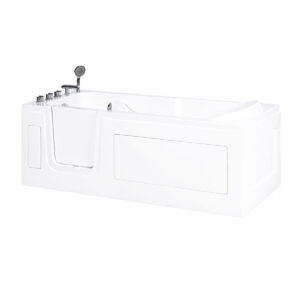
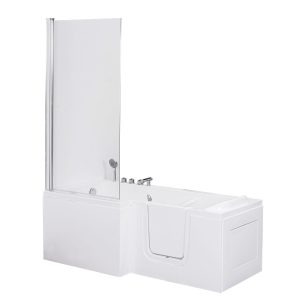
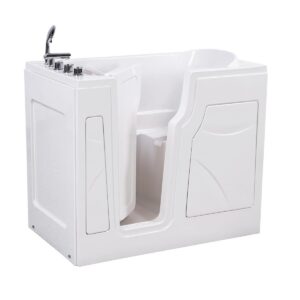
Every Vidalux walk-in bath door is fully watertight, reinforced with high-grade seals, and designed to operate with minimal force. No heavy latches. No awkward twisting. An easy-grip handle built for users with limited dexterity or reduced strength.
But what if it jams?
The door mechanism is mechanical. It doesn’t rely on electronics. There’s no powered lock, no motorised latch, nothing that needs electricity to function. That simplicity is a deliberate choice – fewer components in the critical safety path means fewer things that can fail.
Door positions vary across the range – left or right-hand opening, inward or outward depending on the model – so the bath fits different bathroom layouts and mobility needs.
The common misconception that “walk-in baths leak at the door” comes from experience with poor-quality products. With reinforced seals and proper engineering, the door is watertight.
What Happens If the Power Fails?
This question keeps people awake at night – particularly if they’ve seen walk-in baths marketed with powered drains or electronic controls.
The core safety cycle of a Vidalux walk-in bath – filling, draining, and opening the door – does not depend on electricity. Water drains by gravity through the twin waste outlets. The door operates mechanically. Optional whirlpool systems run alongside the bath, not in the path between you and getting out.
No powered drain pump to fail. No electronic lock to lose power. No scenario where a tripped fuse means you’re stuck.
Built for the Body, Not Just the Bathroom
The fear of entrapment isn’t only about water and doors. It’s about what your body can do once you’re inside.
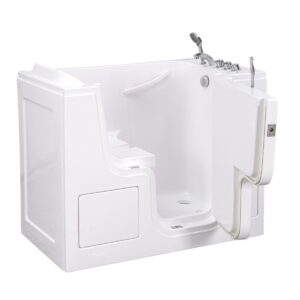
The built-in seat on every Vidalux walk-in bath is moulded into the structure – not a removable accessory that can shift or tip. The seat height is optimised for stability, and a steel support chassis underneath prevents any flexing under load.
What about slipping? Slip-resistant internal textures grip when wet. Reinforced premium acrylic stays warm to the touch – unlike metal, which chills on contact. The low step-in threshold and wide access door mean entry and exit require minimal leg lift and balance.
For users with reduced mobility, that combination – low threshold, wide door, stable seat, non-slip surface, rigid frame – addresses the physical reality of getting in and out safely.
The Vidalux Approach: Quiet Engineering, Not Loud Promises
Every model in the range – even the simplest – includes hi-flow mixer taps, twin fast-flow waste outlets, a fully watertight door, easy-grip handle, reinforced acrylic shell, steel support chassis, slip-resistant surfaces, and built-in structural seating.
That’s not a premium specification. That’s the starting point.
Whirlpool options are available on most models, where space under the bath allows, for users who want hydromassage alongside safety. Long-term spare parts availability means the bath is supported for years after installation.
One thing worth noting: walk-in baths aren’t for everyone. For some users, a level-access steam shower is the better choice. The right decision comes from understanding the options – not from pressure.
Review the full range at https://vidalux.co.uk/walk-in-bathtubs/. Compare the details. Choose with confidence.
Frequently Asked Questions
Q: Can you get trapped in a walk-in bath?
You cannot get trapped in a properly engineered walk-in bath. The main entrapment risk comes from slow drainage – keeping users seated behind a sealed door in cooling water. Twin 40mm fast-flow waste outlets drain rapidly, and the mechanical door opens without any electrical power.
Q: How safe are walk-in bathtubs for elderly users?
Walk-in bathtubs are safe for elderly users when they include low step-in thresholds, built-in seating, slip-resistant surfaces, and twin fast-flow waste outlets. Poorly specified baths with slow drains and weak door seals are where genuine safety concerns arise.
Q: How long does a walk-in bath take to drain?
A walk-in bath drains as quickly as the waste system allows. Vidalux models feature twin 40mm fast-flow waste outlets – significantly faster than single-outlet designs, which is the key factor in reducing seated waiting time after bathing.
Q: What happens if a walk-in bath won’t drain?
A walk-in bath that won’t drain leaves the user seated behind a sealed door until the water clears. This is why twin fast-flow waste outlets matter – they provide redundancy and speed, so a single partial blockage doesn’t create an entrapment situation.
Q: Do walk-in bath doors leak?
Walk-in bath doors leak when seals are low quality, poorly maintained, or damaged by misuse. Reinforced watertight door systems with high-grade seals – properly installed and cared for – do not leak under normal use.
Q: What happens to a walk-in bath during a power cut?
A walk-in bath with gravity-fed drainage and a mechanical door latch continues to function during a power cut. Water drains by gravity through the waste outlets, and the door opens manually – no electricity is needed for the core safety functions.
Q: Are walk-in baths better than walk-in showers for elderly people?
Walk-in baths suit elderly users who specifically want full immersion, warm-water comfort, or optional hydromassage. For users prioritising quick access and minimal waiting time, a level-access shower may be more suitable. The right choice depends on individual needs and circumstances.
- About the Author
- UK’s best-rated?

With over 22 years in the home spa industry, Andrew has overseen every stage of the journey—from initial product design and manufacturing to final installation. An author of multiple technical publications and scientific papers, he founded Vidalux to replace industry hype with engineering-led reliability. His focus remains on delivering gym-quality wellness through honest design and technical truth.
DISCLAIMER: All specifications, claims, and advice relating to any internal or external procedure, practise, product, or service were true at the time of writing. For more accurate and up-to-date details in relation to Vidalux services, please visit the relevant dedicated on-site page. For any product-related information, specifications, or guidance, the information on the product page should be considered the governing source.
Ready to choose?
Browse the full Vidalux range of saunas, steam showers, baths and shower cabins, all in one place