How Long Does a Walk-In Bath Actually Take to Drain? (And Why It Matters More in Winter)
If you’ve been researching walk-in baths, you’ve probably read the same warning a dozen times: you’ll be sitting there, wet and cold, waiting 10 to 15 minutes for the water to drain before you can open the door.
It’s the number one concern we hear. And it’s the number one reason some families abandon the idea altogether.
Here’s the thing. Those complaints are real – but they’re describing a specific type of walk-in bath. One with a single, standard-bore waste outlet and, often, undersized pipework. The drain time problem isn’t a walk-in bath problem. It’s a drainage engineering problem. And like most engineering problems, it has a straightforward solution.
So – how long does a walk-in bath take to drain? The honest answer is: it depends entirely on how the bath is built and how it’s plumbed.
Let’s break that down.
How Long Does a Standard Walk-In Bath Take to Drain?

A standard walk-in bath typically drains in six to 15 minutes – though the actual time varies significantly depending on pipe diameter, pipe gradient, and the length of the run to your soil stack.
That’s a wide range, and every extra minute at the upper end matters. In older UK homes, it’s not unusual to find 32mm waste pipes still in place from a previous bathroom. UK plumbers are clear on this: 32mm is designed for hand basins, not baths. It creates a bottleneck. The recommended minimum for any bath waste is 40mm – and even that can feel sluggish on a long run with poor fall.
But why does this matter more for a walk-in bath than a regular one?
Because you can’t step out. With a standard bath, slow drainage is a mild inconvenience. With a walk-in bath, you must remain seated until the water has fully drained before the door can safely open. Every extra minute of drain time is a minute spent sitting wet – with no towel, no movement, and no way to warm up.
For the person this bath is designed for – typically an older adult or someone with reduced mobility – that wait matters.
Why Winter Makes It Worse
This is the part most product marketing quietly ignores.
UK bathrooms are notoriously under-heated. External walls with poor insulation, single-skin construction, and central heating that cycles off overnight – it all adds up. A bathroom that feels comfortable in July can feel genuinely cold in January, especially first thing in the morning.
Older adults feel this more acutely. As we age, the fat layer beneath the skin thins, reducing natural insulation. Certain medications lower heart rate, which reduces circulation to the hands and feet. The result: cold hits harder, and it hits faster.
Professional walk-in bath installers know this. Many routinely include auxiliary heating – a heat lamp, a heated towel rail, or underfloor heating – specifically to address the drain-wait during colder months. That tells you something important: the people who fit these baths for a living treat the cold-wait issue as a real engineering concern, not an afterthought.
Every Vidalux walk-in bath is engineered around two priorities – getting hot water to you quickly, and getting you out cleanly and as quickly as possible. That’s not a marketing position. It’s what drives the drainage and filling specification on every model in the range.
What Actually Controls How Fast a Walk-In Bath Drains?
Three things. And none of them are complicated.
First: waste outlet size. A 32mm outlet drains significantly slower than a 40mm outlet. Think of it like a drain in a car park – a wider opening allows more water through per second. Any walk-in bath connected to 32mm pipework will drain slowly regardless of how well the bath itself is built.
Second: number of outlets. Think of it like having two exit doors instead of one. A bath with twin waste outlets drains from two points simultaneously, roughly doubling the flow rate compared to a single outlet. The water doesn’t queue – it leaves from both ends at once.
Third: pipe run and gradient. Even with 40mm waste pipes, a long horizontal run with minimal fall will slow drainage. Your plumber will assess this during installation. As set out in UK Building Regulations Approved Document H, proper pipe sizing and gradient are a requirement – and for waste runs longer than around three metres on 40mm pipe, an upgrade to 50mm or an anti-siphon valve may be needed.
So which of these can you actually control?
The pipe run depends on your bathroom layout. But the waste outlet size and the number of outlets are determined by the bath you choose. And this is where the differences between manufacturers become significant.
The Twin-Waste Difference: A Drain Time Comparison
Here’s what the evidence consistently shows across specialist sources, care advisors, and trade professionals:
Configuration | Typical drain time |
|---|---|
Single standard waste, gravity drainage | 6-15 minutes |
Twin waste outlets, gravity drainage | 2-6 minutes |
The gap between the two is not marginal. A bath that drains in three minutes versus one that takes 12 is the difference between mild inconvenience and genuine discomfort.
Let’s be clear: no manufacturer can guarantee an exact drain time. Your home’s plumbing, pipe condition, and gradient all play a role. But the waste configuration of the bath itself is the single biggest factor within your control. Twin 40mm outlets, properly plumbed, will consistently outperform a single outlet by a wide margin.
This is worth checking before you buy any walk-in bath. Ask the manufacturer: how many waste outlets does it have, and what diameter are they?
Important note: When connecting the twin waste outlets found on a Vidalux walk-in bath, each should have its own independent run to the soil stack. If both waste pipe runs are merged into a single pipe run with one connection to the soil stack. You are, in effect, bringing two lanes of traffic together and reducing this to a single lane. This will still drain faster than a single connection. Though it will not perform as intended or as quickly as two individual runs.
The Vidalux Approach – Engineered for Speed and Warmth
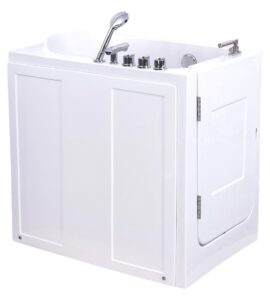
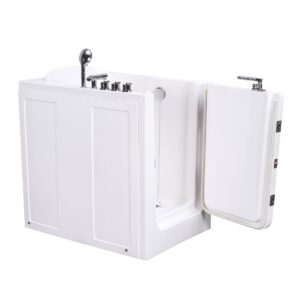
Every Vidalux walk-in bath – including the simplest base model – comes with twin 40mm waste outlets fitted as standard. Not as an upgrade. Not as an optional extra. Standard.
Hi-flow mixer taps come pre-fitted to the bath to minimise fill time, and the reinforced acrylic shell retains heat well – an important consideration when the alternative is a thin metal or stone resin tub that radiates cold against bare skin.
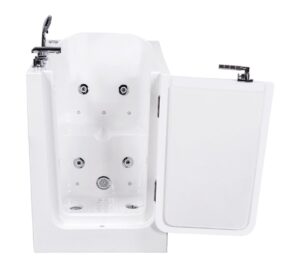
The range also includes whirlpool and airspa options across most models (where under-bath clearance permits), an easy-grip watertight door system for simple operation for all abilities, a steel support chassis for long-term structural strength, and a slip-resistant textured base throughout.
Walk-in baths take daily use from users who depend on them. That means the frame, the seals, the pipework routing, and the waste fittings all need to hold up over years – not just months. Every Vidalux model is built for reliable everyday use, with accessible components if maintenance is ever needed.
Explore the full Vidalux walk-in bath range
Choosing With Confidence
Drain time is a legitimate concern. If you’ve been put off walk-in baths because of what you’ve read online, that caution is well placed – for baths with single, undersized waste outlets.
But it’s a solvable problem. Twin 40mm waste outlets, properly plumbed with adequate pipe gradient, will drain a walk-in bath in a fraction of the time. The cold-wait issue that dominates forum discussions is a symptom of underengineered drainage, not an inherent flaw in walk-in bathing.
Check the waste configuration. Ask about pipe sizing. And if you’re installing in winter or in a cooler bathroom, consider auxiliary heating as part of the project.
Review the options. Compare the details. Choose with confidence.
Frequently Asked Questions
Q: How long does a walk-in bath take to drain?
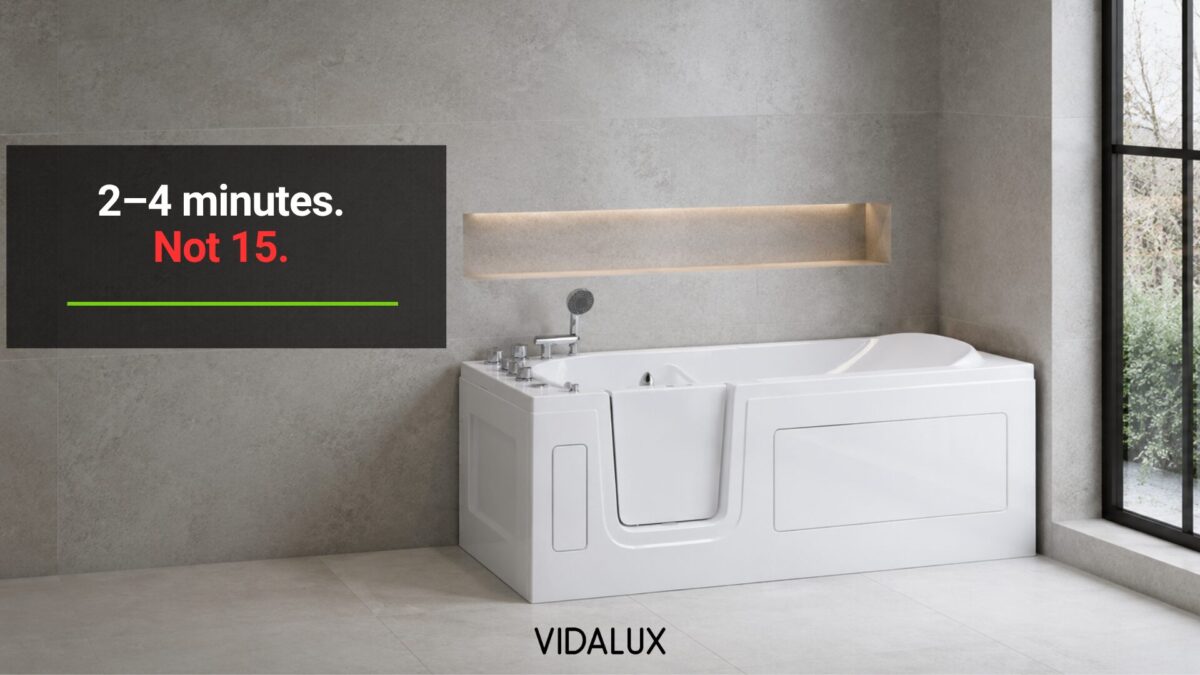
A walk-in bath typically takes between 2 and 15 minutes to drain depending on waste configuration and plumbing conditions. Baths with a single standard waste outlet may take 10 to 15 minutes, while twin 40mm waste outlets can reduce this to 2 to 6 minutes under typical UK plumbing conditions.
Q: Why do walk-in baths take so long to drain?
Walk-in bath drainage is slow when the bath has a single standard-bore waste outlet. Pipe diameter, gradient, and the length of the run all affect flow – and a 32mm waste pipe will drain significantly slower than the 40mm minimum recommended for any bath.
Q: Can you speed up walk-in bath drainage?
Walk-in bath drainage can be improved by ensuring 40mm waste pipes are used with adequate fall toward the soil stack, or by choosing a bath with twin waste outlets. Twin 40mm wastes roughly double the drainage cross-section compared to a single outlet and consistently deliver faster results.
Q: Do you have to sit in a walk-in bath while it drains?
Yes – you must remain seated until the water has fully drained before opening the door. This is why drain speed matters: faster drainage means less time sitting wet and cold, which is particularly important for older adults or those with circulation difficulties.
Q: What is twin-waste technology on a walk-in bath?
Twin-waste technology uses two separate 40mm waste outlets instead of one, draining the bath from two points simultaneously. This can reduce total drain time from over 10 minutes to as little as two to four minutes, depending on pipe conditions and plumbing layout.
- About the Author
- UK’s best-rated?

With over 22 years in the home spa industry, Andrew has overseen every stage of the journey—from initial product design and manufacturing to final installation. An author of multiple technical publications and scientific papers, he founded Vidalux to replace industry hype with engineering-led reliability. His focus remains on delivering gym-quality wellness through honest design and technical truth.
DISCLAIMER: All specifications, claims, and advice relating to any internal or external procedure, practise, product, or service were true at the time of writing. For more accurate and up-to-date details in relation to Vidalux services, please visit the relevant dedicated on-site page. For any product-related information, specifications, or guidance, the information on the product page should be considered the governing source.