Walk-in Bath Door Seals: How They Work, Why They Hold, and What to Check Before You Buy
You’re not the first person to worry about a walk-in bath door leaking. And it’s not a silly concern.
If you’re researching walk-in baths, whether for yourself or a parent, you’ve probably pictured the worst case. A full bath. A door that gives way. Water across the bathroom floor. It’s the single biggest anxiety people carry when considering whether walk-in bath doors are truly watertight.
Here’s the thing. The engineering behind a properly designed walk-in bath door doesn’t just hold the water back. It actually uses the water to strengthen the seal.
Let’s explain how.
How Walk-in Bath Door Seals Actually Work

Most people assume a walk-in bath door seal works like a fridge door, a strip pressed against a frame, hoping for the best. That’s not how it works.
A quality walk-in bath door uses a watertight compression seal. When you close the door and engage the lock mechanism, the seal is compressed to a watertight standard. That’s your starting point, a secure, watertight closure before any water enters the bath.
But what happens when the bath fills up?
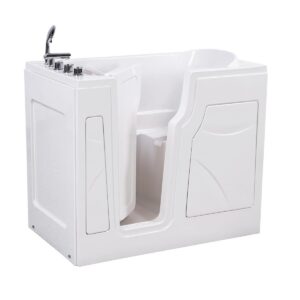
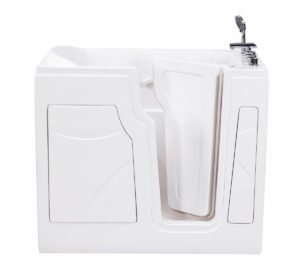
This is where door direction matters. On inward-opening models, as water rises inside the bath, it pushes outward against the door, compressing the seal further into the frame. The higher the water level, the tighter the seal becomes.
Think of it like pushing a cork into a bottle. The more force applied, the firmer the fit. Water pressure works with the seal, not against it.
Outward-opening models use the same watertight compression seal, but here it’s the lock mechanism doing the work rather than water pressure. When the lock engages, it compresses the seal to a watertight standard regardless of water level. Both types rely on the same principle: a compression seal that’s engineered to hold firm.
This isn’t a gimmick. Compression seals are well-established engineering, used across industries where watertight integrity matters.
Vidalux walk-in bath doors are reinforced with high-grade seals and designed as a fully watertight door system across every model, inward or outward opening. Not an upgrade, not an optional extra. Standard, on every bath in the range.
What Causes Walk-in Bath Doors to Leak (And How to Avoid It)
The most common cause of a leaking walk-in bath door is debris in the seal. A strand of hair, soap residue, or a small piece of grit sitting in the seal groove can break the contact point. A quick wipe of the seal before each use prevents this entirely.
The second most common cause is the door handle not being fully engaged. On a quality walk-in bath, the latch mechanism is deliberately firm. That stiffness is what creates the watertight seal. If the handle isn’t pushed all the way home, the seal doesn’t compress fully.
When walk-in bath doors do leak, it’s rarely because the seal has failed on its own.
Can a seal wear out over time?
Yes. Like any component that works under daily pressure, seals are consumable items. On well-engineered models, the door seal is a separate, replaceable part. A worn seal doesn’t mean a new bath. It means a new seal.
One thing to understand: never open the door before the bath has fully drained. There is no overflow safety once the latch is released. If the water hasn’t emptied, it will end up on the floor. This isn’t a design flaw. It’s simply how walk-in baths work. Wait for the drain, then open.
Choosing a bath with dual waste outlets matters here. Twin outlets mean the bath drains significantly faster, so the wait between the tap being turned off and the door being safely opened is noticeably shorter. Less time sitting cold, more warmth retained.
As Age UK notes in its guidance on adapting the home for safer living, the environment around a bath, not just the bath itself, plays a significant role in safe daily use. A bath that drains quickly reduces the time spent in a vulnerable position. You can read Age UK’s advice on adapting your home at Age UK.
What to Look For in a Reliable Walk-in Bath Door
If you’re comparing options, these are the details that separate well-engineered from the rest.
Replaceable seals
Look for models where the door seal is a separate, serviceable component, not a strip glued into place. Glued seals can’t be maintained. Replaceable seals can.
A latch designed to be firm
If a walk-in bath door closes with one finger, question whether it’s creating enough compression for a reliable seal. A firm latch isn’t a fault. It’s the mechanism doing its job. A small amount of silicone grease applied to the latch can make operation smoother without reducing the watertight effect.
Structural rigidity
The bath shell and frame need to stay rigid under load. If the structure flexes when full, the door frame moves with it, and that’s when seals lose contact. A reinforced acrylic shell mounted on a steel support frame prevents this.
Door position options
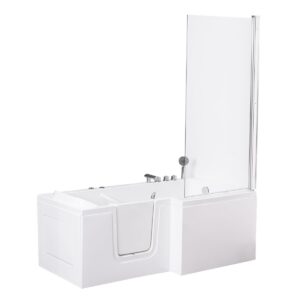
Left-hand or right-hand opening matters for your bathroom layout. Some models offer inward or outward-opening doors depending on available space. Both should use a full compression seal regardless of direction.
Long-term parts availability
Seals, handles, and latches are components that may need replacing over years of daily use. Check whether the manufacturer supplies spare parts and offers ongoing support.
How Vidalux Engineered the Problem Away
“Walk-in baths leak at the door.” It’s one of the most common misconceptions in the market.
It’s also one Vidalux specifically set out to solve.
Every Vidalux walk-in bath, even the simplest base model, includes a fully watertight door system as standard. Models with inward-opening doors benefit from water pressure strengthening the seal as the bath fills. Models with outward-opening doors use the same watertight compression seal, held firm by the lock mechanism itself.
The doors are reinforced with high-grade seals and fitted with an easy-grip handle designed for simple operation for all abilities. The latch engages firmly, no awkward twisting, no excessive force.
Does the seal hold up long term?
The door system is engineered for reliable everyday use. Seals are replaceable. The reinforced acrylic shell and steel support chassis prevent the structural flexing that can weaken door contact over time. And when parts do eventually need replacing, Vidalux supply them.
The dual waste outlets premoulded into every bath shell mean the bath drains significantly faster, so you’re not sitting cold waiting to unlatch the door. Two 40mm waste outlets working together, draining noticeably quicker than a single-outlet design. Less time waiting, more warmth retained.
The door was never an afterthought. It was the starting point of the engineering.
You can explore the full Vidalux walk-in bath range at https://vidalux.co.uk/walk-in-bathtubs/
Making the Right Choice
The concern about walk-in bath doors leaking is understandable. It’s a sensible question to ask before investing in something this important.
But with properly engineered compression seals, whether held by water pressure on inward-opening models or by the lock mechanism on outward-opening ones, the door isn’t a weakness. It’s one of the strongest parts of the design.
Review the details. Compare the engineering. Choose with confidence.
Frequently Asked Questions
Do walk-in bath doors leak?
Walk-in bath doors do not leak when properly engineered with compression seals. Quality models use high-grade seals and a firm latch mechanism that compress to a watertight standard when the lock engages, making leaks extremely unlikely during normal use. Keeping the seal free of debris is the most important daily habit.
How does a walk-in bath door stay watertight?
A walk-in bath door stays watertight through a compression seal and a firm lock mechanism. On inward-opening models, water pressure strengthens the seal further as the bath fills. On outward-opening models, the lock mechanism compresses the seal to a watertight standard independently, regardless of water level.
Can you replace walk-in bath door seals?
Walk-in bath door seals can be replaced on quality models where the seal is a separate, serviceable component. Vidalux walk-in baths use replaceable seals designed for long-term maintenance, meaning a worn seal does not require replacing the entire door or the bath itself.
Why is my walk-in bath door stiff to close?
A walk-in bath door is designed to be stiff. The firmness of the latch is what creates the watertight compression seal that prevents leaks. Applying a small amount of silicone grease to the latch mechanism can make it operate more smoothly without reducing the seal’s effectiveness.
How long does a walk-in bath take to drain?
A walk-in bath with dual waste outlets drains significantly faster than a single-outlet design. Vidalux walk-in baths have twin 40mm waste outlets premoulded into the shell, meaning both outlets drain simultaneously. Always wait for the bath to drain completely before opening the door, as releasing the latch while water remains will result in spillage.
What happens if you open a walk-in bath door before it drains?
Opening a walk-in bath door before it fully drains will release the remaining water onto the floor. There is no overflow safety once the latch is released. Always wait for the bath to drain completely before unlatching. The dual waste outlets on Vidalux models drain significantly faster, reducing the time spent waiting.
- About the Author
- UK’s best-rated?

With over 22 years in the home spa industry, Andrew has overseen every stage of the journey—from initial product design and manufacturing to final installation. An author of multiple technical publications and scientific papers, he founded Vidalux to replace industry hype with engineering-led reliability. His focus remains on delivering gym-quality wellness through honest design and technical truth.
DISCLAIMER: All specifications, claims, and advice relating to any internal or external procedure, practise, product, or service were true at the time of writing. For more accurate and up-to-date details in relation to Vidalux services, please visit the relevant dedicated on-site page. For any product-related information, specifications, or guidance, the information on the product page should be considered the governing source.
Ready to choose?
Browse the full Vidalux range of saunas, steam showers, baths and shower cabins, all in one place