Can You Use a Disabled Facilities Grant and Claim VAT Relief? Yes – Here’s How They Work Together
If you’re looking into a UK Disabled Facilities Grant to help fund a bathroom adaptation, you’ve probably already dealt with means tests, Occupational Therapist assessments, and weeks of waiting.
The last thing you need is more confusion.
So when someone mentions VAT relief – the possibility of removing 20% VAT from qualifying disability products – the obvious question is: can I actually use both, or does one cancel out the other?
Here’s the thing. They’re two completely separate mechanisms. And in most qualifying cases, both can apply to the same project. This article explains how each one works, where they overlap, and what to ask your supplier.
What Is a Disabled Facilities Grant?
It’s a council-administered grant designed to help disabled people adapt their homes. Not a loan. Not a discount scheme. A genuine grant – meaning you don’t pay it back.
In England, the current maximum is £30,000. Wales, Northern Ireland, and Scotland each set their own caps and rules, so it’s worth checking with your local authority if you’re outside England.
Who can apply?
Homeowners, tenants, and landlords (on behalf of a disabled tenant) can all apply. You don’t need to be receiving benefits – though if you are on certain income-related benefits, you’ll usually qualify for the full amount automatically.
For adults, the grant is means-tested. Your income, savings above £6,000, and your partner’s finances are all considered. Children’s applications are exempt from means testing.
What does it cover?
The grant can fund adaptations including walk-in baths, wet-room conversions, ramps, widened doorways, stairlifts, and adapted kitchens. The key requirement is that an Occupational Therapist assesses the work as “necessary and appropriate” for your condition and your property. You can find full eligibility criteria on the GOV.UK Disabled Facilities Grants page.
Worth noting: the means test can sometimes result in a significant personal contribution – which is exactly why understanding VAT relief matters.
What Is VAT Relief for Disabled People?
Most products carry 20% VAT. But under VAT Act 1994 Schedule 8 Group 12, certain goods and services supplied to disabled people can be zero-rated – meaning no VAT at all.
Think of it like this: the price tag stays the same, but the tax disappears. On a £5,000 adaptation, that’s a £1,000 difference.
But who actually qualifies?
HMRC defines eligibility as someone with a long-term physical or mental impairment, a chronic sickness, or a terminal illness. The product must be for personal, domestic use. The detailed criteria are set out in HMRC’s guidance, Reliefs from VAT for disabled and older people (VAT Notice 701/7).
One thing to consider: general old age alone does not qualify. There must be a disabling condition present.
The relief covers qualifying items like adapted bathrooms, specialist baths, grab rails, ramps, and certain building works – and it is not applied automatically. You need to complete a signed VAT Relief Declaration, which your supplier holds as proof of eligibility.
Can You Combine a DFG with VAT Relief?
This is the question that causes the most confusion – and where people often receive conflicting advice from councils, tradespeople, and suppliers.
Let’s be clear: yes, in qualifying cases, both can apply to the same project.
The reason is straightforward. A Disabled Facilities Grant is a funding source – it determines who pays. VAT relief is a tax status – it determines how the supply is taxed. They operate on completely different legal tracks.
It’s a bit like using a gift voucher at a shop that’s running a sale. The voucher covers part of the bill. The sale reduces the price. One doesn’t cancel the other out – they just work in different ways.
But doesn’t the council paying change things?
Generally, no. Under HMRC guidance, building work funded through a DFG is normally treated as a supply to the disabled applicant rather than to the local authority. This means the standard VAT rules for supplies to disabled people can still apply, even when a council grant contributes to the cost. Because individual projects vary, it is worth confirming the position with your supplier.
In practical terms: if a walk-in bath adaptation qualifies for zero-rating, the total cost is reduced by 20% regardless of whether the DFG covers part, most, or all of the bill. If there’s a gap between what the grant covers and the total cost, VAT relief shrinks that gap further.
Does every adaptation qualify for zero-rating?
No. Not all works or products meet HMRC’s criteria. The decision to zero-rate sits with the supplier, who must follow HMRC guidance and retain a valid signed declaration. If you’re unsure, confirm with your supplier before assuming the VAT will be removed – and consider seeking independent advice for complex projects.
What Qualifies for VAT Relief – and What Doesn’t

This is where realistic expectations matter.
Qualifying examples include walk-in baths, wet-room conversions, ramps, grab rails, widened doorways, and building works that adapt a bathroom specifically for a disabled person’s needs.
Non-qualifying examples include general home improvements, cosmetic upgrades, items unrelated to the disability, and goods purchased for business use.
The honest truth? The boundaries aren’t always obvious. A new bathroom suite because you fancy a refresh – that’s standard-rated. A walk-in bath installed because stepping over a standard rim is unsafe due to your condition – that can qualify. The distinction is about why the work is being done and who it’s for.
Your supplier is responsible for verifying eligibility and holding the signed declaration. A good supplier will guide you through this clearly.
How Vidalux Handles VAT Relief
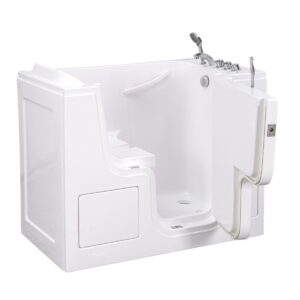
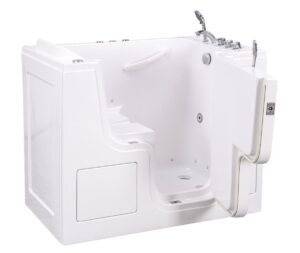
Vidalux walk-in baths are designed for the kinds of adaptations that Disabled Facilities Grants support – a low, easy-entry step-in, a door that seals shut for bathing, and a comfortable, supported soak. They are built to suit users who find a standard bath rim difficult or unsafe to climb over.
Walk-in bath prices on the Vidalux website are displayed without VAT by default. When you place your order, you’ll be prompted to complete the VAT Relief Declaration. Vidalux holds that signed form as proof of eligibility, in line with HMRC requirements. If you later determine you are not eligible, the VAT amount is calculated and payable before your order is dispatched.
No guesswork, no automatic assumptions, and a clear process from start to finish.
Not sure if you qualify?
We can walk you through what’s needed. But we’d always recommend confirming your specific situation with your Occupational Therapist, your local council, or a qualified adviser – particularly if your adaptation involves complex building works.
Explore the full range of Vidalux walk-in bathtubs to see what’s available.
Bringing It Together
A Disabled Facilities Grant helps fund the work. VAT relief reduces the cost of qualifying products and services. They are separate entitlements – and where you meet the criteria for both, they can work together to make your home safer and more comfortable for less.
Neither process is as complicated as it first appears. The DFG requires patience with your council. VAT relief requires a signed declaration with your supplier. Both exist to support people who need genuine help adapting their homes.
Review the options. Compare the details. Choose with confidence.
Frequently Asked Questions
Q: Can I use a Disabled Facilities Grant and claim VAT relief at the same time?
A: Using a Disabled Facilities Grant and claiming VAT relief together is possible in qualifying cases. They are legally independent – the DFG is a funding mechanism, while VAT relief is a tax status based on the nature of the supply and the customer’s eligibility under HMRC rules.
Q: Does receiving a DFG cancel out VAT relief on my adaptation?
A: Receiving a DFG does not automatically cancel VAT relief. Under HMRC guidance, DFG-funded building works are normally treated as supplied to the grant applicant rather than the council, meaning the standard zero-rating rules for disabled people can still apply where all qualifying conditions are met. Confirm the position with your supplier for your specific project.
Q: How do I claim VAT relief on a walk-in bath?
A: Claiming VAT relief on a walk-in bath requires completing a signed VAT Relief Declaration confirming your eligibility. Your supplier removes the VAT – it is not applied automatically at checkout. Vidalux operates a clear declaration process, and walk-in bath prices are shown without VAT by default.
Q: Who qualifies for VAT relief on disability products?
A: People with a long-term physical or mental impairment, chronic sickness, or terminal illness qualify for VAT relief on eligible products purchased for personal domestic use. General old age alone does not qualify – a specific disabling condition must be present to meet HMRC’s criteria.
Q: What home adaptations does a Disabled Facilities Grant cover?
A: A Disabled Facilities Grant covers adaptations such as walk-in baths, wet-room conversions, ramps, widened doorways, stairlifts, and adapted kitchens. The works must be assessed as necessary and appropriate by an Occupational Therapist, and eligibility is confirmed by your local council.
Q: Is the Disabled Facilities Grant means-tested?
A: The Disabled Facilities Grant is means-tested for adults in England, taking into account income and savings above £6,000. Children’s applications are exempt from means testing, and certain income-related benefits may qualify you for the full grant amount automatically.
- About the Author
- UK’s best-rated?

With over 22 years in the home spa industry, Andrew has overseen every stage of the journey—from initial product design and manufacturing to final installation. An author of multiple technical publications and scientific papers, he founded Vidalux to replace industry hype with engineering-led reliability. His focus remains on delivering gym-quality wellness through honest design and technical truth.
DISCLAIMER: All specifications, claims, and advice relating to any internal or external procedure, practise, product, or service were true at the time of writing. For more accurate and up-to-date details in relation to Vidalux services, please visit the relevant dedicated on-site page. For any product-related information, specifications, or guidance, the information on the product page should be considered the governing source.
Ready to choose?
Browse the full Vidalux range of saunas, steam showers, baths and shower cabins, all in one place