Bath Lifts vs. Walk-in Baths: The Honest Comparison Nobody in the Industry Gives You
When someone in the family has a difficult moment in the bathroom – a slip, a struggle to climb out, a near miss – the research starts fast.
Bath lift. Walk-in bath. Accessible bathing. You type something into a search engine and find a wall of products, comparison pages, and options that all seem vaguely similar. The bath lift appeals immediately. Lower cost. No building work. Nothing to rip out.
Here’s the thing. The decision isn’t quite as simple as it looks. And the cheaper option isn’t always the cheaper option.
This guide is a straight, honest comparison of the bath lift vs walk-in bath question – the real differences in safety, cost, and long-term suitability. Not a sales pitch. Just the information you actually need.
How a Bath Lift Works – And What It Can’t Do
A bath lift lowers you onto a seat once you’re already inside the tub. Most are battery-powered: a motorised seat descends when you press a handset, you sit, it lowers you into the water, and it raises you back up when you’re done.
For mild, stable mobility needs, they do the job they’re designed for.
But there’s a problem that no amount of motor power can fix.
The step over the tub side is completely unchanged.
This is where most bathroom accidents happen. The lift does nothing about it. You still have to step over a standard bath rim to get in – the same rim that caused the original concern. The lift only helps once you’re safely inside and seated.
Worth noting: occupational therapists consistently flag this as the core limitation of bath lifts. The Royal College of Occupational Therapists provides guidance on finding a qualified occupational therapist who can assess an individual’s specific needs – because suitability for any bathing adaptation depends on actual functional ability, not just current comfort level. Bath lifts are appropriate for people with mild, stable mobility issues who can still safely clear the tub edge. For anyone whose mobility is declining – or for whom the step itself is already the problem – a bath lift doesn’t solve what needs solving.
Then there’s the battery question. A flat battery mid-bath is not a theoretical risk. It’s a documented one. People get stuck. Families get called. And the trust in the product – and in bathing independently – often doesn’t recover.
The “Temporary Fix” Cost Nobody Mentions
Let’s talk honestly about the numbers.
A standard battery bath lift retails online for roughly £200-£250. Many families pay significantly more than this – often four figures – when buying through a mobility specialist or branded installer. Same product, very different price.
Add the ongoing costs: battery replacements, occasional servicing, and you have a figure that climbs quietly over time.
But here’s where it really starts to add up.
For a mild, stable condition, a bath lift can work for a few years. But mobility conditions don’t always stay mild and stable. When the user can no longer safely step over the tub edge – or loses confidence in the seat – the lift becomes unusable. And the family is back to square one, now needing a walk-in bath or level-access shower anyway.
The honest cost scenario looks like this: bath lift purchase, plus batteries and maintenance, plus eventual walk-in bath installation, plus tiling and making good after the old tub is removed.
Most families who’ve been through this process describe it the same way. An expensive delay, rather than a solution.
The emotional cost sits alongside the financial one. A parent who stops using their bath lift out of fear – quietly, without mentioning it – isn’t just losing a piece of equipment. They’re losing independence, routine, and dignity. That’s not a small thing.
What a Walk-In Bath Actually Does Differently

Here’s where the comparison becomes clearer.
A walk-in bath doesn’t manage the tub-entry problem. It removes it entirely.
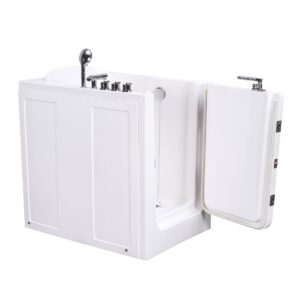
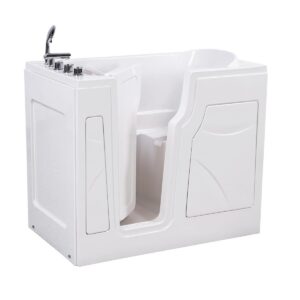
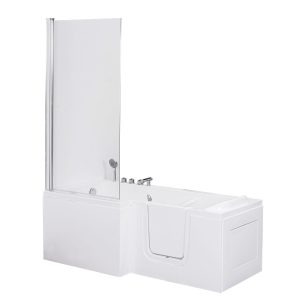
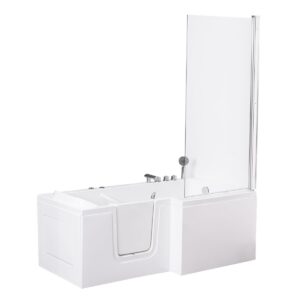
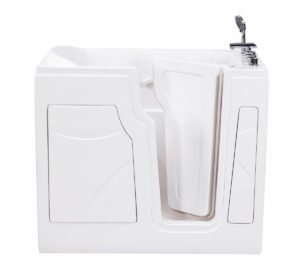
The fully watertight side door means the user steps through, not over. The threshold is low. The movement required is a fraction of what a standard tub demands. For anyone whose primary concern is that dangerous high step over a bath rim – this is the engineering answer to that specific problem.
The seat is structural, not supplementary. It’s moulded into the bath shell, built at the correct height for stable seated bathing, and it doesn’t move. Think of the difference between sitting in a chair that’s bolted to the floor versus sitting on a stool placed on a slippery surface. The walk-in bath seat is the former.
The reinforced acrylic shell and steel support chassis are built for daily use, long term. There’s no battery. No motor to fail mid-session. No handset to lose.
But what about getting cold while waiting for it to fill?
This is the most common concern people have about walk-in baths – and it’s a fair one. You enter before the water runs. If the bath fills slowly, that’s a real problem.
Twin fast-outflow wastes drain the bath quickly when you’re done – so there’s no sitting cold waiting for the water to empty before you can open the door. Hi-flow mixer taps, pre-fitted as standard, minimise fill time. Think of it like having two exit doors instead of one: the water simply clears faster. Vidalux treats this as a primary design requirement, not an afterthought.
The door system uses a fully watertight compression seal, designed for limited mobility users and built to operate with minimal force. No awkward twisting. No heavy latching. It works reliably, every time.
Who Should Consider a Bath Lift – And When It Makes Sense
This isn’t a piece that argues bath lifts have no place. They do.
For renters who can’t modify their bathroom, a bath lift can be a practical, proportionate solution. For someone recovering from a temporary injury or surgery – where the mobility limitation is expected to improve – a bath lift is sensible and cost-effective. For anyone whose needs are genuinely mild and stable, and who can still safely manage the tub step, a lift provides meaningful support.
The key question to ask is this: is this condition stable, or is it likely to progress?
If the answer is stable – a bath lift may be the right call for now. If the answer is likely to progress, or already has, the case for a walk-in bath becomes considerably stronger.
One thing to consider: an assessment from an occupational therapist before purchasing either solution is genuinely worth having. The NHS provides guidance on home adaptations and how to access an OT assessment through your local council. An OT can assess actual ability, not just current comfort level, and give guidance on what will genuinely serve someone for the longest period.
Put simply: bath lifts are the right tool for a specific, narrower set of circumstances. When they’re sold outside those circumstances, as a long-term accessibility solution for significant or progressing mobility needs, the outcomes tend to be poor.
Walk-In Baths: The Practical Realities
People often imagine a walk-in bath requires a full bathroom renovation. In most cases, it doesn’t.
A walk-in bath replaces a standard bath. It fits standard UK plumbing. A competent bathroom installer handles the job – no specialist skills required. The waste connections use standard plumbing fittings, and everything needed to connect the bath to your existing waste system is included.
Compact models start from 1200mm in length – suitable for most standard UK bathroom footprints. The Ashford 1350 and Denton 1300, for example, both feature low-entry thresholds and a width of 700mm, making them well suited to tighter spaces and users who need the easiest possible access. Wheelchair-accessible options are also available.
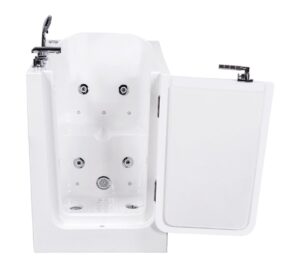
For those who want more than safe bathing, whirlpool options are available across most models, where physical space permits pump installation, and AirSpa is available on selected models. Hydromassage jets offer gentle, relaxing water pressure; the AirSpa system delivers thousands of fine air bubbles for a softer, full-body sensation. Neither of these replaces medical treatment, but both support comfort, relaxation, and general wellbeing in a way a bath lift simply can’t.
Spare parts are readily available. Aftercare support is built into the design philosophy. This is a product intended to last – not to be replaced in two years.
The Vidalux Approach – Designed for the Long Term
Every Vidalux walk-in bath is built around three principles: safety first, fast dignified bathing, and engineering reliability.
The common complaints about walk-in baths – slow filling, cold waits, leaking doors – exist because those problems exist in badly engineered products. They’re not inherent to the category. They’re the result of cutting corners.
A reinforced acrylic shell that holds up under daily use. A steel support chassis for long-term structural strength. A fully watertight compression seal on the door, easy to operate with minimal force. Twin fast-outflow wastes and hi-flow mixer taps that drastically reduce the time spent waiting inside.
These aren’t features added to a brochure. They’re engineering decisions made because the problems they solve are real ones.
For anyone making a genuine long-term accessibility decision – for themselves or for someone they care about – this is the range worth reviewing.
Explore the full Vidalux walk-in bath range at https://vidalux.co.uk/walk-in-bathtubs/
Closing Thoughts
A walk-in bath isn’t the dramatic choice. It replaces a bath, connects to your existing plumbing, and is fitted by any competent bathroom installer.
The dramatic choice is paying twice – once for a temporary solution that doesn’t remove the original hazard, and once for the permanent one you needed all along.
Review the options. Compare the details. Choose with confidence.
Frequently Asked Questions
Q: Is a bath lift safer than a walk-in bath?
A bath lift is not inherently safer than a walk-in bath – safety depends on the user’s mobility level. A walk-in bath eliminates the need to step over the tub, which is where most bathroom falls occur, providing more reliable long-term safety.
Q: What are the disadvantages of a bath lift?
The main disadvantages of a bath lift are reliance on battery power (which can fail mid-bath), the need to still step over the tub side, limited seat stability for users with poor balance, and ongoing battery and servicing costs. It is typically unsuitable for progressing mobility conditions.
Q: How long does a bath lift last?
A bath lift’s lifespan varies, but battery degradation and mechanical wear are common concerns within a few years of regular use. Unlike a walk-in bath – a permanent, structurally integrated fixture – a bath lift is a supplementary device with higher maintenance requirements over time.
Q: Can I install a walk-in bath in a standard bathroom?
Yes. A walk-in bath installs in place of an existing bath using standard UK plumbing connections – no specialist skills required. Compact models are available from 1200mm in length, suitable for most UK bathroom footprints.
Q: Which is cheaper – a bath lift or a walk-in bath?
A bath lift has a lower upfront cost, but the full picture is less clear-cut. When you factor in battery replacements, servicing, and the likelihood of needing a walk-in bath later as mobility progresses, many families pay more overall by choosing a lift first.
Q: Do walk-in baths have a seat?
Yes. Walk-in baths include a built-in moulded seat as part of the bath structure. Unlike a bath lift – which places a separate seat inside a standard tub – the walk-in bath seat is integrated, stable, and built for supported seated bathing.
Q: Are walk-in baths good for elderly people?
Walk-in baths are designed to support elderly users and those with reduced mobility. The low-threshold door removes the need to step over a tub side, the built-in seat provides stable support, and slip-resistant surfaces reduce risk throughout. Whirlpool and AirSpa options add comfort.
Q: What is the difference between a walk-in bath and a regular bath?
The key difference is the access door. A walk-in bath has a fully watertight side-entry or end-entry door, allowing users to enter and be seated before the bath fills. This removes the need to step over a high tub side – the primary hazard in standard bath use.
- About the Author
- UK’s best-rated?

With over 22 years in the home spa industry, Andrew has overseen every stage of the journey—from initial product design and manufacturing to final installation. An author of multiple technical publications and scientific papers, he founded Vidalux to replace industry hype with engineering-led reliability. His focus remains on delivering gym-quality wellness through honest design and technical truth.
DISCLAIMER: All specifications, claims, and advice relating to any internal or external procedure, practise, product, or service were true at the time of writing. For more accurate and up-to-date details in relation to Vidalux services, please visit the relevant dedicated on-site page. For any product-related information, specifications, or guidance, the information on the product page should be considered the governing source.