Will Your Boiler Cope With a Walk-in Bath? What to Check Before You Commit
If you’re researching walk-in baths – for yourself or a parent – one question comes up early: how much water does a walk-in bath use, and will your boiler cope? More specifically, will it strain the boiler, empty the hot water tank, or push your bills up?
These are practical concerns. And they deserve straight answers.
The good news is that the reality is probably more reassuring than you expect – because walk-in baths have a quiet advantage that most people overlook. And it comes down to basic physics.
How Much Water Does a Walk-in Bath Hold?
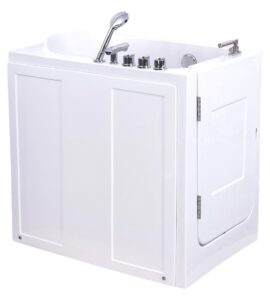
Walk-in bath water use varies by model size, and Vidalux doesn’t publish fixed capacity figures because they’re not the most useful way to approach this question. A compact model like the Ashford 1200 uses meaningfully less water than a full-length model, but in both cases, the volume of water your home system actually needs to supply is less than the bath’s total size suggests.
Here’s why.
The Displacement Factor – Why You Use Less Water Than the Capacity Suggests

This is the part most comparison articles miss.
When you sit inside a walk-in bath before it fills, your body displaces a significant volume of water. A seated adult displaces a considerable amount, depending on body size, and that’s water the bath doesn’t need to supply.
Think of it like filling a jug that already has ice in it. The ice takes up space, so you need less liquid to reach the top.
Compare that to a standard bath where you lie flat. Less of your body is submerged vertically, which means less displacement – and more water is needed to achieve the same depth around you.
Put simply: the seated position works in your favour. You’re not using more water than a conventional bath. In many cases, you’re using less.
Will a Walk-in Bath Strain Your Boiler?
This is the anxiety behind the question. Not “how many litres” – but “can my system actually cope?”
The answer depends on what type of heating system you have. But for most UK homes, the answer is yes – comfortably.
Combi boiler? A combi heats water on demand. There’s no stored tank to run out of. The fill rate depends on your flow rate, not a stored reserve – so the bath fills steadily at whatever speed your system delivers. Your heating engineer can confirm your combi is suited to the model you choose.
System boiler with a hot water cylinder? This is where people worry most. But remember the displacement factor – you’re not filling to the total bath size. In most setups, a standard domestic cylinder handles a compact or mid-size walk-in bath comfortably. Your plumber can confirm your cylinder capacity against the model.
Gravity-fed system? Lower pressure means a slower fill rate – but walk-in baths still work. If the flow feels slow, your plumber may recommend a pump to improve delivery speed.
Worth noting: if you’re unsure about your system’s capacity, your heating engineer or plumber can confirm this in a short conversation. It’s a straightforward check – not a major assessment.
What About Running Costs and Your Water Bill?
The short answer: comparable to a standard bath.
On a metered water supply, a typical bath fill costs a matter of pence based on standard UK rates. Heating that water adds a similar modest amount, depending on your energy source – gas boilers are generally more efficient than electric immersion systems.
According to the Energy Saving Trust, hot water accounts for around 18% of a household’s heat demand, so the way you heat your water matters more to the running cost than the bath itself. Their guidance on saving water at home is a useful starting point if you want to work through your own figures precisely.
So the total cost of running a walk-in bath sits in a similar range to a standard bath. No surprises.
Does the bath lose heat quickly?
Vidalux walk-in baths use reinforced premium acrylic – a material that’s naturally insulating and warm to the touch. Unlike thin-shell alternatives, acrylic retains heat well, so the water stays comfortable for longer without constant topping up. That means less need to run additional hot water mid-bath, which keeps overall water use down.
How Vidalux Walk-in Baths Are Designed for Efficiency
Every Vidalux walk-in bath is engineered around two priorities: minimising the time you spend waiting, and making the most of the water your system provides.
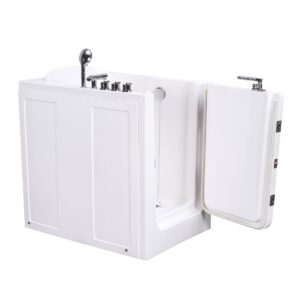
Hi-flow mixer taps come pre-fitted on every model – not thermostatic taps, but high-throughput mixers chosen to fill the bath quickly from whatever pressure your system delivers. Faster filling means less time sitting in a cooling bath while it fills around you.
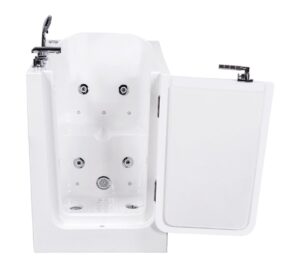
Drainage is built for the same reason. Dual waste outlets are premoulded into the bath shell, with the waste trap pre-fitted and a flexible waste connector supplied so your installer can connect to your home’s existing pipework. Two outlets clear the bath faster than a single drain, which matters because you wait for a walk-in bath to empty fully before opening the door.
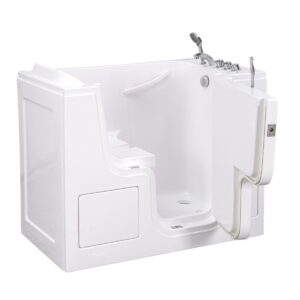
The range is built on a steel support chassis with reinforced acrylic, a slip-resistant base, and a fully watertight door system. These aren’t afterthoughts. They’re the foundation of every bath in the range.
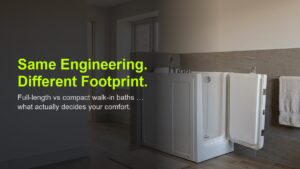
The range covers everything from compact models like the Ashford 1200 – suited to smaller bathrooms and lighter hot water systems – through to full-length models, including the Abberton for homes with more space and capacity.
What to Check Before You Buy
A few straightforward checks will tell you whether your home is ready.
Look at your hot water cylinder if you have one. The capacity is usually printed on the label. For most compact and mid-size walk-in baths, a standard cylinder is sufficient – and body displacement means you’re typically drawing less than you’d expect.
Ask your plumber about your system’s flow rate. This determines how quickly the bath fills – and it matters more than the bath’s total size.
If you’re on a gravity-fed system, discuss pump options with your plumber. A small pump can make a noticeable difference to fill speed without any major plumbing work.
And if you’re choosing between models, match the bath size to your system. A compact model paired with the right plumbing will outperform a larger bath on an underpowered supply.
If cost is part of your decision, it’s also worth checking whether you qualify for VAT relief – our complete VAT exemption guide explains who’s eligible and how it works.
The Short Version
Walk-in baths use less water than most people expect – because you’re sitting inside before it fills, displacing a significant volume. In most UK homes, the existing boiler and hot water system handles a walk-in bath comfortably. And the running costs are comparable to a standard bath.
The numbers work. The engineering supports it.
Explore the full range of Vidalux walk-in baths to see what fits your home.
Frequently Asked Questions
Q: How much water does a walk-in bath use?
A: Walk-in bath water use varies by model size. Because you sit inside the bath before it fills, your body displaces a meaningful volume – so the hot water your system needs to supply is less than the bath’s total size would suggest. In practice, water use is comparable to a standard bath.
Q: Will a walk-in bath empty my hot water tank?
A: A walk-in bath won’t empty most standard hot water cylinders. Body displacement from the seated position reduces the actual water volume required to reach a comfortable soaking depth – so a standard cylinder typically handles a compact to mid-size walk-in bath without difficulty.
Q: Can a combi boiler fill a walk-in bath?
A: A combi boiler can fill a walk-in bath effectively since it heats water on demand. There’s no stored tank to run out of, so the fill rate depends on your flow rate. Your heating engineer can confirm your combi suits the model you choose.
Q: Does a walk-in bath use more water than a normal bath?
A: A walk-in bath does not necessarily use more water than a standard bath. The seated position creates greater body displacement – meaning less water is needed to reach a comfortable bathing depth than the bath’s full size would imply.
Q: How much does it cost to fill a walk-in bath?
A: Running costs are comparable to a standard bath. Water costs a matter of pence per fill at standard UK rates, with heating costs added depending on your energy source. Your plumber or heating engineer can give you an accurate estimate based on your system.
- About the Author
- UK’s best-rated?

With over 22 years in the home spa industry, Andrew has overseen every stage of the journey—from initial product design and manufacturing to final installation. An author of multiple technical publications and scientific papers, he founded Vidalux to replace industry hype with engineering-led reliability. His focus remains on delivering gym-quality wellness through honest design and technical truth.
DISCLAIMER: All specifications, claims, and advice relating to any internal or external procedure, practise, product, or service were true at the time of writing. For more accurate and up-to-date details in relation to Vidalux services, please visit the relevant dedicated on-site page. For any product-related information, specifications, or guidance, the information on the product page should be considered the governing source.