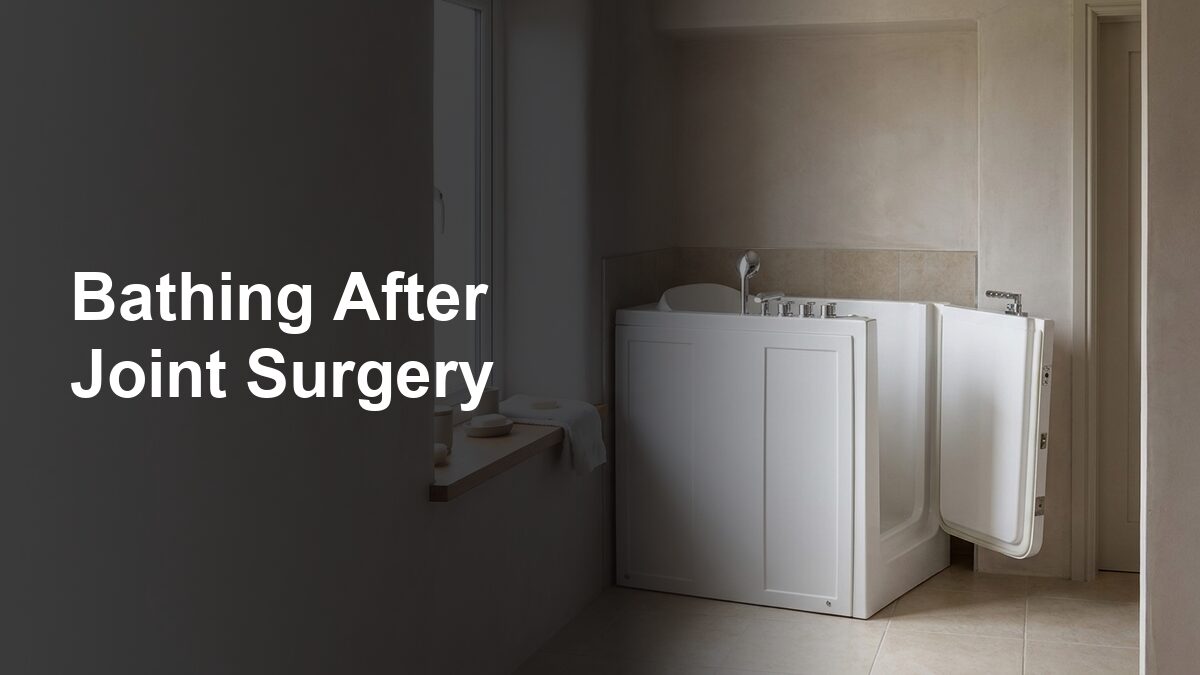
Bathing After Joint Surgery: Why Seat Height and Entry Step Matter
You’ve come home from having your hip or knee replaced. You’re managing – the walking frame is doing its job, the raised toilet seat is in place, and the discharge leaflet is somewhere on the kitchen table. Then you look at the bathroom and realise: no one has actually explained what you’re allowed to do in there.
Bathing after joint surgery is one of the most anxious parts of early recovery – and also one of the most practically misunderstood. The restriction on using your standard bath isn’t vague caution. It’s a clinical assessment based on two specific physical variables that make your existing bath genuinely unsafe during recovery: seat height and the entry step.
Once you understand those two things, the path forward becomes much clearer.
Why the Standard Bath Is Clinically Unsafe During Joint Surgery Recovery
This surprises some people – but it shouldn’t.
Most NHS trusts don’t describe the standard domestic bath as inconvenient post-surgery. They describe it as unsafe. That’s not an abundance of caution. It’s a clinical assessment based on what the bath actually requires your body to do.
The restriction has a defined duration. Most discharge teams advise avoiding standard bath use for at least six weeks following hip replacement surgery. Many extend this to eight to twelve weeks before full immersion – sitting in the bottom of the bath – is considered safe. For knee replacement patients, the timeline varies, but the physical barriers are just as real.
The reason isn’t the bath itself. It’s two design characteristics of the standard bath that make it incompatible with joint replacement recovery: how low the seated position is, and how high the entry step is. Both create clinical problems. Both are solvable.
Worth noting: if your only shower is positioned over the bath, you may not be able to use that either during this period. Stepping over the bath rim to reach the shower tray creates the same problems as getting into the bath – which we’ll come to shortly.
As NHS guidance on hip replacement recovery confirms, wound immersion should be avoided until after the two-week GP wound review, with full bath use typically restricted for considerably longer. What the leaflet often doesn’t explain is the biomechanical reason. That’s where the practical decisions start to make sense.
The First Problem – Seat Height and the 90-Degree Rule
The 90-degree rule sounds like an abstract clinical concept. In practice, it is the single most important physical constraint governing every seated position you use during the first months of recovery.
For posterior approach hip replacement patients, the hip joint must not bend past 90 degrees during the healing period. This isn’t a guideline encouraging caution – it is a biomechanical boundary enforced by the geometry of the new implant and the soft tissue surrounding it. Think of it like a new hinge that hasn’t fully set yet. Push it past its limit before it’s ready, and the whole mechanism can fail.
When you sit in a seat that is too low for your height, your knees rise above your hips. That’s the violation – right there, in the everyday act of sitting down. A standard bath floor sits well below any safe seated height for a recovering hip replacement patient. Lowering yourself into the bottom of the bath creates exactly the angle that the recovery period is designed to prevent.
So how high does the seat actually need to be?
Occupational therapists calculate this individually, using a precise formula. The standard used at NHS discharge is popliteal height – the measurement from the back of the knee crease to the floor – plus 5 cm (approximately two inches). This gives your personal precautionary height. Any seat surface below this measurement creates a clinical risk every time you sit down or stand up.
It applies to every seated surface during recovery: your chair, your bed, your toilet seat – and whatever bathing solution you choose. A bath board, a shower stool, a walk-in bath. If the seat surface doesn’t meet your individually calculated height, it doesn’t meet the requirement.
For knee replacement patients, the mechanism is slightly different. Quadriceps strength falls significantly in the first weeks after surgery, making controlled lowering onto a low surface dangerous regardless of joint angle. The practical outcome is the same: the lower the seat, the greater the demand on a joint that isn’t ready for it.
The Second Problem – The Entry Step
Even before seat height becomes a concern, many patients hit a more immediate barrier: simply getting into the bath in the first place.
A standard domestic bath rim requires you to lift one leg fully over it, balance momentarily on one leg on a wet floor, then lower the other. For someone recovering from hip replacement surgery, this is a problem on two levels at once. Lifting the operated leg forces the hip into flexion and rotation simultaneously – both of which are restricted during recovery. For posterior approach patients, this single movement can violate two precautions in one go.
For knee replacement patients, the challenge is muscular rather than angular. Lifting and lowering a leg over a bath rim requires precisely the kind of slow, controlled eccentric contraction that the recovering knee struggles most to produce. It’s demanding when you’re healthy. Post-surgery, it’s where most bathroom incidents occur.
The honest truth? For many patients, the entry step makes the bath entirely inaccessible – not difficult, but genuinely impossible to use safely – before the seat height question even arises. And if the only shower available is over that same bath, the problem becomes acute. Strip washes or trips to a family member’s home become the practical daily reality for weeks at a time.
The Workarounds – And Where They Fall Short
Let’s be clear about something first: many of the temporary solutions patients reach for during recovery are appropriate for what they are. A bath board or shower chair, used correctly, serves a real purpose in the early post-operative period. We’re not dismissing them. We’re being straightforward about their limits.
Bath boards – the plank-style devices that bridge across the bath rim – let you wash from a seated position without descending to the bath floor. Occupational therapists prescribe them regularly for the early recovery period, and for good reason. In the right bathroom, they work.
But they have genuine contraindications. They can’t be used with over-bath shower screens or tracks, which rules them out in a large proportion of UK bathrooms. They won’t grip curved or rolled bath edges. And the seated surface height depends entirely on the height of your specific bath rim – which may or may not meet your individual precautionary height requirement. A bath board that sits too low for your calculated popliteal height is no safer than the bath floor.
Bath lifts – motorised seats that lower you into the bath – are sometimes suggested as a solution. The problem is straightforward: the lift lowers you in, but it doesn’t get you in. You still have to step over the rim to reach the seat. For hip replacement patients, the step is precisely the barrier the lift doesn’t address.
Shower chairs are the right answer where a separate walk-in shower is available. Seated showering, with a handheld shower head, is what most OTs recommend for the early recovery period. But if your only shower is over a standard bath, the chair doesn’t solve the step problem.
The honest gap in all these workarounds is the same: they work well in the right bathroom setup, and fall short in many real UK homes. That’s worth knowing before you commit to a temporary fix that doesn’t fit your layout.
What to Look For in a Longer-Term Bathing Solution

The clinical requirements are not complicated to summarise. Any bathing solution for joint replacement recovery needs to address both variables at once: the entry step should be eliminated or minimised, and the seat should allow stable bathing without lowering the user to the bath floor. A solution that solves one but not the other remains clinically incomplete.
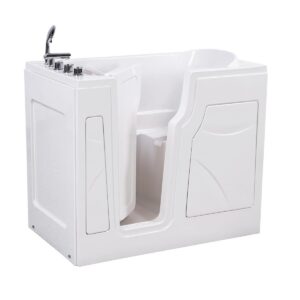
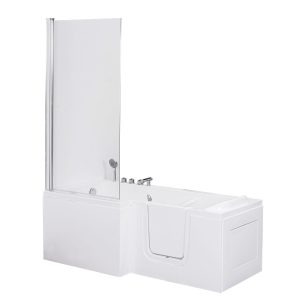
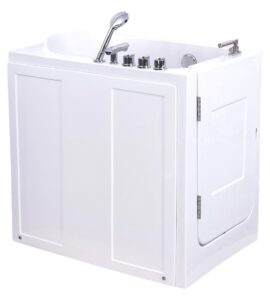
The bath category designed specifically around both of these requirements is the walk-in bath. Door-entry access removes the need to step over a rim entirely. A built-in seat allows full bathing from a stable seated position. These aren’t comfort upgrades. They’re the direct engineering answer to the two things that make a standard bath dangerous during recovery.
One thing to consider: walk-in baths require installation by a competent bathroom fitter. They’re a longer-term home adaptation – not something that can be in place within days of surgery. For the immediate post-operative window, a shower chair or bath board may be the most practical first step. A walk-in bath is the considered, durable solution for the weeks and months of recovery ahead – and for the long term after that.
Worth noting on cost: walk-in baths are zero-rated for VAT for eligible disabled users and those with qualifying long-term conditions. As NICE guidelines on joint replacement (NG157) note, patients should receive full information about their home environment options as part of the post-operative care pathway – and the VAT exemption is one practical detail that changes the cost calculation significantly for many people. Vidalux walk-in baths are displayed without VAT on the website, and customers complete a simple exemption declaration before dispatch.
The Vidalux Approach
Two problems. Two engineering answers.
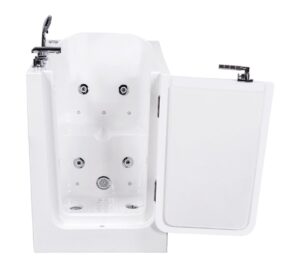
Vidalux walk-in baths are built around the door-entry system that removes the step-over barrier entirely. You step through the door, close it, then fill the bath. No rim to clear. No momentary single-leg balance on a wet surface. The door features an easy-grip handle designed for limited mobility users, with a mechanical latch that keeps it secure throughout bathing.
High-flow taps fill the bath quickly, and a dual-waste drainage system empties it significantly faster than single-outlet designs – which matters most when you’re sitting inside, waiting to open the door. The reinforced acrylic shell and steel support chassis are built for long-term daily use. Slip-resistant internal surfaces reduce the risk of movement on wet surfaces. Most models include grab rails to support safe entry, exit, and repositioning throughout bathing.
Two models are specifically recommended for customers with accessibility and recovery requirements: the Ashford 1350 and the Denton 1300, which includes a wheelchair-accessible design. Both feature low-entry door access and a 700 mm width suited to a range of bathroom layouts, with built-in seating designed for stable, supported bathing (seat configuration varies by model).
See the full walk-in baths range to compare models and specifications.
Bathing After Joint Surgery: Finding the Right Fit
Recovery is measured in weeks, not days. The bathroom – which most of us take entirely for granted – becomes one of the most consequential decisions you make during that time.
Two variables determine whether bathing is safe or dangerous after hip or knee replacement surgery: the entry step and the seat height. Understanding both is most of the work. Finding a solution that addresses both is the rest.
If you’re planning ahead before surgery, or working out your options at home right now, the walk-in bath range is a good place to start.
Frequently Asked Questions
When can I have a bath after hip replacement surgery?
Bathing after hip replacement is typically restricted for at least six weeks following surgery. During this period, the operated hip must not be lowered to the bottom of a standard bath, as this places the joint beyond the safe hip flexion angle. Most NHS trusts advise waiting eight to twelve weeks before full immersion.
How high does a bath seat need to be after a hip replacement?
After a hip replacement, your bath or shower seat should be high enough that your hips remain level with or above your knees when seated. Occupational therapists typically calculate this as popliteal height – the distance from the back of the knee crease to the floor – plus approximately 5 cm.
Is a walk-in bath suitable for hip or knee replacement recovery?
A walk-in bath is well-suited to hip and knee replacement recovery because it addresses both key clinical barriers: the door entry removes the need to step over a bath rim, and the built-in seat allows bathing from a stable seated position without lowering to the bath floor.
What is a bath board, and is it safe after hip replacement?
A bath board is a plank-style device that sits across the bath rim, allowing seated washing without descending to the bath floor. It can be appropriate for some patients but has limitations: it cannot be used with over-bath shower screens, and the seated height depends on the bath rim, which may not meet your individual precautionary height requirement.
What bathroom equipment do I need after joint replacement surgery?
After joint replacement surgery, occupational therapists typically recommend a raised toilet seat, grab rails beside the toilet and in the bathroom, a shower chair where a walk-in shower is available, and a long-handled sponge to wash without bending. A bath board may also be prescribed where a standard bath is the only option.
Do you get cold waiting inside a walk-in bath for it to drain?
Waiting for a walk-in bath to drain before the door can be opened is the most commonly raised concern. Vidalux walk-in baths include a dual-waste drainage system and high-flow taps designed to reduce waiting time significantly – both filling and draining are faster than standard single-outlet designs.
Can I use my shower after hip replacement if it is over the bath?
If your only shower is positioned over a standard bath, it may not be accessible during the early weeks after hip replacement surgery. Stepping over the bath rim requires lifting the operated leg into hip flexion and rotation, both of which are restricted during recovery. NHS guidance typically classes over-bath showers as unavailable during this period.
Does a walk-in bath qualify for VAT exemption?
Walk-in baths from Vidalux are displayed without VAT on the website, as they qualify for VAT relief for registered disabled users and those with a chronic or long-term condition. Customers complete a VAT exemption declaration before dispatch. If you are unsure whether you qualify, the declaration form sets out the eligibility criteria, or you can confirm with HMRC.
- About the Author
- UK’s best-rated?

With over 22 years in the home spa industry, Andrew has overseen every stage of the journey—from initial product design and manufacturing to final installation. An author of multiple technical publications and scientific papers, he founded Vidalux to replace industry hype with engineering-led reliability. His focus remains on delivering gym-quality wellness through honest design and technical truth.
DISCLAIMER: All specifications, claims, and advice relating to any internal or external procedure, practise, product, or service were true at the time of writing. For more accurate and up-to-date details in relation to Vidalux services, please visit the relevant dedicated on-site page. For any product-related information, specifications, or guidance, the information on the product page should be considered the governing source.