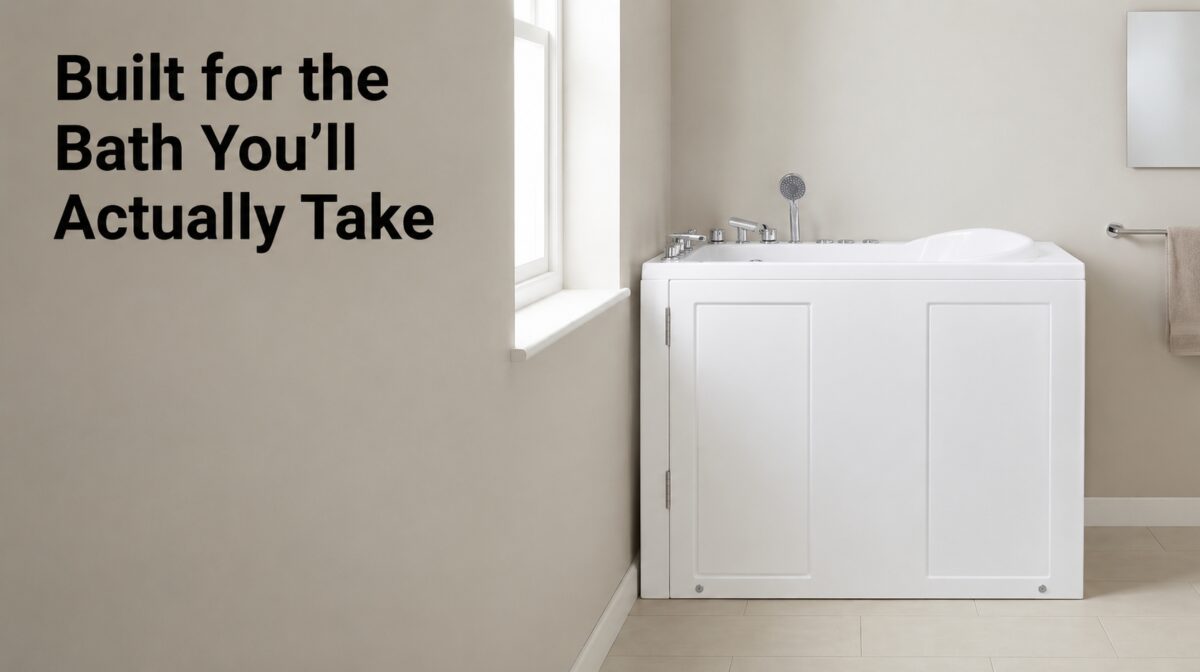
Upright Walk-in Bath vs. Deep Soaker: Which Sitting Position Is Right for Your Body?
There’s a question most people don’t ask the sales rep.
They’ve narrowed it down to two types. One is upright and compact. The other is deeper, larger, and costs more. Somewhere – in a brochure, a comment from a physio, a passing conversation – they’ve read that chest-deep water is better for joints. But the upright one doesn’t look chest-deep.
So which is it? A compromise or a different solution entirely?
The answer comes down almost entirely to one thing: how much of your body is actually underwater. Once you understand that, the question of upright walk-in bath vs. deep soaker becomes far clearer than the brochures suggest.
What Water Depth Actually Does to Your Body

Deeper immersion provides meaningfully more joint relief than shallower bathing, and the physics explains why.
When you’re submerged in water, two things happen. First, buoyancy reduces the effective weight your joints are carrying. Second, hydrostatic pressure – the gentle, even compression the water exerts against your body – supports circulation and can help reduce the feeling of swelling or heaviness in the lower limbs.
Both effects scale with depth.
Physiotherapy and rehabilitation research gives us some useful reference points. Waist-deep immersion reduces effective body weight by around 50%. Chest-deep immersion reduces it to roughly 25%.
According to the Chartered Society of Physiotherapy, immersion depth is one of the primary variables affecting hydrotherapy outcomes – and that gap is not a subtle one. For an adult with stiff or aching joints, the difference between waist-deep and chest-deep can mean the difference between a bath that feels pleasant and one that feels genuinely soothing.
But does that mean only a deep soaker delivers real benefit? Not necessarily – and this is where most comparisons go wrong.
The depth of water relative to your body is what matters, not the size of the shell it’s held in. A compact upright shell and a very deep reclined shell can deliver equivalent immersion, depending entirely on the geometry involved.
Worth noting: buoyancy and hydrostatic pressure support comfort, circulation, and general wellbeing. They are not medical treatments, and no bath – however deep – treats or cures specific conditions.
The Geometry Insight – Why “Upright” Doesn’t Mean “Shallow”
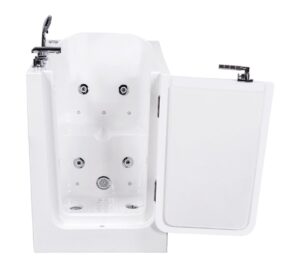
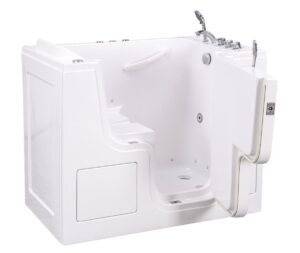
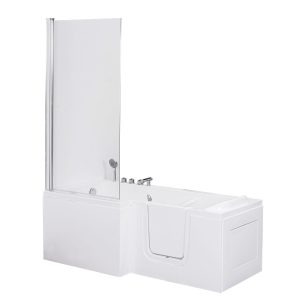
An upright walk-in bath can achieve chest-deep immersion comparable to a deep soaker – through geometry rather than shell size. This is the detail most buyers don’t discover until someone explains it directly.
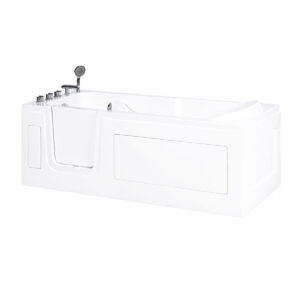
In a traditional reclined bath – including most deep soaker designs – you lie at a shallow angle. The shell is long and wide to achieve full-body immersion. The water column is relatively low, and the footprint is substantial.
In an upright walk-in bath, the geometry is entirely different.
You sit vertically. Your body takes up less horizontal space. The water column rises against a much shorter footprint – and because you’re seated upright rather than reclined, chest-deep water requires far less shell volume than a reclined design demands.
Think of it this way. A tall, narrow glass holds the same amount of water as a wide, shallow bowl – but the water level in the glass is dramatically higher. An upright walk-in bath works on the same principle. The seat position is structural, built directly into the reinforced acrylic shell, designed to place the user correctly so that a proper fill reaches the chest – not just the waist.
This is not a compromise. It is a deliberate geometry decision that delivers meaningful immersion depth in a bathroom that couldn’t accommodate a traditional deep soaker.
So why don’t more people know this? Because “deep soaker” sounds like depth and “upright” sounds like shallow. The names do most of the selling – and most of the misleading.
The steel support chassis and reinforced acrylic shell are not just structural details. They hold the geometry precisely, ensuring the seat position stays consistent and the water behaves as intended every time. That is the engineering that makes the depth claim honest.
One note for readers: confirm the precise internal depth specifications with any supplier before purchasing. The geometry principle applies across upright designs – exact figures vary by model.
The Practical Case – Fill Time, Plumbing, and Daily Usability
The most common complaint about deep soaker walk-in tubs is not the depth. It is fill time and drain time.
Standard household plumbing paired with a large shell means fill times that stretch to 15-20 minutes in commonly reported customer experience. Users describe sitting in an empty tub, waiting, cooling, losing patience – then having to wait through the drain cycle before they can get out. That is not a product problem. It is a specification mismatch. And it applies equally to any walk-in bath – upright or deep soaker – if the plumbing hasn’t been properly considered.
But won’t an upright bath with meaningful depth have the same fill-time problem? It doesn’t have to.
Hi-flow mixer taps reduce fill times significantly compared to standard fittings. Dual waste outlets – premoulded directly into the shell and designed specifically for walk-in bathing – empty the bath far faster than a single standard waste could manage. Think of it like two exit doors instead of one. The bath empties roughly twice as fast, which means far less time sitting in cooling water waiting to stand up.
These are not premium upgrades. They are standard engineering decisions that make daily use practical.
One thing to confirm with any supplier: what is the tap flow rate? How many waste outlets? This separates a bath built for daily use from one built to look good in a photograph.
A well-specified upright walk-in bath will fill and drain faster in a standard UK bathroom than a deep soaker paired with average household plumbing – not because the deep soaker is worse, but because the upright bath is solving a different problem with less volume and a faster waste configuration.
Who Should Choose Which – A Practical Decision Guide
Neither type is universally right. What matters is matching the bath to the person, the home, and the daily routine.
An upright walk-in bath suits you if:
- Your bathroom is a standard UK size and floor space is limited
- Fast, daily bathing matters as much as therapeutic depth
- You want chest-deep immersion without large water volume or extended fill time
- Simplicity of operation is a priority – now or as mobility changes over time
- You want whirlpool hydrotherapy options within a compact shell
A deep soaker walk-in tub suits you better if:
- You have a large bathroom with adequate floor space and circulation room
- Your hot water system has the capacity to fill a significantly larger volume quickly
- You prefer a reclined bathing posture and have the leg strength to manage the transfer comfortably
- Your installer has confirmed the floor loading and plumbing can support it
Consider neither if:
- An occupational therapist has assessed your needs and recommended a level-access shower as the safer primary option
- You need full carer-assisted bathing that requires different access geometry
The pattern that leads to regret is consistent: buyers who chose based on size assumptions or sales enthusiasm, without confirming depth, fill rate, or plumbing capacity first. The result – in both directions – is an expensive fixture that doesn’t get used.
Asking the right questions before you buy costs nothing. Retrofitting afterwards costs a great deal.
The Vidalux Approach – Built Around the Bath You’ll Actually Use
Every walk-in bath in the Vidalux range is engineered around three things: safe access, fast and dignified bathing, and long-term reliability.
The upright design is not a smaller compromise on a deep soaker. It is a considered geometry that delivers chest-deep immersion in a footprint that fits real UK bathrooms – with dual waste outlets and hi-flow mixer taps as standard, because a bath that takes 20 minutes to fill and drain is a bath people stop using. Whirlpool options are available across the range on models where under-bath space allows, with pump sizing matched specifically to each shell – not added as an afterthought. Long-term spare parts availability and real human support are part of the same commitment.
Compare the specifications for yourself.
Frequently Asked Questions
Q: Does an upright walk-in bath give you the same depth as a deep soaker?
An upright walk-in bath can achieve chest-deep immersion comparable to a deep soaker, but through geometry rather than shell size. Because you sit vertically, the water column rises against a compact footprint – meaning meaningful depth is achievable in a standard UK bathroom without the floor space or fill volume a reclined deep soaker requires.
Q: Is chest-deep immersion more comfortable for stiff joints than waist-deep?
Chest-deep immersion does provide greater joint off-loading than waist-deep bathing, based on how buoyancy works. Physiotherapy research suggests waist-depth reduces effective body weight by roughly half, while chest-depth reduces it to around a quarter – meaning significantly less load through hips, knees, and lower joints during a soak. These are general wellbeing effects; hydrotherapy does not treat or cure specific conditions.
Q: What is hydrostatic pressure and why does it matter in a walk-in bath?
Hydrostatic pressure is the even, gentle compression water exerts on the body when submerged. It matters in a walk-in bath because deeper immersion means more of this pressure across the legs and torso, which can support circulation and help reduce the sensation of swelling or heaviness in the lower limbs.
Q: Why do some walk-in baths take so long to fill?
Long fill times are usually a specification problem rather than a product flaw. Walk-in baths fitted with standard household taps and a modest hot-water cylinder struggle to fill a deeper shell quickly. Hi-flow mixer taps, matched to an adequate hot-water supply, reduce fill times significantly – this is worth confirming with any supplier before purchasing.
Q: Is a deep soaker walk-in tub worth the extra cost?
A deep soaker walk-in tub is worth the extra cost only if your bathroom, plumbing, and daily routine can genuinely support it. If floor space is limited, your hot-water capacity is standard, or fast daily bathing matters more than occasional deep soaking, an upright walk-in bath often delivers comparable immersion depth with fewer practical compromises.
Q: Which walk-in bath is most comfortable for stiff joints?
The most comfortable walk-in bath for stiff joints is the one that consistently achieves chest-deep water immersion in your actual bathroom. Immersion depth – not jet count or shell size – is the primary variable that affects how much load is taken off weight-bearing joints during a soak. Confirm internal depth specifications and fill rates before deciding.
Q: What is the difference between an upright and a deep soaker walk-in bath?
The main difference is posture and shell geometry. An upright bath positions you seated vertically, achieving water depth against a compact shell. A deep soaker uses a larger, reclined shell to achieve similar immersion. Both can reach chest depth – the choice turns on available space, plumbing capacity, and daily usability.
Q: Does Vidalux offer a deep soaker walk-in bath?
The Vidalux range is built around the upright seated design – a deliberate engineering choice rather than a limitation. The geometry of an upright bath delivers chest-deep immersion within a footprint that suits standard UK bathrooms. See the full range.
- About the Author
- UK’s best-rated?

With over 22 years in the home spa industry, Andrew has overseen every stage of the journey—from initial product design and manufacturing to final installation. An author of multiple technical publications and scientific papers, he founded Vidalux to replace industry hype with engineering-led reliability. His focus remains on delivering gym-quality wellness through honest design and technical truth.
DISCLAIMER: All specifications, claims, and advice relating to any internal or external procedure, practise, product, or service were true at the time of writing. For more accurate and up-to-date details in relation to Vidalux services, please visit the relevant dedicated on-site page. For any product-related information, specifications, or guidance, the information on the product page should be considered the governing source.
Ready to choose?
Browse the full Vidalux range of saunas, steam showers, baths and shower cabins, all in one place