What If I Fall? Why Balance Anxiety Stops People Bathing (And What Actually Helps)
If you’re researching bathroom fall prevention for elderly family members – or for yourself – you’ve probably already fitted a grab bar. Maybe a non-slip mat. And yet the anxiety remains. Because the fear isn’t about one grab rail. It’s about every moment in between – stepping in, lowering down, standing up, stepping out – where there’s nothing reliable to hold onto.
Here’s the thing. That gap between what most people install and what actually keeps someone safe is where the real risk lives.
Why Bathrooms Are the Most Dangerous Room in the House
The numbers are stark.
Around one in three adults over 65 falls at least once a year. For those over 80, roughly half. Bathrooms are consistently among the highest-risk rooms – wet surfaces, high step-overs, and unsupported transfers create a combination that’s genuinely dangerous.
NICE clinical guidelines on falls in older people record tens of thousands of related A&E attendances annually, with hip fractures ranking among the most serious consequences. The annual cost to the NHS of managing hip fractures is estimated at approximately £2 billion, with one-year mortality rates running between 18% and 33% in older adults. According to NICE guidance (NG147), preventing falls – and the fear they leave behind – is a clinical priority, not just a quality-of-life concern.
Recovery is rarely straightforward. Many patients lose their previous level of independence within 12 months. The financial and emotional cost to families is substantial – and often avoidable.
The Fear Cycle – Why One Fall Changes Everything
The physical injury heals. The fear often doesn’t.
Research on hip fracture outcomes consistently shows that a significant proportion of patients report fear of falling in the weeks after injury – and that fear often persists for months. Older adults describe being “terrified of slipping” even with safety aids already in place. Some stop showering entirely, switching to wipes for weeks, sometimes longer.
Fear leads to avoidance, avoidance leads to muscle loss, and deconditioning increases fall risk further. A cycle that’s difficult to break.
The solution has to do more than prevent a fall. It has to make someone feel stable enough to bathe again.
What Occupational Therapists Actually Recommend
Professionals who assess bathroom safety for a living don’t think in terms of single products. They think in terms of the full transfer sequence – approach, turn, sit, stand, step.
Their consistent recommendation is to increase secure points of contact at every stage. That means grab bars anchored into wall studs. Stable, purpose-built seating – not a loose board balanced across the bath rim. Low-threshold entry to eliminate the dangerous step-over. And non-slip surfaces throughout.
Why do suction grab bars fail? They’re designed for convenience, not for arresting a fall. Occupational therapists describe them as acceptable for travel but unreliable as a primary safety measure. Towel rails are worse still – rarely anchored to support a person’s weight.
Put simply: built-in, structurally fixed solutions are what professionals prefer. Retrofitted accessories are interim measures, not the whole answer.
Three Points of Contact – How Purpose-Built Bathing Works
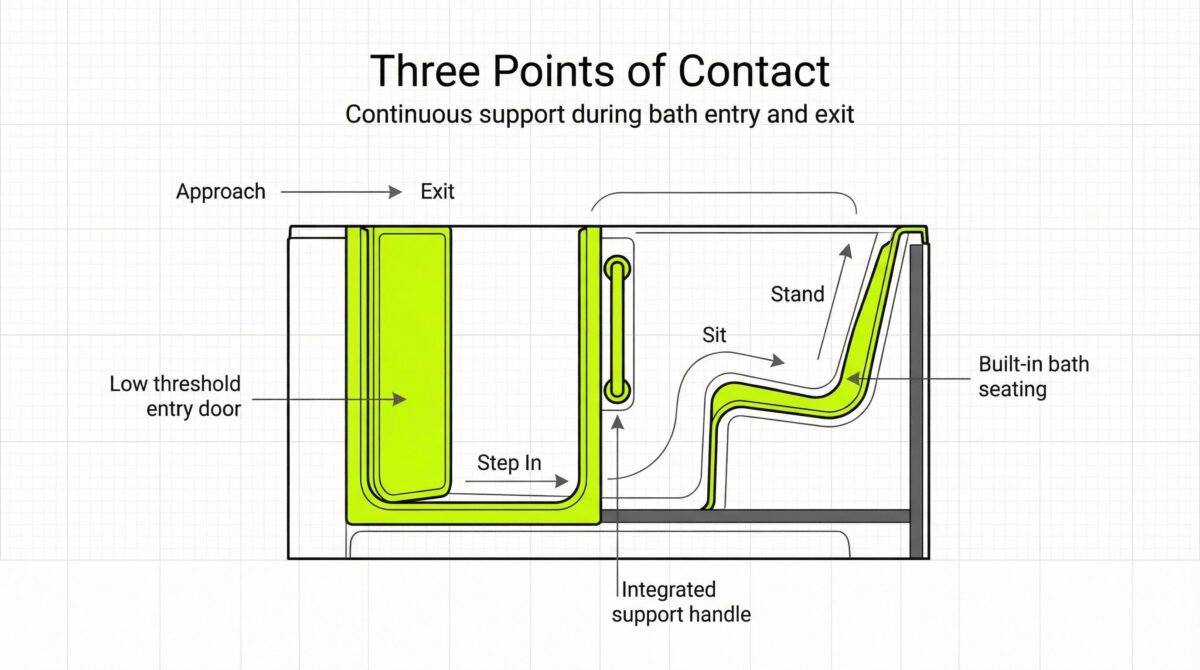
Think of it like a handrail on a staircase. You don’t just need it at the top or the bottom – you need it the whole way through.
Vidalux walk-in baths are engineered so the user is never unsupported at any stage of the process. Built-in features make this possible.
1. The Door. A low-threshold, wide-access door removes the most dangerous moment – stepping over a high bath rim. The door system is fully watertight, reinforced with high-grade seals, and designed to operate with minimal force and no awkward twistinghigh-grade seals.
2. The Seat. Not a clip-on board or a loose stool. The seat is built into the reinforced acrylic shell itself, supported by a steel support frame underneathseat is built into the reinforced acrylic shell itself. It doesn’t flex, slide, or shift. Engineered for seated use and built to support heavy loads safely.
Together, these features mean no mid-air moments. No relying on grip strength alone. Every model also includes a slip-resistant textured internal floor for further stability.
Solving the Cold Wait – Why Filling and Draining Time Matters for Safety
One fair criticism of walk-in baths is waiting time. You sit inside while it fills, and wait while it drains. If that takes too long, you get cold – and cold, uncomfortable users rush.
Vidalux addressed this with two straightforward engineering decisions.
High-flow manual mixer taps come standard on every model, minimising fill time. Twin 40mm dual waste outlets – two large-bore drains instead of one – drastically reduce draining timeTwin 40mm dual waste outlets. Think of it like having two exit doors instead of one. The bath empties significantly faster, so the user isn’t sitting cold waiting to get out.
On selected whirlpool models, an inline heater maintains water temperature during longer sessions. This doesn’t heat cold water from scratch – it holds the temperature of water you’ve already filled, slowing heat loss during extended use.
Fill time and drain time aren’t just convenience considerations. They’re safety ones.
Choosing with Confidence
When evaluating any walk-in bath, look for a genuinely low step-in threshold, a structurally integrated seat, reinforced build quality with a steel support frame, slip-resistant internal surfaces, fast-fill and fast-drain capability, a watertight door tested for long-term use, and UK-based aftercare with spare parts availability.
Vidalux walk-in baths include all of the above as standard – even on the simplest models. The reinforced acrylic stays warm to touch, resists cracking and yellowing, and is easy to clean.
Feeling safe isn’t a luxury. It’s the foundation of independent, dignified bathing.
Review the options. Compare the details. Explore the full Vidalux walk-in bathtub range.
Frequently Asked Questions
Q: How common are bathroom falls in elderly people?
A: Bathroom falls in elderly people are very common. Around one in three adults over 65 falls at least once a year, and bathrooms are consistently ranked among the highest-risk rooms due to wet surfaces, high step-overs, and unsupported transfers.
Q: Why do older adults stop showering after a fall?
A: Older adults often stop bathing after a fall because of post-fall anxiety. Research on hip fracture outcomes shows that fear of falling is common in the weeks and months after injury, leading many people to avoid any activity that feels unstable – including bathing.
Q: Are suction grab bars safe for elderly bathroom use?
A: Suction grab bars are not considered safe for primary fall prevention. Occupational therapists warn they can detach without warning under load. Properly fixed grab bars anchored into wall studs or solid backing are recommended for reliable support.
Q: Do walk-in baths get cold while filling?
A: Walk-in baths can feel cold during filling if the design is slow. Vidalux models use high-flow manual mixer taps for fast filling and twin 40mm dual waste outlets for rapid draining, minimising the time spent waiting inside the bath.
Q: What should I look for in a walk-in bath for an elderly parent?
A: When choosing a walk-in bath, look for a genuinely low step-in threshold, a structurally built-in seat, reinforced acrylic with a steel support frame, slip-resistant internal surfaces, fast-fill and fast-drain systems, and a watertight door engineered for long-term reliability.
- About the Author
- UK’s best-rated?

With over 22 years in the home spa industry, Andrew has overseen every stage of the journey—from initial product design and manufacturing to final installation. An author of multiple technical publications and scientific papers, he founded Vidalux to replace industry hype with engineering-led reliability. His focus remains on delivering gym-quality wellness through honest design and technical truth.
DISCLAIMER: All specifications, claims, and advice relating to any internal or external procedure, practise, product, or service were true at the time of writing. For more accurate and up-to-date details in relation to Vidalux services, please visit the relevant dedicated on-site page. For any product-related information, specifications, or guidance, the information on the product page should be considered the governing source.