Anti-Slip Bathroom Flooring: What the R Ratings Actually Mean (and What They Don’t)
If you’re searching for anti-slip bathroom flooring for elderly parents – or for yourself – you’ve probably hit a wall of confusing numbers. R9, R10, R11. PTV. Pendulum tests. BS 7976.
All you want is a straight answer: what floor is actually safe when it’s wet and soapy?
Here’s the thing. The ratings system isn’t as clear as it should be. Some of those numbers weren’t even designed for bathrooms. And some products labelled “anti-slip” would struggle to prove it under real conditions.
This article explains what the ratings mean, which test matters most in the UK, and how to tell genuine grip from a marketing label.
Why Bathroom Falls Are So Serious
According to research published by Age UK, around 70,000 people a year in the UK sustain a hip fracture, with roughly 70% of those aged over 80. Falls are the leading cause of injury-related death in over-75s – and wet bathrooms are consistently identified as high-risk areas.
The financial cost to the NHS and social care system is significant – but the human cost is what matters most. Many elderly people never fully regain the confidence or independence they had before a fall.
The point isn’t to frighten anyone. It’s to make clear that choosing the right floor surface is a decision worth getting right.
R Ratings Explained – R9 to R13

Most tile shops use R ratings. But here’s what they rarely explain.
R ratings come from DIN 51130 – a German ramp test designed for industrial workrooms. The test involves a person wearing shoes, walking on an oiled, inclined surface. It grades friction from R9 (low grip) to R13 (very high grip, heavy industrial).
Think of it like a grading system designed for one subject being used to mark a completely different one. The test was built for shod feet in factories – not bare feet in a wet bathroom with soap on the floor.
General guidance suggests R11 or above for wet indoor areas. R10 is moderate. R9 is minimal and not recommended where water is present.
Worth noting: R ratings are not a legal requirement for domestic bathrooms in the UK. They’re a manufacturer classification – useful as a rough guide, but they don’t tell you how the surface performs wet, soapy, and barefoot.
PTV – The Test That Actually Matters
PTV stands for Pendulum Test Value, measured under BS 7976. It’s the UK’s formally recognised method for assessing slip risk.
Unlike the DIN ramp test, the pendulum test measures friction on a horizontal surface and can be performed wet or contaminated. The Health and Safety Executive and UK Slip Resistance Group use the same benchmark: PTV of 36 or above means “low risk of slip.”
Can you convert between R ratings and PTV?
Not reliably. The UK Slip Resistance Group warns against treating them as interchangeable – the tests measure different things under different conditions.
Put simply: if you’re choosing a floor for someone elderly or unsteady, PTV tested wet is the number that matters. If a supplier can’t provide a wet PTV value, that’s worth knowing.
Why “Anti-Slip” Labels Aren’t Always What They Seem
The phrase “anti-slip” isn’t regulated the way you might expect. A product can carry the label based on a dry test, a shod ramp test, or sometimes no formal test at all.
Slip-testing professionals have long flagged this gap. Many surfaces marketed as “anti-slip” only achieve safe friction values when bone-dry. Once contaminated with soap, body oils, and limescale – things you’d expect in any bathroom – grip drops significantly.
Aftermarket coatings and adhesive strips are common workarounds, but coatings wear through with cleaning, and stickers can lift at the edges. The honest truth? A surface relying on a coating for grip is only as safe as that coating’s lifespan.
Choosing Anti-Slip Flooring – Moulded Texture vs Surface Coatings
There are two fundamentally different approaches to slip resistance.
The first is texture moulded into the material during manufacture. The grip is part of the product’s structure – formed in the mould, integral to the surface, impossible to wear off through normal cleaning.
The second is a coating or treatment applied to a smooth surface after manufacture. It sits on top rather than being part of the material, and degrades with use and cleaning over time.
Does the base material matter?
It does. Non-porous materials like reinforced acrylic resist the soap scum buildup that makes surfaces slippery. They’re easier to keep clean without abrasive products – so the textured surface stays effective longer. Structural rigidity matters too. A base that flexes underfoot adds instability; a steel-framed base eliminates that entirely.
The Vidalux Approach – Grip Built In, Not Bolted On
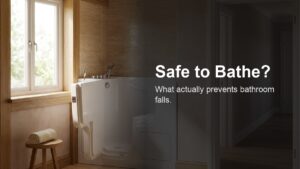
Vidalux walk-in baths and shower cabins use textured reinforced acrylic bases, with the slip-resistant surface formed during the moulding process – not sprayed, etched, or stuck on afterwards.
Every walk-in bath includes a textured internal floor designed to prevent slipping when standing or seated. The reinforced acrylic is non-porous, warm to the touch, and resistant to cracking and yellowing. A steel support chassis underneath prevents any flex, keeping the base solid and stable.
Combined with easy step-in thresholds, wide access doors, high-grip internal surfaces, and built-in seating, the textured base is part of a complete safety system – not a standalone marketing claim.
Safety features should be structural, not cosmetic. That’s the difference between grip that lasts the lifetime of the product and grip that fades with every clean.
Review the standards. Compare the details. Choose with confidence. See the full Vidalux walk-in bath collection.
Frequently Asked Questions
Q: What is the R rating on bathroom flooring?
A: The R rating on bathroom flooring is a slip-resistance classification from the DIN 51130 ramp test, grading surfaces from R9 (low grip) to R13 (high grip). It was designed for shod feet in industrial settings, not barefoot domestic bathrooms.
Q: What is PTV, and why does it matter for bathroom floors?
A: PTV, or Pendulum Test Value, measures slip resistance using the BS 7976 standard. A PTV of 36 or above is classified as low slip risk by the UK Slip Resistance Group and is the benchmark most relevant to wet bathroom conditions.
Q: Is there a legal R-rating requirement for UK bathrooms?
A: No. R ratings are not a legal requirement for domestic bathrooms in the UK. The legal duty is to provide a surface that is reasonably safe, typically evidenced through PTV testing and risk assessment rather than an R classification.
- About the Author
- UK’s best-rated?

With over 22 years in the home spa industry, Andrew has overseen every stage of the journey—from initial product design and manufacturing to final installation. An author of multiple technical publications and scientific papers, he founded Vidalux to replace industry hype with engineering-led reliability. His focus remains on delivering gym-quality wellness through honest design and technical truth.
DISCLAIMER: All specifications, claims, and advice relating to any internal or external procedure, practise, product, or service were true at the time of writing. For more accurate and up-to-date details in relation to Vidalux services, please visit the relevant dedicated on-site page. For any product-related information, specifications, or guidance, the information on the product page should be considered the governing source.
Ready to choose?
Browse the full Vidalux range of saunas, steam showers, baths and shower cabins, all in one place