The ‘Toaster’ Myth: Why Cheap Infrared Heaters Won’t Detox You
There’s a question we hear more often than you might expect.
Someone has seen a plug-in infrared panel online – maybe on Amazon, maybe a patio heater with wellness claims on the listing – and they’re wondering whether it does the same thing as a proper infrared sauna. Whether sitting in front of it for half an hour would produce the same results.
It’s a fair question. And the honest answer to the infrared heaters detox myth starts with something the industry rarely admits: a lot of infrared marketing is genuinely misleading. So let’s be precise about what’s real.
What Do We Actually Mean by “Infrared”?
The problem starts with the word itself.
“Infrared” describes a band of the electromagnetic spectrum – a vast range spanning from wavelengths just beyond visible light all the way to those that overlap with microwave radiation. Calling something “infrared” tells you almost nothing about what it does, any more than “vehicle” tells you whether you’re looking at a bicycle or a lorry.
Within the spectrum relevant to wellness, there are three distinct sub-bands:
- Near Infrared (NIR) – shortest wavelengths, surface-level penetration, associated with skin and shallow tissue
- Mid Infrared (MIR) – reaches soft tissue, supports circulation and flexibility
- Far Infrared (FIR) – the longest wavelengths, penetrates deepest into the body, associated with core temperature rise and deep heat-induced sweating
A standard patio heater, a halogen bar, a cheap plug-in panel – these all emit infrared too.
But here’s what matters: the wavelength they emit at.
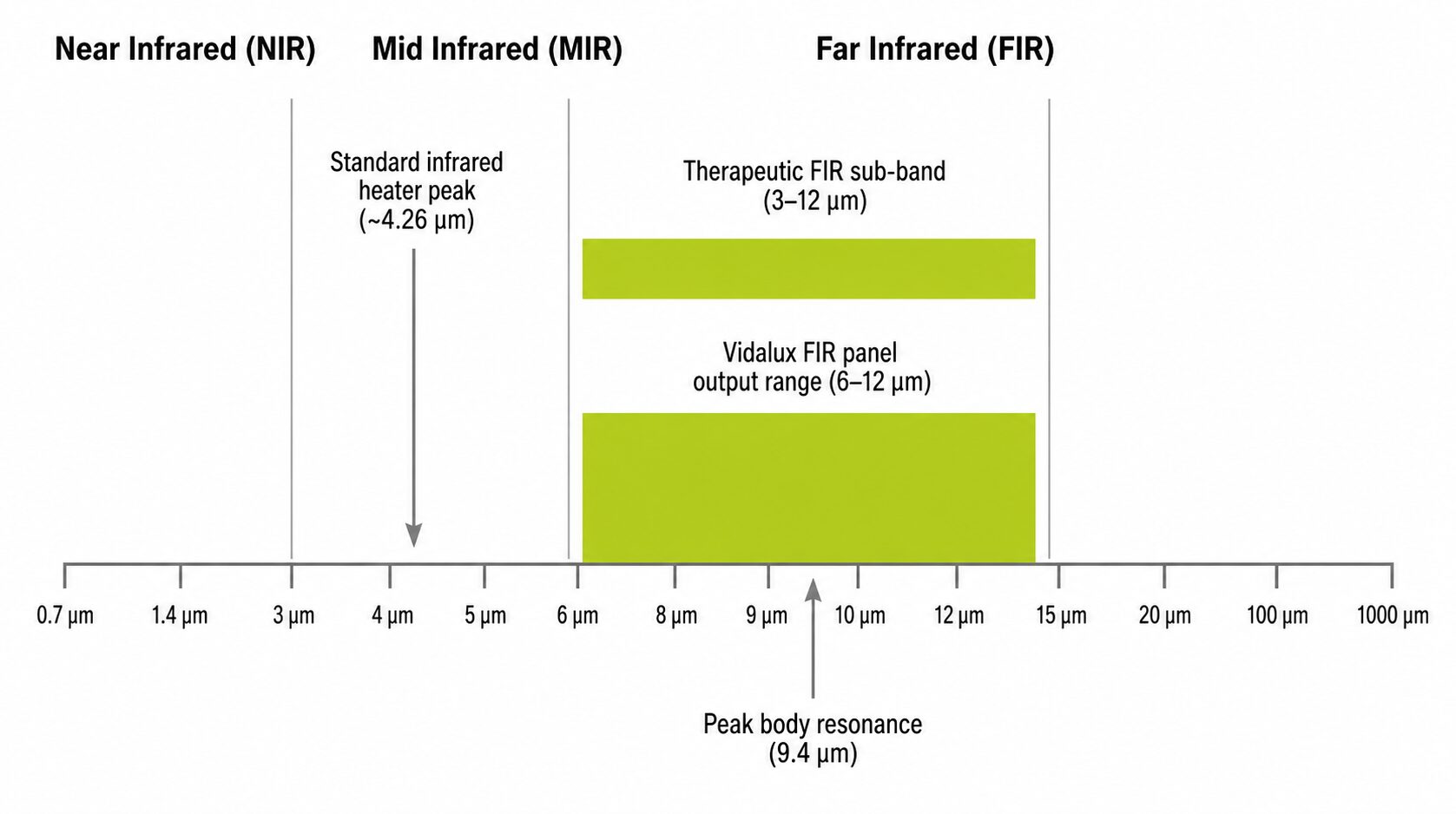
Halogen elements run at very high surface temperatures, which causes them to peak at short wavelengths – well below the range where Far Infrared has documented biological effects. According to a peer-reviewed review by Vatansever and Hamblin published in Photonics and Lasers in Medicine, it is the 3-12 micron sub-band of Far Infrared that has been shown in laboratory and animal studies to stimulate cells and tissue.
That is the range the body’s water-containing tissue absorbs meaningfully – closely matching the body’s own thermal emission at approximately 9.4 microns. Shorter wavelengths outside this window don’t produce the same response.
Think of it like a radio frequency. Two transmitters both broadcasting “radio waves” – but if one is on FM and one is on shortwave, your receiver won’t pick up both. The frequency is everything.
What Heat-Induced Sweating Actually Does
Here’s where the detox conversation needs to be handled carefully – because most of it is either dramatically overclaimed or unfairly dismissed.
The honest truth? Heat-induced sweating is a genuine and meaningful process.
Sweating produced through sustained heat exposure differs from exercise-induced sweat in one specific respect: it is produced mainly through the lymphatic system, eliminating toxins without heavily involving the liver and kidneys.
This means heat supports detoxification pathways and aids the body in eliminating toxins through the skin – both exogenous toxins (environmental pollutants and chemicals) and endogenous toxins (biological waste from the body’s own metabolism) – while placing lesser pressure on the body’s major filtering organs, not more.
Heat also mimics the conditions of a mild fever. The body responds by boosting T-cell production and improving interferon activity – proteins that help fight toxins and support the immune system’s natural function.
So why is the claim still overstated?
Because this entire mechanism depends on creating the right conditions. Deep, sustained heat-induced sweating requires sustained core temperature elevation over a proper session – 20 to 30 minutes in a properly designed enclosure, with panels surrounding the body, emitting at the right wavelengths.
A plug-in panel heater in a room creates none of these conditions.
No enclosure. No surrounding panel array. No sustained core temperature elevation. It heats the air around you and the surface of your skin. That’s a categorically different physiological event – and the detox process that heat genuinely supports simply doesn’t get triggered.
What a Properly Engineered FIR Sauna Actually Does
A purpose-built Far Infrared sauna doesn’t work by heating the air to extreme temperatures. It works by emitting radiant energy – specifically in the 6-12 micron wavelength range – that is directly absorbed by the body’s tissue.
The human body itself emits infrared at approximately 9.4 microns. Vidalux infrared panels are engineered to concentrate output in the 6-12 micron range, peaking at that 9.4 micron frequency – what’s known as bio-resonance. The result is efficient absorption rather than energy bouncing off the skin surface.
What this produces – in a properly designed enclosure, over a 20-30 minute session, with panels surrounding the body – is a genuine physiological response. Core body temperature rises gently. Heat-induced sweating increases. Circulation is supported. The lymphatic mechanism described above is properly engaged.
None of this happens with a panel heater in a room.
A panel heater has no enclosure. No surrounding array of calibrated emitters. It operates at the wrong surface temperature and the wrong wavelength to drive the response described above. You can sit next to one for an hour and your core temperature will not rise in the way a proper FIR session produces.
The Engineering Gap – Why Not All Infrared Heaters Are Equal
Not all cheap devices are created equal. Neither are all infrared saunas. And the quality gap comes down to a few specific engineering choices.
Emissivity is the ability of a panel to emit infrared at a useful intensity in the right wavelength range. High-emissivity carbon panels engineered for sauna use do this efficiently. Vidalux’s redeveloped carbon fibre offers a 20% increase in infrared output versus regular carbon fibre heaters. A standard room heater has no such specification.
Surface temperature matters too – and here’s something counterintuitive. Lower surface temperatures on a well-designed carbon panel produce better FIR output in the therapeutic range. A carbon panel running at moderate temperatures emits predominantly in the 8-12 micron window. A halogen element running at extreme temperatures peaks at a completely different part of the spectrum.
But what about panel placement?
A single wall-mounted panel, regardless of quality, cannot replicate the surrounding coverage that a full sauna enclosure provides. Being surrounded by emitters – not just facing one – is what produces even heat distribution across the body.
Vidalux’s full-spectrum heaters address another specific problem. Standard infrared rays travel in a straight line. Flat or straight-tube heaters – used by 90% of the market – leave dead zones where the body receives no infrared coverage at all. Vidalux heaters are coiled in a concave shape, with surgical-grade stainless steel deflectors behind the elements, focusing and distributing output to maximise coverage and eliminate those dead zones entirely.
Worth noting: most brands charge £200-£500 extra for full-spectrum heater upgrades. Vidalux includes them as standard.
The Vidalux Approach – Engineered for the Right Result
Vidalux has been engineering saunas for over 15 years. This is not a category we entered because wellness became fashionable.
Complete Heat technology is a deliberate combination: Nano-Carbon Crystal panels on the walls and floor delivering wide, even Far Infrared coverage, and Full-Spectrum Carbon Fibre Ruby Quartz heaters positioned behind the backrest delivering Near, Mid, and Far Infrared simultaneously. Each choice is made for a specific engineering reason – wavelength precision, coverage geometry, emissivity, bio-resonance. None of it is accidental.
We don’t make promises about what your body will do. What we can tell you is that the engineering choices in a Vidalux sauna are made to give the body the right conditions to do what it naturally does – deep, heat-induced sweating, gentle circulation support, sustained core temperature elevation – at the right wavelengths, in the right enclosure, for the right duration.
That’s a different category of product from a panel heater. Not because of marketing. Because of physics.
A Calm Summary
If you’ve been sceptical about infrared wellness claims, that scepticism is well-placed for much of what’s marketed under the infrared label.
A cheap plug-in heater cannot raise your core temperature. It cannot trigger the heat-induced sweating mechanism that supports the body’s natural detoxification processes. It emits at the wrong wavelength, with no enclosure to sustain exposure over a session.
A properly engineered Far Infrared sauna is something different – not because the word “infrared” is magic, but because the design is specific. The wavelength, the emissivity, the placement, the enclosure, the session conditions – each one matters.
The question worth asking isn’t “does infrared work?” It’s whether the device in front of you is actually producing the right kind.
See the quality. Review the range.
Frequently Asked Questions
Q: Can a cheap infrared heater detox your body?
A: A cheap infrared heater cannot support the body’s natural detoxification processes in any meaningful way. Standard panel heaters do not emit in the correct wavelength range or raise core body temperature enough to trigger the heat-induced sweating associated with proper infrared therapy – the fundamental mechanism required.
Q: Is an infrared heater the same as an infrared sauna?
A: An infrared heater and an infrared sauna are not the same thing. Infrared heaters emit radiant heat across a broad spectrum, primarily to warm a room. A purpose-built infrared sauna uses calibrated carbon or ceramic panels positioned around the body to emit specifically in the 6-12 micron Far Infrared range, which the body absorbs directly.
Q: What wavelength does Far Infrared therapy use?
A: Far Infrared therapy operates most effectively in the 8-10 micron wavelength range. This is the range peer-reviewed research identifies as biologically active – closely matching the body’s own thermal emission frequency of approximately 9.4 microns, which supports efficient tissue absorption rather than surface reflection.
Q: Why don’t cheap infrared heaters work as saunas?
A: Cheap infrared heaters fail as saunas for two reasons: wrong wavelength and no enclosure. Halogen and standard panel heaters typically emit below the therapeutically active FIR window, and without a surrounding panel array and insulated cabin, they cannot raise core body temperature or sustain the heat-induced sweating a proper session requires.
Q: Do infrared saunas support detoxification?
A: Infrared saunas support the body’s natural detoxification processes by promoting deep heat-induced sweating, which aids the body in eliminating toxins through the skin. This works in complement to the liver and kidneys – a properly engineered FIR sauna creates the right conditions for this process through sustained core temperature elevation.
Q: What makes Vidalux infrared heaters different from standard panel heaters?
A: Vidalux infrared saunas use Nano-Carbon Crystal panels and Full-Spectrum Carbon Fibre Ruby Quartz heaters engineered to emit in the 6-12 micron range, peaking at 9.4 microns. The heaters are coiled in a concave shape with surgical-grade stainless steel deflectors to eliminate coverage dead zones – engineering choices absent from standard room-heating products.
Q: Is Far Infrared safe?
A: Far Infrared at the wavelengths used in properly engineered sauna cabins is considered safe for general wellness use. It is non-ionising, does not use UV radiation, and operates at lower air temperatures than traditional saunas – typically 45°C to 60°C – making it well-tolerated for longer sessions by most healthy adults.
- About the Author
- UK’s best-rated?

With over 22 years in the home spa industry, Andrew has overseen every stage of the journey—from initial product design and manufacturing to final installation. An author of multiple technical publications and scientific papers, he founded Vidalux to replace industry hype with engineering-led reliability. His focus remains on delivering gym-quality wellness through honest design and technical truth.
DISCLAIMER: All specifications, claims, and advice relating to any internal or external procedure, practise, product, or service were true at the time of writing. For more accurate and up-to-date details in relation to Vidalux services, please visit the relevant dedicated on-site page. For any product-related information, specifications, or guidance, the information on the product page should be considered the governing source.
Ready to choose?
Browse the full Vidalux range of saunas, steam showers, baths and shower cabins, all in one place