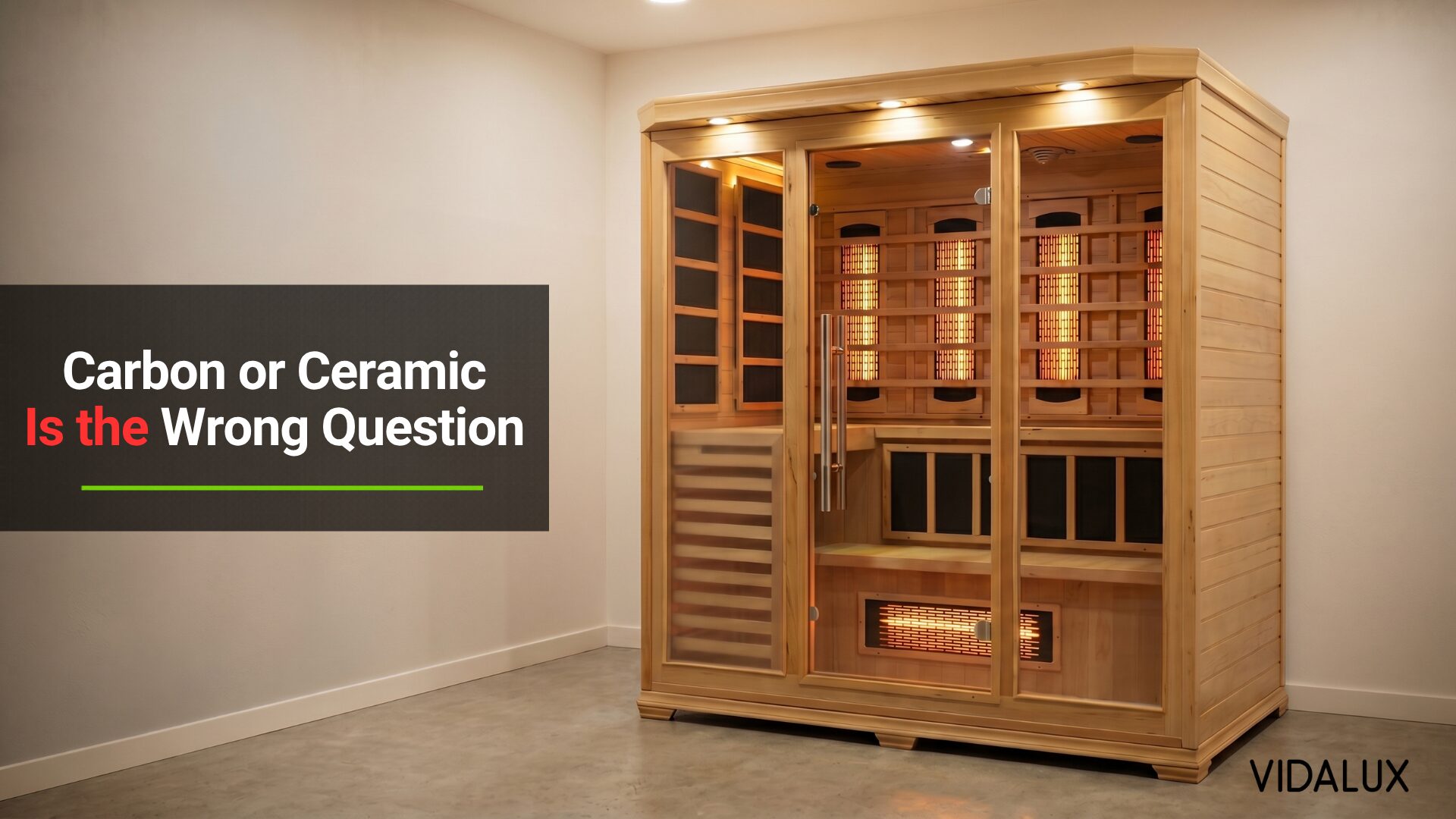
Carbon vs Ceramic Infrared Sauna Heaters: The Real Differences (And Why You Might Not Have to Choose)
Carbon or ceramic? If you’ve been researching infrared saunas, you’ve probably hit this question – and found ten different answers depending on where you looked.
Some forums swear by carbon. Some brands push ceramic as the premium choice. Most comparison articles give you a long list of pros and cons, then leave you exactly where you started.
Here’s the thing. The carbon vs ceramic infrared sauna debate isn’t really about picking a winner. It’s about understanding what each heater type actually does – and whether you need to compromise at all.
Let’s break it down properly.
What Carbon Heaters Actually Do
Most of what you’ll read online about carbon heaters is technically correct. The problem is what gets left out.
Carbon panel heaters produce FAR infrared – wavelengths in the 5.6 to 15 micron range. They’re mounted across the side walls of the sauna cabin, and their strength is coverage. Wide, even heat that wraps around you rather than hitting you from one direction.
The warmth is gentle. Consistent. Comfortable for longer sessions of 30 to 45 minutes without that “too close to the fire” feeling.
But aren’t they slow to heat up?
They are. Carbon panels take longer to reach operating temperature than ceramic. That’s the trade-off for their even distribution – they heat gradually rather than intensely.
They’re also energy efficient and produce minimal cold spots. For daily relaxation and comfort-focused wellness, carbon is a perfectly valid choice.
Worth noting: not all carbon panels are equal. The difference between a generic carbon film and a refined nano-carbon emitter is significant – in output quality, longevity, and the evenness of the heat you actually feel. Most budget saunas use the cheapest carbon sheets available. The engineering behind the panel matters as much as the panel type itself.
What Ceramic Heaters Actually Do
Ceramic gets a mixed reputation, and most of it comes from outdated information.
Ceramic heaters can be FAR-only or full spectrum – producing near infrared (NIR), mid infrared (MIR), and far infrared (FIR) together. Full-spectrum ceramic is a premium option, and it’s the version that delivers the broadest wavelength coverage.
The defining characteristic of ceramic is intensity. High surface temperature. Strong, direct penetration close to the body. Fast warm-up time – noticeably quicker than carbon.
So what’s the downside?
Reach. Ceramic heaters have a shorter infrared throw. The heat is powerful up close but drops off quickly, which creates cold spots further from the element. During a long session, that unevenness becomes noticeable. Some users find ceramic harsh when seated directly against the heater for extended periods.
The other reality is cost. Full-spectrum ceramic heaters are typically sold as upgrades – often £200 to £500 per heater on top of the sauna’s base price. FAR-only ceramic, which is cheaper, misses the NIR and MIR wavelengths entirely.
Carbon vs Ceramic – The Honest Comparison

This is the comparison most people came here for. No spin – just what the engineering tells us.
Warm-up speed: Ceramic wins. It reaches temperature faster due to higher surface heat output.
Heat distribution: Carbon wins. Wide, even coverage with minimal cold spots across the whole cabin.
Session comfort for long use: Carbon wins. Lower surface temperature means less harshness over 30+ minute sessions.
Close-range intensity: Ceramic wins. Stronger immediate penetration, especially for targeted areas like the lower back.
Infrared spectrum: Ceramic can offer full spectrum (NIR + MIR + FIR). Carbon produces FAR only.
Cold spots: Carbon has fewer. Ceramic’s short throw creates uneven coverage.
Energy efficiency: Similar, with a slight edge to carbon.
Let’s be clear: both have genuine strengths. Both have genuine weaknesses.
The real question isn’t which is better. It’s whether you have to choose at all.
The Real Answer – Why the Best Saunas Use Both

The debate assumes you’re stuck with one or the other. You’re not.
Vidalux spent years testing every heater configuration – ceramic-only, carbon-only, FAR-only, and various full-spectrum setups. The R&D conclusion was consistent: every single-heater-type sauna had a weakness that couldn’t be engineered away without adding the other type.
That’s why Complete Heat exists.
Think of it like combining a floodlight with a spotlight. One gives you broad, even illumination across the whole room. The other gives you focused, powerful light exactly where you need it. Neither replaces the other – but together, they eliminate every dark corner.
How does it actually work?
Complete Heat uses two heater types in the same cabin, working together by design.
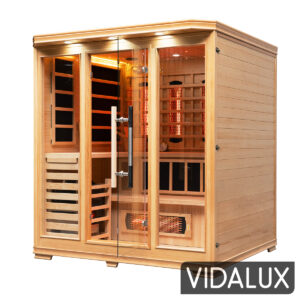
Nano-carbon crystal heaters line the walls and floor. These deliver wide, even FAR infrared coverage – the gentle, enveloping warmth that carbon does best. They’re energy efficient, low EMF, and engineered for long, comfortable sessions with no cold spots.
Full-spectrum carbon fibre ruby quartz heaters sit behind the backrest, close to the body’s largest muscle groups. These deliver all three infrared wavelengths – NIR, MIR, and FIR – with instant heat-up and deep tissue penetration.
The heaters are tuned to concentrate output in the 6 to 12 micron range, peaking at 9.4 microns. According to published research, far infrared radiation is emitted by the human body with a peak output at 9.4 microns – a principle called bio-resonance – which supports more effective infrared absorption rather than the heat simply bouncing off the skin.
The heaters themselves use a concave design with surgical-grade stainless steel deflectors behind the elements. This scatters and focuses the infrared to eliminate the dead zones that plague flat or straight-tube heaters used by most of the market.
The result is a 20% increase in emissivity compared to regular carbon fibre, with full spectrum included as standard – not charged as an upgrade.
What if I just want gentle FAR sessions sometimes?
The back heaters operate independently. Each one has its own control dial, so turn them down or off and you have a pure carbon FAR session, or turn them up for the full Complete Heat experience. Your choice, every time you step in.
It’s worth understanding the scale of this: full spectrum infrared is thought to provide up to 10 to 15% more benefit than FAR-only systems. Most brands charge hundreds extra per heater for that upgrade. With Complete Heat, it’s built in from the start.
What About Hybrid Saunas? (A Quick Note)
The terms get confused, so let’s clear this up quickly.
Complete Heat is the infrared system – carbon panels and ceramic heaters working together. That’s what this article has been about.
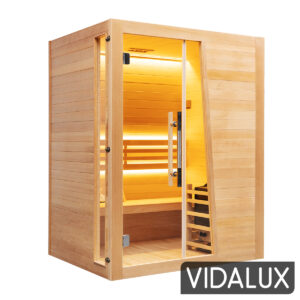
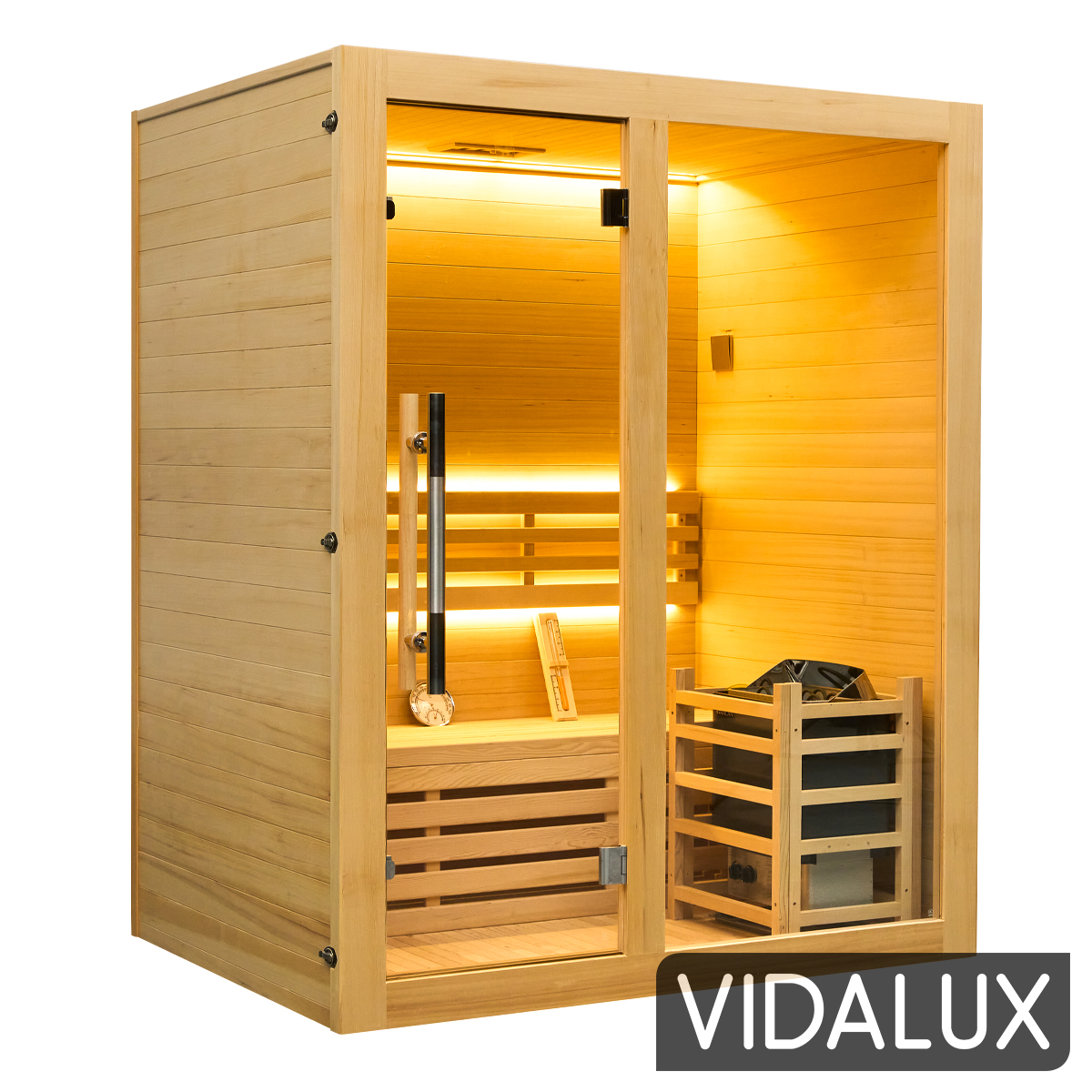
A Hybrid sauna takes Complete Heat and adds a traditional Finnish stove to the same cabin. That gives you two modes: infrared only, or stove only … the two systems can’t run at the same time, so you switch between them rather than combining them. It’s designed for people who want gym-style high-temperature heat alongside their infrared sessions.
Different product, different purpose. If you want the traditional sauna experience as well as infrared, explore the full home saunas range at https://vidalux.co.uk/home-saunas/ to see what’s available. For outdoor options, see the outdoor saunas range at https://vidalux.co.uk/outdoor-saunas/ … the current outdoor line-up is the traditional-stove Barrel Sauna, with no hybrid or infrared outdoor model on sale yet.
What to Look For When Comparing Infrared Saunas
Forget the brand name for a moment. These are the questions that actually matter when you’re comparing infrared saunas.
Does the sauna use carbon, ceramic, or both? If it uses both, are they engineered to work together – or just placed in the same box?
Is it FAR-only or full spectrum? If full spectrum is listed as an optional upgrade, what’s the real total cost once you add it?
What’s the heater placement like? Are dead zones likely based on where the elements sit relative to where you sit?
What materials are the heaters made from? Generic carbon sheets and refined nano-carbon panels are not the same thing – even if they’re both called “carbon.”
What’s the warm-up time? And what’s the warranty? Perhaps most importantly – has the company been around long enough to honour it?
The honest truth? The answers to these questions matter more than any single “carbon vs ceramic” verdict.
Once you understand what each heater type actually does – and that the most effective systems combine both – the decision gets much simpler.
You don’t have to compromise between even coverage and deep penetration. You don’t have to choose between gentle warmth and fast warm-up. And you don’t have to pay extra for full spectrum as an afterthought.
Compare the craftsmanship. Review the engineering. Choose with confidence.
Explore the full range of Vidalux home saunas at https://vidalux.co.uk/home-saunas/ to see Complete Heat for yourself.
Frequently Asked Questions
Q: Is carbon or ceramic better in an infrared sauna?
A: Neither carbon nor ceramic is outright better in an infrared sauna – each has strengths. Carbon provides wide, even FAR heat ideal for long sessions. Ceramic delivers fast, intense penetration. The most effective systems combine both for full-body coverage.
Q: What is the difference between carbon and ceramic infrared heaters?
A: The difference between carbon and ceramic infrared heaters is how they deliver heat. Carbon panels spread gentle FAR infrared evenly across the body. Ceramic elements heat faster with stronger close-range intensity but create cold spots further away.
Q: Do carbon infrared saunas take longer to warm up?
A: Carbon infrared saunas do typically take longer to warm up than ceramic models. Carbon panels heat gradually to achieve even distribution, while ceramic reaches operating temperature faster due to its higher surface heat output and concentrated element design.
Q: What is a full spectrum infrared sauna?
A: A full spectrum infrared sauna produces near, mid, and far infrared wavelengths together – not just FAR. This broader range supports circulation, muscle recovery, and deeper tissue warmth. Most budget saunas produce FAR infrared only.
Q: What is Complete Heat technology in a sauna?
A: Complete Heat technology combines nano-carbon panels with full-spectrum carbon fibre ruby quartz heaters in the same sauna. This delivers wide, even warmth plus deep penetration across all three infrared wavelengths – with no cold spots.
- About the Author
- UK’s best-rated?

With over 22 years in the home spa industry, Andrew has overseen every stage of the journey—from initial product design and manufacturing to final installation. An author of multiple technical publications and scientific papers, he founded Vidalux to replace industry hype with engineering-led reliability. His focus remains on delivering gym-quality wellness through honest design and technical truth.
DISCLAIMER: All specifications, claims, and advice relating to any internal or external procedure, practise, product, or service were true at the time of writing. For more accurate and up-to-date details in relation to Vidalux services, please visit the relevant dedicated on-site page. For any product-related information, specifications, or guidance, the information on the product page should be considered the governing source.
Ready to choose?
Browse the full Vidalux range of saunas, steam showers, baths and shower cabins, all in one place