Infrared Heat and Joint Comfort: What Users Report
If you’ve been managing arthritis for any length of time, you’ll know the feeling.
The tablets work well enough to get you through the day. But they don’t fix anything. And quietly, in the background, there’s the question you’ve probably never fully shaken: what is taking these things every day actually doing to me?
That question is well-founded. This article doesn’t ask you to abandon your treatment plan. What it does is explain, clearly and honestly, what far infrared therapy for arthritis can offer alongside it – based on mechanism, engineering, and a clinical study most arthritis sufferers have never come across.
Why Long-Term Painkillers Are a Complicated Answer – Not a Bad One
Nobody is suggesting that NSAIDs don’t work.
They reduce prostaglandin activity, which directly contributes to joint inflammation and the pain signals that go with it. For managing acute arthritis pain and getting through flare-ups, they are a rational first-line response.
The complication isn’t whether they work. It’s what they are.
NSAIDs and analgesics are symptom managers. They don’t alter the underlying condition. They don’t slow the progression of joint damage in rheumatoid arthritis or osteoarthritis. The joint is still changing. The pain is simply less audible for a while.
But what about long-term use?
Long-term NSAID use carries documented risks, including gastrointestinal damage and, in a minority of cases, ulcers or bleeding … ask your GP or rheumatologist what that risk looks like for you specifically. Renal risk also increases with consistent, long-duration use, particularly in older patients.
People managing rheumatic and musculoskeletal conditions are among those a 2023 study found at higher risk of moving from a first opioid prescription to long-term use … worth a conversation with your GP before any long-term painkiller plan is set.
Worth noting: this isn’t fringe concern. It’s a conversation the medical community is already having internally. Patients deserve to be part of it.
The honest truth? Painkillers often feel like a trap – partially effective, carrying escalating risk, with no path toward actually improving joint function. It’s not surprising that so many people living with chronic pain are quietly looking for something more.
What Far Infrared Actually Does – And Why It’s Not Just Heat
Here’s the misconception that needs clearing up first.
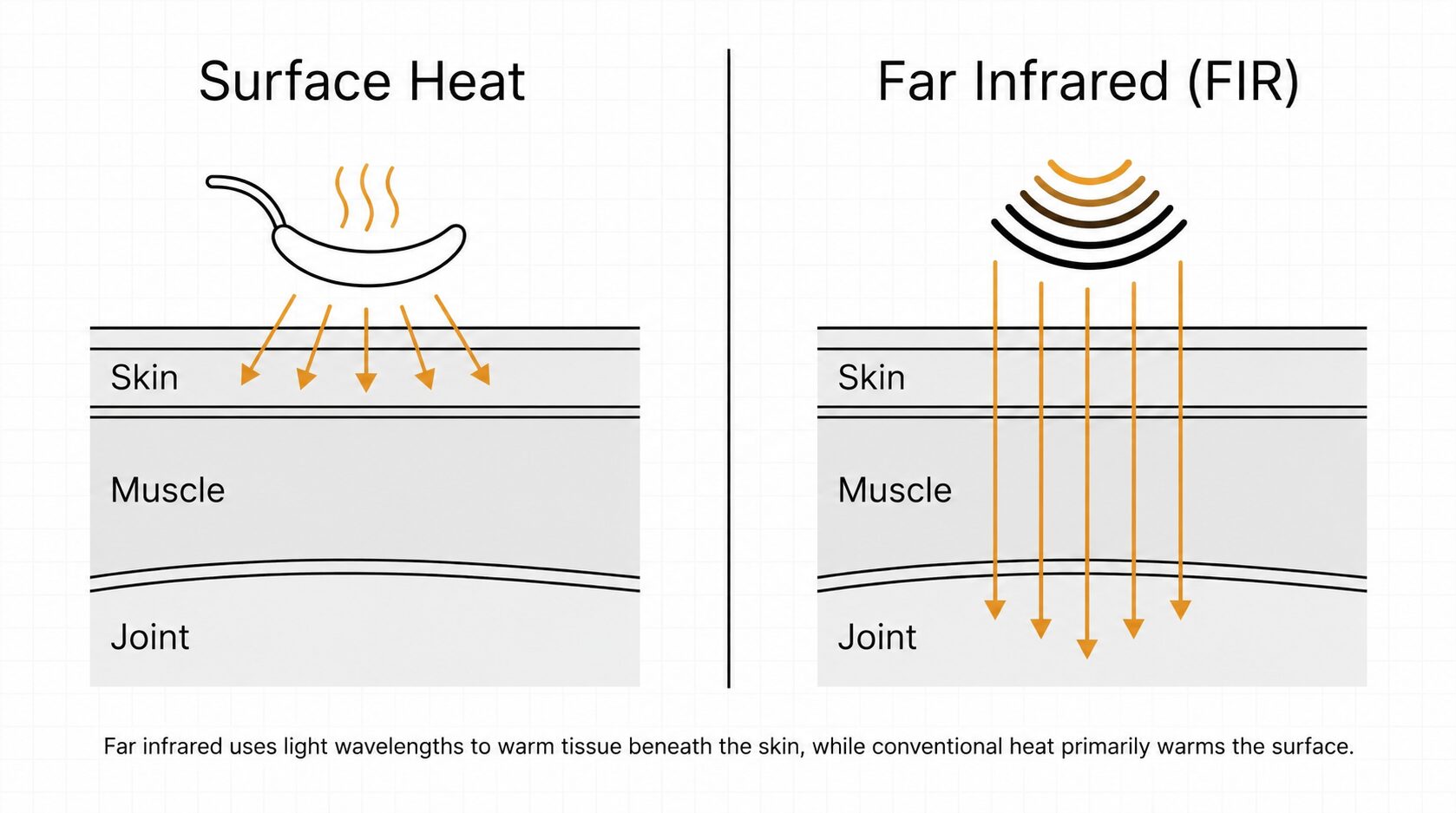
When most people think “heat therapy for arthritis,” they picture a hot water bottle, an electric blanket, or a warm bath. Surface warmth. Temporary comfort. The kind of heat that feels good for 20 minutes and fades.
Far infrared is a different mechanism entirely.
Think of it like sunlight warming you through a window on a cold day – the glass itself doesn’t heat up, but the warmth passes straight through and lands on your skin. Far infrared works on a similar principle, except it penetrates significantly deeper than surface warmth. It doesn’t heat the air around you. It uses light wavelengths to warm tissue directly from within.
Far infrared (FIR) sits in the 5.6-15 micron wavelength range. At these frequencies, energy passes below the skin surface and into soft tissue, supporting blood flow, relaxing muscle tissue, and encouraging the kind of warmth that supports recovery rather than just comfort.
What does that mean for arthritic joints specifically?
Chronic joint pain in conditions like rheumatoid arthritis and osteoarthritis is rarely just about the joint itself. Secondary muscle tension builds up around affected joints – a protective tightening response that often amplifies stiffness and pain. Users report that FIR heat reaching into that tissue helps it feel more relaxed, alongside a sense of increased circulation to the area. The nervous system, which plays a role in how pain signals are processed, responds to sustained heat exposure with a calming effect.
None of this is mystical. It’s applied physics – deliberately used.
One further detail worth understanding: the human body naturally emits infrared energy at approximately 9.4 microns. Vidalux infrared heaters are engineered to concentrate output in the 6-12 micron range, peaking at that same 9.4-micron frequency. This bio-resonance means the body absorbs the energy more readily – rather than the heat simply resting at the skin’s surface and dissipating.
The lower operating temperature of an infrared sauna – typically 45°C to 60°C, compared to 70°C+ in a traditional sauna – is not a limitation. It’s the point. Because the heat is delivered through light penetration rather than superheated air, it feels far more comfortable at the same time on the clock. Worth knowing: no health body sets a longer session for infrared than for a traditional sauna … the lower temperature changes how it feels, not how long you should stay in.
What a Dutch Clinical Study Actually Found
Opinions about infrared therapy are easy to find. Independent clinical data is rarer.
A 2009 pilot study published in Clinical Rheumatology (Oosterveld and colleagues, volume 28, pages 29-34) looked at infrared sauna use in patients with rheumatoid arthritis and ankylosing spondylitis. 17 RA patients and 17 AS patients completed eight infrared sessions across a four-week period.
The findings were clinically relevant.
Pain and stiffness fell significantly during the sessions themselves, and fatigue came down as well. Across the full four weeks the improvements continued but did not reach statistical significance, and the authors were careful to say so. Crucially, the safety data was equally clear – no negative long-term impact was noted, and no exacerbation of disease activity was observed.
Put simply: it helped, and it didn’t make anything worse.
It’s important to be precise about what this means and what it doesn’t. These were short-term improvements, recorded during an active treatment period. This is not a cure. Infrared therapy does not reverse joint damage or modify the underlying disease.
And before adding any heat therapy protocol to an existing arthritis management plan, you should speak with your rheumatologist – particularly if your condition is currently active or if you’re taking immunosuppressant medication.
What the study does establish is that infrared heat isn’t simply “something that feels nice.” It has been studied in the exact patient population that is reading this article. That distinction matters.
Heat Therapy as Part of a Managed Plan – Not Instead Of
Managing arthritis well has never been about finding one answer.
It’s a combination – medication, physiotherapy, mobility work, stress reduction, rest, and activity calibration all working together. Heat therapy slots into that picture. It doesn’t replace it.
One thing to consider: heat and cold therapy serve different purposes, and the distinction is important. Cold packs and cold therapy are typically more appropriate during acute flare-ups, when joints are actively swollen and inflamed. Applying heat during a significant acute flare can increase blood flow to an already inflamed joint and may intensify discomfort.
Far infrared is most effective as a tool for the other phase – the persistent, background stiffness, the joint ache that follows you through the day, the fatigue that accumulates when your body is working harder than it should to manage pain signals. This is where regular heat therapy for arthritis earns its place.
So how often should someone use it?
Benefits are cumulative, not instant. Regular sessions build on each other over time. Canada’s National Collaborating Centre for Environmental Health suggests healthy adults keep a session to around 10 to 15 minutes, dropping to 5 to 10 minutes for anyone managing a cardiovascular condition, diabetes, or high blood pressure … and your physical therapist or GP is the right person to set your frequency. Like physiotherapy itself, consistency matters more than intensity.
Non-pharmacological approaches carry a favourable risk profile compared with escalating NSAID or opioid use … that’s a genuine, practical reason to consider adding one alongside your existing plan. When the documented risks of escalating NSAID or opioid use sit on one side of the scale, a tool with a strong safety record and clinically studied effectiveness sits meaningfully on the other.
None of this requires abandoning your rheumatologist’s guidance. It works best alongside it.
The Vidalux Approach – Engineered for Daily Wellness
Not all infrared saunas deliver the same experience.
The majority on the market produce far infrared only – from carbon or ceramic heater panels. FIR is the most studied wavelength, effective at low temperatures, and a perfectly valid wellness foundation. But there are meaningful engineering differences between how well any given sauna actually delivers it.
Vidalux infrared saunas use nano-carbon crystal panels across the walls and floor to provide wide, consistent FIR coverage – eliminating the cold spots that compromise a session. In Complete Heat models, full-spectrum heaters are also positioned behind the backrest, close to the large muscle groups most associated with secondary joint stiffness.

These back heaters, present in Complete Heat models as standard, deliver near infrared (NIR), mid infrared (MIR), and far infrared (FIR) together. Near infrared supports surface tissue recovery. Mid infrared reaches soft tissue and supports circulation. Far infrared provides the deepest penetration. A full spectrum sauna adds near and mid infrared to the far infrared band, for a fuller heat than a FAR only sauna.
All Vidalux heaters are tuned to concentrate output at 9.4 microns – matching the body’s own resonant frequency for maximum tissue absorption.
For daily arthritis comfort management, that engineering precision matters. A session that reaches the tissue that needs it, distributed evenly, at the right wavelength, is a different proposition from a sauna that simply warms the air around you.
Explore the Vidalux infrared sauna range to see the engineering behind the heat.
A Final Thought
The search for alternatives to painkillers for arthritis isn’t about rejecting medicine.
It’s about building a more complete approach – one that addresses joint comfort through multiple, complementary routes without carrying the accumulated risk of a single pharmacological answer taken indefinitely.
Far infrared therapy has a studied mechanism, clinical evidence in rheumatoid arthritis patients, and a safety profile that compares favourably with long-term NSAID use. It won’t replace your rheumatologist. It won’t reverse joint damage. But used consistently and appropriately, it supports the quality of life that arthritis management is ultimately working toward.
Review the options. Compare the standards. Choose with confidence.
Frequently Asked Questions
Q: Can infrared therapy help with arthritis pain?
A: Infrared therapy can support arthritis comfort by delivering far infrared wavelengths that penetrate deep into tissue, supporting circulation and muscle relaxation around affected joints. A clinical study at Saxion University found statistically significant short-term reductions in pain, stiffness, and fatigue in rheumatoid arthritis and ankylosing spondylitis patients. Always consult your rheumatologist before starting.
Q: What is the difference between infrared heat and a regular heat pad for arthritis?
A: Infrared heat differs from a standard heat pad because it uses light wavelengths – particularly far infrared at 5.6-15 microns – to warm tissue from within, rather than heating the skin’s surface externally. This deeper penetration supports circulation and joint comfort more effectively than surface-level warmth.
Q: Is infrared therapy a replacement for arthritis medication?
A: Infrared therapy is not a replacement for arthritis medication. It functions as a non-pharmacological adjunct – supporting comfort, circulation, and stiffness relief alongside an existing management plan. Any changes to medication should be discussed with your GP or rheumatologist.
Q: How often should someone with arthritis use an infrared sauna?
A: Sessions are shorter than most people expect. Canada’s National Collaborating Centre for Environmental Health suggests healthy adults keep a session to around 10 to 15 minutes, dropping to 5 to 10 minutes for anyone managing a cardiovascular condition, diabetes, or high blood pressure. Benefits are cumulative, so consistency matters more than length. Benefits are cumulative rather than immediate. Your rheumatologist or physical therapist can advise on a frequency appropriate to your specific condition and any active symptoms.
Q: Is it safe to use an infrared sauna with rheumatoid arthritis?
A: Infrared sauna use is generally well-tolerated in rheumatoid arthritis, with clinical data showing no negative long-term impact in studied patients. However, heat therapy is not appropriate during active flares with significant joint swelling. Always seek guidance from your rheumatologist before introducing heat therapy into your routine.
Q: What does far infrared do to joints?
A: Far infrared wavelengths penetrate deep tissue and support increased blood flow to affected joints, helping reduce stiffness and supporting the muscle relaxation that often eases secondary joint discomfort. This mechanism is why far infrared is widely used as a wellness adjunct in arthritis symptom management.
Q: Is far infrared the same as red light therapy?
A: Far infrared and red light therapy are related but distinct. Far infrared (FIR) uses longer wavelengths (5.6-15 microns) to generate deep tissue warmth and support circulation. Red light therapy uses shorter wavelengths closer to visible light, primarily to support cellular activity and surface tissue recovery.
- About the Author
- UK’s best-rated?

With over 22 years in the home spa industry, Andrew has overseen every stage of the journey—from initial product design and manufacturing to final installation. An author of multiple technical publications and scientific papers, he founded Vidalux to replace industry hype with engineering-led reliability. His focus remains on delivering gym-quality wellness through honest design and technical truth.
DISCLAIMER: All specifications, claims, and advice relating to any internal or external procedure, practise, product, or service were true at the time of writing. For more accurate and up-to-date details in relation to Vidalux services, please visit the relevant dedicated on-site page. For any product-related information, specifications, or guidance, the information on the product page should be considered the governing source.
Ready to choose?
Browse the full Vidalux range of saunas, steam showers, baths and shower cabins, all in one place