The Hidden Cost of Bath-Time Caring: Why Walk-in Bath Design Matters for Your Back
Most bathroom accessibility content is written for the person in the bath.
The seat heights, the door positions, the entry thresholds – all of it designed around the person bathing. Which makes sense. Except it misses something important.
There’s someone else in that bathroom.
Family carers describe bending over the side of a standard bath for weeks, then months. Hunching. Leaning in. Knowing the position is wrong, knowing the strain is building, and having no alternative because the bathroom simply wasn’t designed for two people.
This article is written for the person standing beside it. If you’re a carer looking at walk-in baths – or trying to understand whether the design actually helps you, not just the person you’re caring for – this is what you need to know.
What “Walk-In” Really Means – and Why It Changes Everything for the Carer
The name causes confusion.
People assume “walk-in” refers to the person bathing – a feature that makes entry easier for someone with limited mobility. That’s true. But it misses the point of why the design matters to the carer.
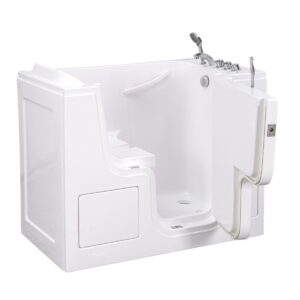
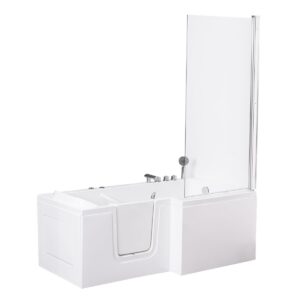
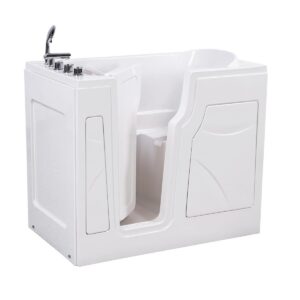
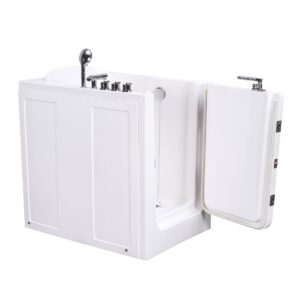
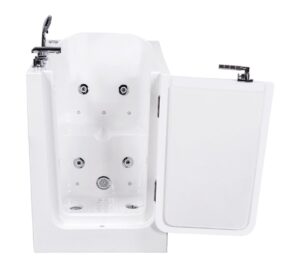
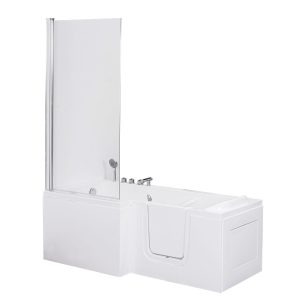
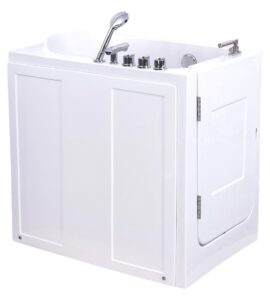
The defining feature of a walk-in bath isn’t the seat or the jets. It’s the door.
The user opens a low-threshold door, steps through, and sits on a built-in seat. They don’t climb over a rim. They don’t lower into a deep well. They walk in – at standing height – and sit down.
Here’s the thing. That one design decision removes the primary mechanical problem for the carer. There’s no rim to help someone over. No dead weight to absorb at an awkward angle. No lowering into depth while braced against a hard acrylic edge.
The carer guides and supports. The bath architecture does the rest.
All Vidalux walk-in bath doors use a compression seal system – fully watertight, with an easy-grip handle engineered for simple operation for all abilities. That low operating force matters just as much to the carer managing entry and exit as it does to the person stepping through.
The Standard Bath Was Never Designed for Two People
This isn’t a criticism. It’s simply true.
A standard bath was designed for one able-bodied adult who steps in, lowers themselves down, washes, and gets out. It works perfectly for that. It was never designed for assisted bathing – and that gap has real physical consequences.
For a carer, a standard bath demands sustained bending at close to a right angle over a hard rim edge. It demands absorbing partial bodyweight at the moment of lowering and raising. It demands standing in a confined, often cramped space where correct posture isn’t possible. And when the person being cared for moves unexpectedly on a wet surface, the carer reacts – which is exactly when backs, shoulders, and wrists get hurt.
But isn’t this just part of caring for someone?
That’s what many carers tell themselves. And it explains why so many are doing this weekly, quietly managing the strain, reducing bathing to once a month – not by choice, but because that’s all their body can handle.
These aren’t exceptional moments. They compound. The same bend, the same grip, the same reactive bracing – repeated across weeks and months. The NHS guidance on looking after your back as a carer notes that the way carers move, lift, and handle the person they support is a significant and underreported driver of musculoskeletal problems.
Worth noting: carers often feel guilty for using technique they know is unsafe – because there is no alternative. The bathroom doesn’t give them one.
A walk-in bath does.
How the Design Changes the Body Mechanics – Section by Section

This is the part most product descriptions skip over.
They list features. They don’t explain what those features actually change for the person assisting.
The low entry threshold means the user steps through a door, not over a rim. The carer guides – but doesn’t bear the weight of someone being lowered.
The built-in structural seat is moulded into the bath body at a stable, practical height. The carer assists from a standing position alongside, not from a right-angle crouch. Think of the difference between helping someone into a chair versus lowering them into a deep sofa – the chair requires steadying, not carrying.
The wide access door gives the carer room to stand alongside naturally. Not reaching across. Not twisted at the hip.
The slip-resistant internal base removes the probability of sudden, unpredictable movement. Carers brace reactively – when footing is predictable, that reflex is less needed.
The easy-grip door handle is designed for simple operation for all abilities. That matters to the user entering the bath. It also matters to the carer helping manage entry and exit.
Every one of these is standard across the Vidalux walk-in bath range – not an upgrade, not a premium option. They’re part of the core design because assisted bathing situations are one of the primary use cases the range was built around.
The Detail Most Carers Don’t Notice Until It’s Too Late
Carer strain isn’t just about posture. It’s about time.
Every minute spent in a bathroom in a physically demanding position adds to the cumulative load. A session that takes 40 minutes exposes the carer to twice as much physical stress as one that takes 20.
This is why fill and drain speed matters – not just for the person waiting in a cooling bath, but for the carer standing beside it.
Vidalux walk-in baths use hi-flow mixer taps for fast filling, and dual-waste outlets premoulded into the bath shell for faster draining. Dual-waste drainage works like having two exit routes instead of one – the water clears significantly faster than single-outlet designs.
Put simply: a faster bath is a shorter assisted bathing session. Across a year of regular baths, that difference adds up considerably.
When the Person Bathing Feels Safer, So Does the Carer
There’s a physical dimension to this that’s easy to underestimate.
A significant portion of carer back strain is reactive. It’s not the planned movement that causes injury – it’s the unplanned one. The sudden shift. The slip that almost happened. The body bracing at the wrong moment.
Concern about falls during transfers is one of the most consistently described anxieties among family carers. The combination of water, a confined space, and an unsteady person makes carers hypervigilant – and sustained hypervigilance is its own form of physical and mental load.
The slip-resistant internal base reduces the chance of that sudden movement happening.
The structural built-in seat means the person bathing has consistent, stable seating – not a precarious position the carer is constantly monitoring.
The fully watertight door uses a compression seal on all models – both inward and outward opening – engineered for long-term reliable operation. That reliability removes an anxiety carers rarely mention but consistently carry.
Does this mean the carer can fully relax?
Not completely – and we wouldn’t suggest otherwise. But there’s a meaningful difference between assisting in a controlled, well-designed environment and assisting in one that requires constant reactive vigilance. The first is sustainable. The second is exhausting.
The Vidalux Approach – Built With Both People in Mind
Assisted bathing isn’t an afterthought in the Vidalux walk-in bath range. It’s a core use case the range was engineered around.
The seat height, the door mechanism, the drainage speed, the slip-resistant base – these aren’t features listed because they sound good on a specification sheet. They’re the result of engineering decisions made by people who have worked in real homes, seen real bathrooms, and understood what assisted bathing actually demands.
Professionals who support families through these transitions consistently observe something worth taking seriously: well-planned bathing adaptations, installed early, are more effective and less disruptive than reactive changes made after an injury or a fall. A walk-in bath is exactly this kind of proactive decision. Models like the Ashford 1350 and Denton 1300 – both 700mm wide with low-entry doors – are particularly suited to assisted bathing situations where space is limited.
It doesn’t solve everything. But it removes a significant portion of the physical demand that accumulates, quietly and relentlessly, when a standard bath is the only option.
Explore the full range of Vidalux walk-in baths.
A Note on Caring for Someone at Home
Changing a bathroom for someone you love isn’t a small decision. It involves cost, disruption, and the particular weight of acknowledging that things are changing.
Vidalux understands that. The range was designed for this situation – not as a luxury upgrade, but as a practical, reliable answer to a real problem.
Review the options. See what fits your home and your situation. Then decide.
Designed for the person in the bath. And the person beside it.
Frequently Asked Questions
Q: How does a walk-in bath reduce back strain for caregivers?
A: A walk-in bath reduces carer back strain by removing the need to help someone over a raised bath rim. The user enters through a low-threshold door and sits on a built-in moulded seat – eliminating the sustained bending, weight-bearing, and reactive bracing a standard bath demands from the person assisting.
Q: Is a walk-in bath designed with the carer in mind, as well as the person using it?
A: Yes – Vidalux walk-in baths are designed with both people in mind. The low-entry door, easy-grip handle, built-in seat, wide access, and slip-resistant base all reduce physical demand on the carer. Assisted bathing is a core use case the range was engineered around.
Q: What features of a walk-in bath make assisted bathing physically easier?
A: The features that make assisted bathing easier include a low-threshold entry door, a built-in moulded seat at a stable height, a slip-resistant internal base, wide door access with an easy-grip handle, and hi-flow mixer taps with dual-waste outlets – reducing both physical effort and total time in the bathroom.
Q: Do I need to lift someone into a walk-in bath?
A: No – a walk-in bath does not require lifting. The user enters through a door at standing height, steps over a low threshold, and sits on the built-in seat. The carer guides and supports, but the design removes the need to lower someone over a rim or into depth.
Q: Which walk-in bath models are recommended for assisted bathing at home?
A: For assisted home bathing, the Ashford 1350 and Denton 1300 are both well-suited options – each 700mm wide with low-entry door access, designed for easier access and tighter spaces. The full range is available here.
Q: How does bathing time affect the carer’s physical strain?
A: Bathing time directly affects carer strain – longer sessions mean extended physical effort in a confined space. Vidalux walk-in baths use hi-flow mixer taps for fast filling and dual-waste outlets premoulded into the bath shell, helping reduce the overall time spent at each assisted bathing session.
Q: When should a family consider a walk-in bath – before or after a carer injury?
A: A walk-in bath delivers most value when installed as a proactive adaptation – before a fall or injury occurs. Professionals who support families in these situations consistently observe that earlier specialist bathing solutions reduce both disruption and risk compared to reactive changes made after an incident.
Q: Can a walk-in bath help prevent carer injury?
A: A walk-in bath removes many of the postural demands that contribute to carer strain – sustained bending over a rim, weight absorption during transfers, and reactive bracing on slippery surfaces. No product can guarantee prevention of injury, but the design significantly reduces the physical load on the person assisting.
- About the Author
- UK’s best-rated?

With over 22 years in the home spa industry, Andrew has overseen every stage of the journey—from initial product design and manufacturing to final installation. An author of multiple technical publications and scientific papers, he founded Vidalux to replace industry hype with engineering-led reliability. His focus remains on delivering gym-quality wellness through honest design and technical truth.
DISCLAIMER: All specifications, claims, and advice relating to any internal or external procedure, practise, product, or service were true at the time of writing. For more accurate and up-to-date details in relation to Vidalux services, please visit the relevant dedicated on-site page. For any product-related information, specifications, or guidance, the information on the product page should be considered the governing source.
Ready to choose?
Browse the full Vidalux range of saunas, steam showers, baths and shower cabins, all in one place