Designing a Dementia-Safe Bathroom: Why Colour Contrast and Familiar Controls Reduce Confusion
You stand outside the bathroom door, bracing yourself. The simplest part of the day has become the hardest.
What looks like stubbornness is almost always perception. Dementia changes the way the brain interprets what the eyes see – and when a bathroom isn’t designed with that understanding, every surface and every control becomes a source of confusion. Dementia-safe bathroom design isn’t about clinical adaptations. It’s about making a familiar space visible, understandable, and calm again.
Why Bathing Becomes So Distressing

Dementia physically changes the brain’s ability to interpret what the eyes see – and that makes an ordinary bathroom deeply disorientating.
As dementia progresses, it damages the visual cortex – the part of the brain responsible for interpreting what you see. Contrast sensitivity drops. Depth perception distorts. Colours blend together.
The result? A white toilet against a white wall can become genuinely invisible. Glossy tiles look wet. A dark bathmat appears to be a hole in the floor. Patterned flooring creates obstacles that aren’t there.
And the water itself?
Some people with dementia describe shower spray as feeling like needles. Others don’t recognise their own reflection in glass screens – and believe a stranger is in the room.
This isn’t behavioural. It’s neurological. Understanding that changes everything about how you approach the bathroom.
The Power of Colour Contrast (The 30-Point Rule)
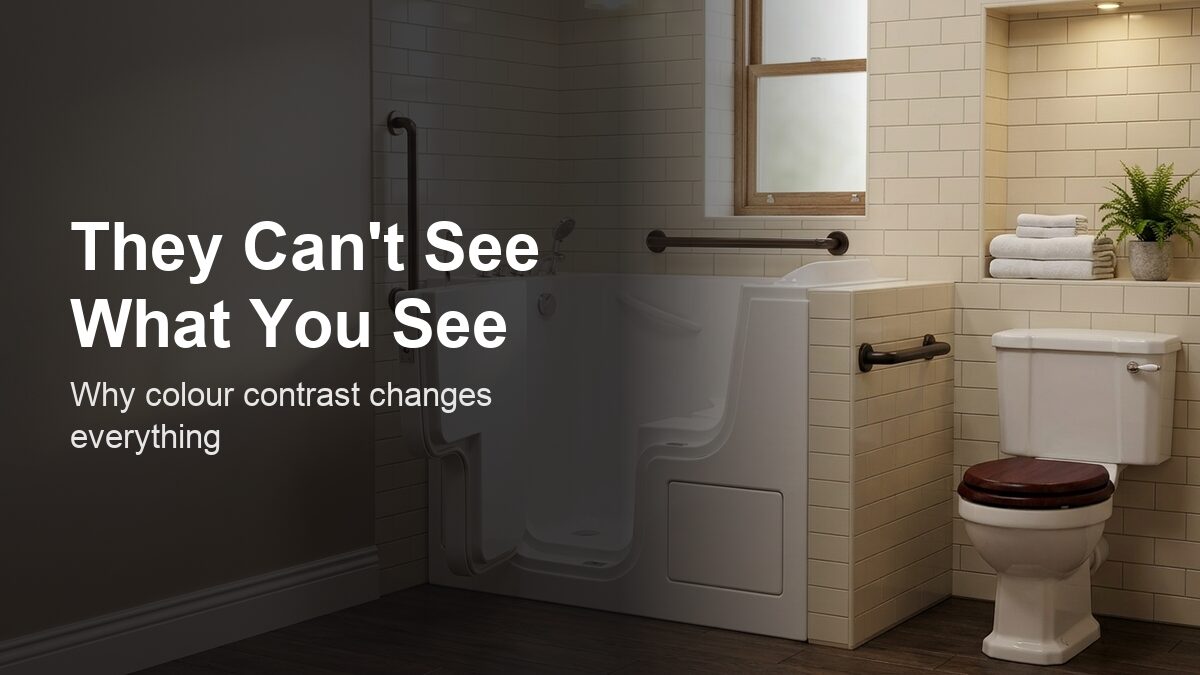
If you take one thing from this article, let it be this: colour contrast is the single most impactful change you can make.
The University of Stirling’s Dementia Services Development Centre and BS 8300 building regulations both recommend a minimum 30 Light Reflectance Value (LRV) point difference between adjacent bathroom surfaces. LRV measures how light or dark a surface appears on a scale of 0 to 100. The greater the gap between two numbers, the easier it is to tell one surface from another.
Think of it like road markings. White lines on dark tarmac are obvious. White lines on pale concrete? Almost invisible. The same principle applies to every surface in a dementia-friendly bathroom.
So what does that look like in practice?
A dark toilet seat on a white pan. Grab rails that contrast clearly with the wall behind them. Non-reflective, single-colour flooring that’s visibly different from the bath base. Door handles that stand out against the door.
Worth noting: there’s a common myth that everything must be red. It doesn’t. Any colour works as long as it provides sufficient contrast with what’s beside it.
One detail that catches people out – threshold strips between rooms should stay within 10 LRV points of the surrounding floor. Otherwise, the person may perceive a step that isn’t there.
Simple Controls, Familiar Layouts – Designing for Recognition
Modern doesn’t always mean better. Not for this.
People with dementia retain long-term procedural memory longer than most other cognitive functions. A traditional lever tap or cross-head handle – the kind they’ve used for decades – is far more recognisable than a push-button or infrared sensor. Familiar layouts reduce confusion. Unfamiliar technology increases it.
What about scalding risk?
This is where thermostatic mixing valves matter. A TMV2-approved valve – the domestic standard – automatically limits water temperature to a safe maximum, typically 44°C. It removes the scalding risk without the person needing to understand or operate the valve at all.
Clear “hot” and “cold” labelling on taps supports whatever cognitive function remains. And high-flow taps reduce filling time – meaning less time sitting in an empty bath, cold and confused, waiting for water. Overhead rain shower heads should be avoided entirely, as they can cause fright and disorientation.
Walk-In Baths – Why Access Design Matters for Dementia
A standard bath asks a lot. Step over a high rim. Lower yourself down. Get back up when you’re done.
For someone with impaired depth perception and altered spatial awareness, that rim might as well be a wall. It’s a fall risk, a fear trigger, and a physical strain for the carer.
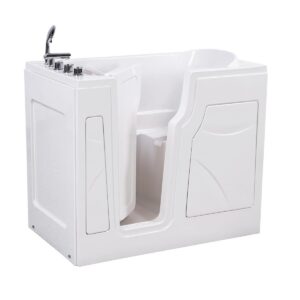
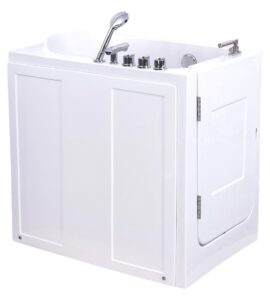
A walk-in bath with a low step-in threshold, wide access door, and built-in seating removes the most dangerous barriers in one change. No climbing. No lifting. No negotiation with a rim the person can’t judge the height of.
But won’t they sit there cold while it fills?
This is the engineering detail that separates a well-designed walk-in bath from a poor one. Hi-flow mixer taps minimise fill time. Dual fast-flow waste outlets – think of it like having two exit doors instead of one – drain the bath significantly faster, so the person isn’t sitting cold waiting to get out. Slip-resistant internal surfaces provide grip without looking clinical. And the door should operate with minimal force and no awkward twisting – because a complicated latch is just another barrier.
Vidalux walk-in baths are built around exactly these principles. Every model comes with hi-flow mixer taps pre-fitted, dual fast-flow waste outlets, an easy-grip door handle, reinforced premium acrylic on a steel support frame, and a fully watertight door system. The range is built for users with limited mobility, older adults, and carer-assisted bathing – with spare parts readily available, because a bathroom adaptation is a lasting investment.
Getting Help – OT Referrals, Funding, and Where to Start
You don’t have to work this out alone.
An occupational therapist (OT) is the gateway to bathroom adaptations in the UK. You can request an assessment through your GP, local authority adult social care, or by self-referring directly. The OT visits the home, assesses functional barriers, and recommends specific modifications.
What about cost?
The Disabled Facilities Grant (DFG) provides up to £30,000 in England (£36,000 in Wales) for eligible adaptations. People with dementia qualify. Small changes under £1,000 – handrails, contrasting toilet seats, lever taps – are often provided free through local authority services.
One thing to consider: adapt early. Both the Alzheimer’s Society and dementia design specialists recommend making changes while the person can still familiarise themselves with the new layout. Research from the BATH-OUT study found that accessible adaptations improved perceived ease of bathing from 30 out of 100 to 91 – and independence in bathing rose from 54% to 85%.
See the walk-in bath range and find a model suited to your situation.
Frequently Asked Questions
Q: What is dementia-safe bathroom design?
Dementia-safe bathroom design uses colour contrast, simplified controls, and anti-scald protection to reduce confusion and fall risk. The goal is to make every surface visible and every control familiar, supporting safer and more dignified bathing.
Q: Why does colour contrast help someone with dementia?
Colour contrast helps because dementia reduces contrast sensitivity, making same-coloured surfaces blend together. A minimum 30 LRV point difference between adjacent surfaces – such as a dark toilet seat on a white pan – helps the person identify fixtures clearly.
Q: What is a thermostatic mixing valve and why does it matter?
A thermostatic mixing valve (TMV) automatically limits water temperature to a safe maximum, typically 44°C. This removes the scalding risk for someone with dementia who may not sense when water is dangerously hot.
Q: Are walk-in baths suitable for someone with dementia?
Walk-in baths with a low step-in threshold, built-in seat, simple controls, and fast fill-and-drain times can support safer bathing for someone with dementia. They remove the need to climb over a high bath rim, which is a major fall and confusion risk.
Q: Can I get funding for a dementia-friendly bathroom adaptation?
The Disabled Facilities Grant (DFG) provides up to £30,000 in England for eligible adaptations. People with dementia qualify. An occupational therapy assessment is required, and small adaptations under £1,000 are often provided free through local authority services.
Q: Should I adapt the bathroom early after a dementia diagnosis?
Early adaptation is recommended by the Alzheimer’s Society and dementia design specialists. Making changes while the person can still familiarise themselves with new fixtures reduces the risk of them refusing to use an unfamiliar bathroom later.
- About the Author
- UK’s best-rated?

With over 22 years in the home spa industry, Andrew has overseen every stage of the journey—from initial product design and manufacturing to final installation. An author of multiple technical publications and scientific papers, he founded Vidalux to replace industry hype with engineering-led reliability. His focus remains on delivering gym-quality wellness through honest design and technical truth.
DISCLAIMER: All specifications, claims, and advice relating to any internal or external procedure, practise, product, or service were true at the time of writing. For more accurate and up-to-date details in relation to Vidalux services, please visit the relevant dedicated on-site page. For any product-related information, specifications, or guidance, the information on the product page should be considered the governing source.