Bathroom Adaptations for Reduced Mobility: Why Safe Entry and Stable Seating Matter
For many stroke survivors, the bathroom becomes the most frightening room in the house.
Not the stairs. Not the kitchen. The bathroom – where wet tiles, high bath rims, and nothing solid to grip turn a routine task into something you dread. If you’re researching bathroom adaptations after a stroke – for yourself or someone you love – that fear is completely rational. According to a systematic review of fall risk in stroke survivors, approximately half of stroke patients experience at least one fall in the first year post-stroke, and bathrooms are a key risk area.
The right adaptations don’t just reduce that risk. They restore something deeper – the confidence to manage personal care safely and with dignity.
Why Bathrooms Become a Risk Area After a Stroke
The bathroom concentrates more fall hazards in less space than anywhere else in the home. For a stroke survivor with one-sided weakness, that combination – wet surfaces, high entry points, and nothing solid to grip – creates real danger from tasks that most people don’t think twice about.
One-sided weakness changes everything about how you move through a bathroom.
Hemiparesis – the partial paralysis affecting one side of the body after many strokes – makes movements most people take for granted feel dangerous. Lifting a leg over a bath rim. Turning around in a shower. Reaching across to adjust the temperature.
What do people grab when they feel unsteady? Whatever’s closest – towel rails, basin edges. The problem is that standard bathroom fixtures aren’t designed to bear a person’s weight. Wall-hung basins can pull away from the wall. Towel rails flex or snap.
The knock-on effect goes beyond the physical. Many survivors begin avoiding bathing altogether, dreading “shower day.” Carers describe it as one of the most stressful parts of their routine. That loss of privacy and independence feeds into low mood and reduced motivation to engage with rehabilitation.
It doesn’t have to stay that way.

The Adaptations That Make the Biggest Difference
Most bathroom fall risks have practical, proven solutions. An occupational therapist can assess your specific situation, but these are the adaptations recommended most often.
- Grab rails – properly fixed to studs or reinforced walls at transfer points: beside the bath, next to the toilet, and at the bathroom door. Suction-cup rails are not a safe substitute.
- Non-slip surfaces – textured mats or integrated slip-resistant flooring inside the bath and across the bathroom floor.
- Lever taps – the detail that makes the biggest difference for one-handed use. Standard twist taps require grip strength and two-handed coordination. Lever taps can be operated with a single hand, or even a forearm.
- Stable seating – a properly rated shower seat or built-in bath seat removes the need to stand throughout the entire wash.
- Clear floor space and good lighting – trip hazards and poor visibility both increase risk, particularly when spatial awareness has been affected.
Worth noting: these aren’t luxuries. Bathing is one of the core activities of daily living that therapists use to measure functional independence after stroke. Getting it right matters.
One-Handed Use – The Detail Most People Overlook
After a stroke, many people have reliable use of only one hand – and that single change makes standard bathroom controls surprisingly difficult.
Grab rails and non-slip mats get discussed often. Tap design rarely does.
Twist taps need grip and rotation. Cross-head taps are worse. And reaching across the body to the “wrong” side can throw off balance entirely.
Lever-style taps solve this cleanly. A simple push or lift – no gripping, no twisting.
But what about other controls? The same logic applies to door handles, waste plugs, and temperature adjustments. Think of it like redesigning a cockpit for single-handed operation – every switch needs to be reachable, intuitive, and low-effort. When balance is fragile, you can’t afford to wrestle with your own bathroom.
How Walk-in Baths Support Balance Confidence
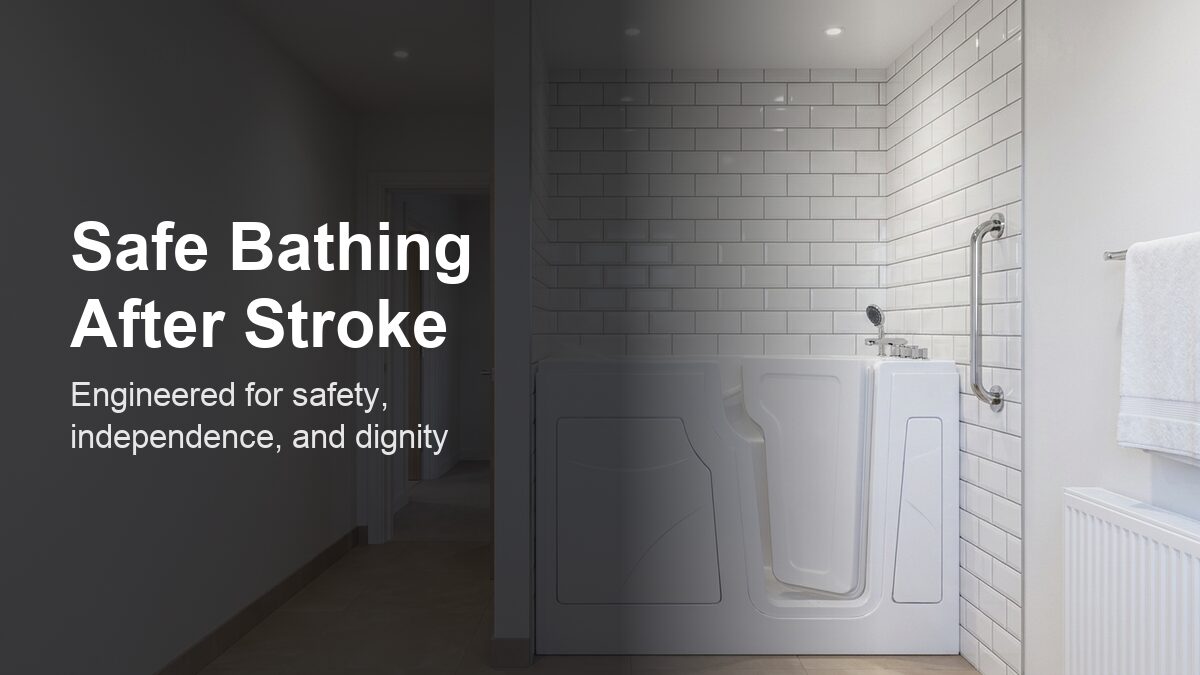
Grab rails and lever taps address individual risks. A purpose-built walk-in bath addresses several at once.
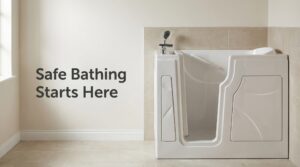
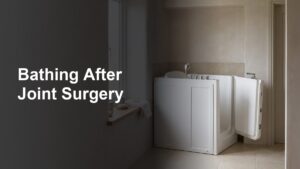
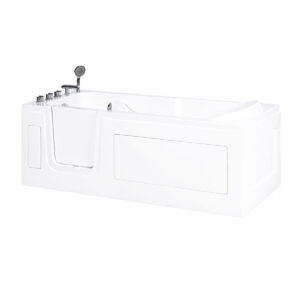
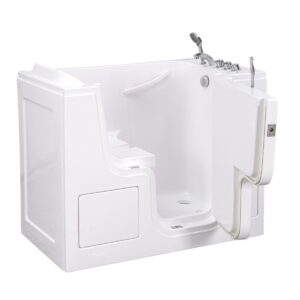
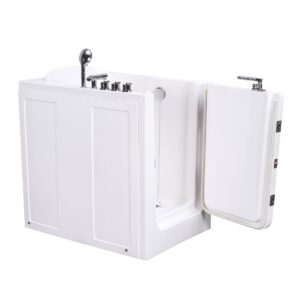
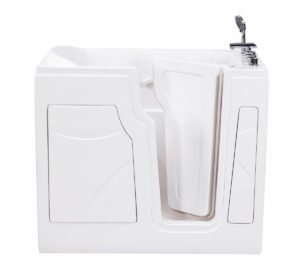
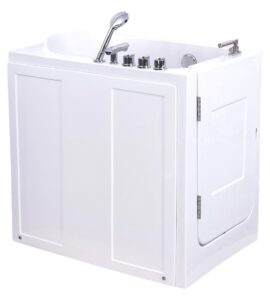
The most dangerous movement for someone with hemiparesis is stepping over a high bath rim on one weak leg. A walk-in bath removes that movement entirely – a low step-in threshold and a wide access door mean you walk in rather than climb over. Inside, a built-in seat at a height optimised for stability provides a secure base. Slip-resistant internal surfaces reduce the risk of sliding.
But won’t you sit cold while it fills? A fair concern. High-flow mixer taps – included and pre-fitted on every model – minimise fill time, and dual waste outlets drain significantly faster than single-outlet designs. Think of it like having two exit doors instead of one – the bath empties faster, so you’re not waiting around getting cold.
Door engineering matters too. A walk-in bath door that’s stiff or awkward to latch defeats the purpose. Vidalux walk-in bath doors are engineered for minimal force and no awkward twisting – with left-hand and right-hand opening positions available depending on the model. That flexibility is important when one side of the body is stronger than the other.
Every model sits on a steel support frame with a reinforced acrylic shell – warm to the touch, non-porous, and built for years of daily use.
Why Bathroom Independence Supports Recovery
Occupational therapists don’t recommend bathroom adaptations simply to prevent injuries. There’s a deeper reason.
Fear of falling creates a cycle. A fall – or even a near-miss – breeds anxiety. Anxiety leads to avoidance. Avoidance weakens muscles and balance further, which increases fall risk again. The Stroke Association notes that balance problems after a stroke can leave people worried about falling and less confident about moving around.
Safe adaptations break it. When a stroke survivor manages a bath or shower independently – safely, without panic – it rebuilds belief that daily life is manageable. Therapists note that success with personal care tasks is linked to improved confidence, lower depression risk, and greater willingness to keep engaging with rehabilitation.
Put simply: a safe bathroom doesn’t just prevent falls. It gives someone a reason to keep going.
The Vidalux Approach
Every Vidalux walk-in bath is built around three principles: safety first, fast and dignified bathing, and true engineering reliability.
That means high-flow mixer taps and dual waste outlets as standard on every model. Easy-grip door handles designed for all abilities. Slip-resistant internal textures. Built-in seating. Reinforced acrylic on a steel support frame. And spare parts readily available – because a product someone depends on daily must be supportable for years.
For those who want additional comfort, whirlpool versions offer gentle hydromassage that supports relaxation and comfort for sore muscles.
No gimmicks. No unnecessary complexity. Dependable, thoughtfully engineered bathing – designed by people with decades of hands-on installation experience.
See how we support safer bathing.
Frequently Asked Questions
Q: How do I make a bathroom safe after a stroke?
Making a bathroom safe after a stroke involves fitting properly secured grab rails at transfer points, adding non-slip surfaces inside the bath and on the floor, installing lever taps for one-handed operation, and providing stable seating. An occupational therapist can assess your specific needs.
Q: Are walk-in baths good for stroke recovery?
Walk-in baths support safer bathing after a stroke by offering a low step-in threshold, built-in seating, and easy-grip controls – reducing fall risk and supporting independence. They do not treat stroke but remove common bathroom hazards.
Q: How do you prevent falls in the bathroom after a stroke?
Preventing bathroom falls after a stroke means reducing the movements that cause them – stepping over high rims, standing on wet surfaces, and reaching across the body. Grab rails, non-slip flooring, lever taps, and low-threshold entry all address these specific risks.
Q: Can a walk-in bath improve balance confidence?
A walk-in bath supports balance confidence by removing the need to step over a high rim and by providing a stable built-in seat. Combined with grab rails and slip-resistant surfaces, this reduces the fear of falling that often limits post-stroke independence.
Q: What bathroom features help with one-sided weakness after a stroke?
One-sided weakness (hemiparesis) makes grip-and-twist movements difficult. Lever taps, easy-grip door handles, grab rails positioned on the stronger side, and controls reachable from a seated position all support safe one-handed use.
Q: Are walk-in baths available with left-hand or right-hand door access?
Yes. Vidalux walk-in baths are available in both left-hand and right-hand opening configurations depending on the model, so the door can be positioned on whichever side suits the user’s stronger hand.
- About the Author
- UK’s best-rated?

With over 22 years in the home spa industry, Andrew has overseen every stage of the journey—from initial product design and manufacturing to final installation. An author of multiple technical publications and scientific papers, he founded Vidalux to replace industry hype with engineering-led reliability. His focus remains on delivering gym-quality wellness through honest design and technical truth.
DISCLAIMER: All specifications, claims, and advice relating to any internal or external procedure, practise, product, or service were true at the time of writing. For more accurate and up-to-date details in relation to Vidalux services, please visit the relevant dedicated on-site page. For any product-related information, specifications, or guidance, the information on the product page should be considered the governing source.