Why Is My Infrared Sauna Slow to Heat Up? What the Display Doesn’t Tell You
You turned the cabin on a while ago. The display is still climbing, the number looks low, and you’re starting to wonder whether something has gone wrong.
An infrared sauna slow to heat up often isn’t faulty. In most cases the heaters are working normally and the display is measuring something different from what you expected, or a setting, a vent or a cold room is holding the air temperature back. This guide takes each cause in the order we’d check it, and explains how warm-up works on traditional and hybrid models as well.
Why Is My Infrared Sauna Slow to Heat Up?
Most of the time the heaters are working normally and it’s the display that looks slow. The number on the panel is the air temperature, and infrared warms your body directly while the air in the cabin rises more gently around you.
Traditional saunas work the other way round. A stove heats the air, the air heats you, and a high reading is the whole point of the session. Infrared heaters send their warmth straight to your skin, which is why infrared sessions run at lower air temperatures.
According to a 2018 systematic review in Evidence-Based Complementary and Alternative Medicine, infrared saunas “generally run at lower temperatures (45–60°C) than Finnish saunas”. Vidalux’s own guidance puts a traditional sauna at 70°C to 85°C. The idea that an infrared cabin has to reach 70°C or more before it’s doing anything is a myth. Infrared uses wavelengths of light that warm the body directly, so it gives comfortable warmth at a lower air temperature. If you judge an infrared sauna by the figure a traditional sauna would show, it will always look slow, however well it’s working.
If you’re new to infrared, there’s a separate guide on sauna temperature and session timing that sets out what a comfortable session looks like.
So how do I know it’s working?
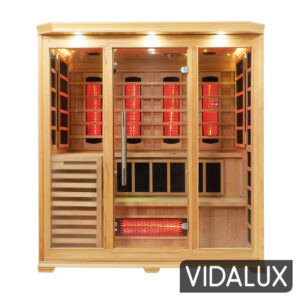
Sit in the cabin a little while after turning it on and you should feel warmth on your back, legs and feet before the air reading reaches its top figure. On Vidalux Complete Heat cabins, the Carbon Fibre Ruby Quartz Glass Full Spectrum Heaters sit behind the backrest, close to large muscle groups, and begin warming as soon as the cabin is on. The Nano-Carbon Crystal heaters on the walls and floor spread a wider, even warmth across the rest of the space.
If you feel little or nothing after a reasonable wait, the checks below are where to start.
Check the Heater Dial First
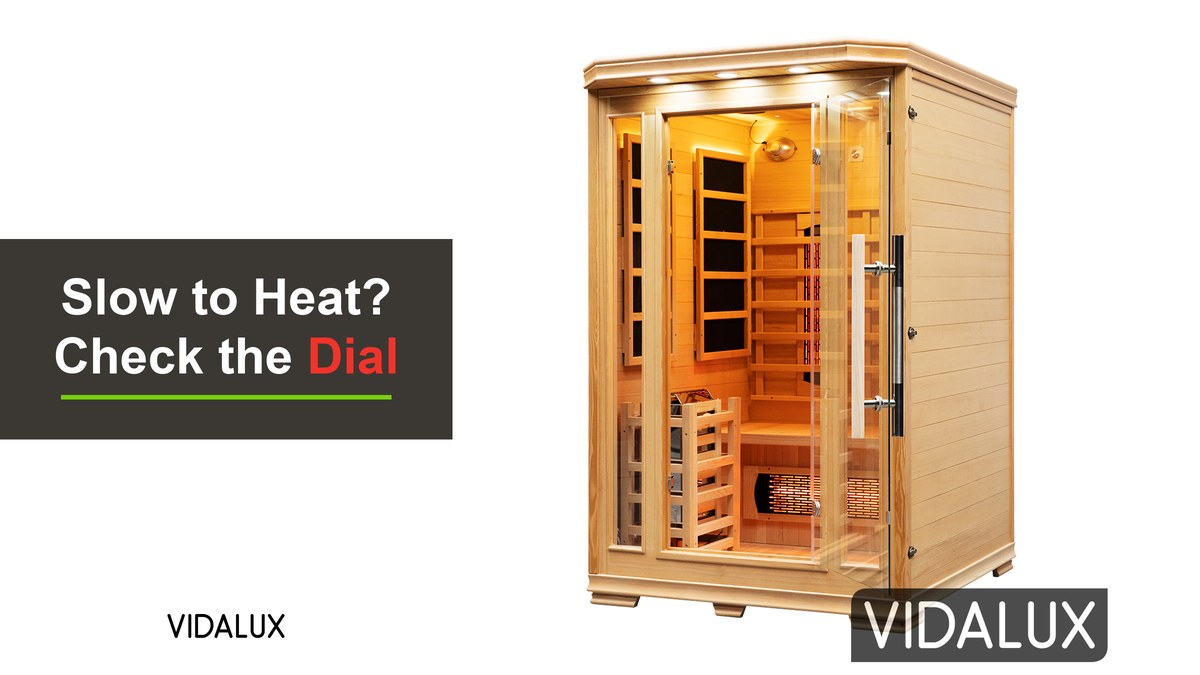
A common cause of a slow warm-up on a Vidalux infrared sauna is a heater dial set below maximum. It’s an easy thing to miss, and it’s the check Vidalux’s support team suggests when an infrared sauna is taking much longer than expected.
Every Vidalux infrared and hybrid model controls heater output with a dial that runs from 20% to 100%. Turning it down gives a gentler session once the cabin is warm. The catch is that a dial left part-way round from your last session means a slower start next time.
Leaving the dial at 40% has the same effect as a radiator valve turned half shut: the heating still works, but the room takes longer to warm.
So before you look for anything else, turn the dial up to 100% and give the cabin time to come up to temperature. Once you’re settled, you can bring it back down to whatever feels comfortable.
Close the Ceiling Vent and Check the Door
When a cabin is slow to warm, Vidalux’s support advice is to make sure the ceiling vent is closed and check that the door seals are making good contact. Both are quick to check and easy to overlook.
Vidalux cabins have a ceiling vent that can be opened or closed to regulate airflow and temperature, so its position is worth a look before anything else on this list.

Does the Room Around the Sauna Make a Difference?
Yes. The starting temperature of the room plays a major role in how long any sauna takes to warm up.
A cabin has to bring its own air up from wherever the room starts. An unheated conservatory in winter, a cold garage or an outbuilding all add time in the same way, because the cabin begins from a much lower point than it would in a heated room. The air that it draws in from the outside will also have a cooling effect on the sauna. If the sauna will sit in a cold or unheated room, expect a longer wait for the air temperature to climb. Infrared still warms your body directly in a cold room, so you may feel the heat well before the air reading catches up with it.
Is it worth warming the room first?
If the room is cold, taking the chill off it before a session gives the cabin less ground to make up. We don’t put a figure on how much time that saves, because every room is different, but it’s the simplest change you can make in winter.
Does the Heater Type Change How Fast It Feels Warm?
Heater type mostly changes where you feel the warmth first, and the room, the dial and the vent have more effect on how quickly the air reading climbs. There is no ceramic element in a Vidalux sauna.
Complete Heat pairs two carbon-based heater types. The Nano-Carbon Crystal heaters give wide, even coverage and are designed to eliminate cold spots, while the Carbon Fibre Ruby Quartz Glass Full Spectrum Heaters behind the backrest add near, mid and far infrared close to your back. Vidalux redeveloped its carbon fibre to give a 20% increase in infrared output (emissivity) compared with regular carbon fibre heaters.
Picture a desk lamp beside a ceiling light. The lamp is brighter where it points, and the ceiling light covers the room more evenly. The heaters behind the backrest and the wall heaters split the job in a similar way.
If you’re still choosing a cabin, there’s a fuller guide to how carbon and ceramic heaters compare and what each one feels like in use.
How Long Do Vidalux Saunas Take to Heat Up?
Our traditional heater models, which include the hybrid, typically heat up to an optimal temperature in as little as around 15 minutes. We don’t quote a single figure for infrared-only cabins, because the room, the dial setting and the vent all change how quickly the air reading climbs.
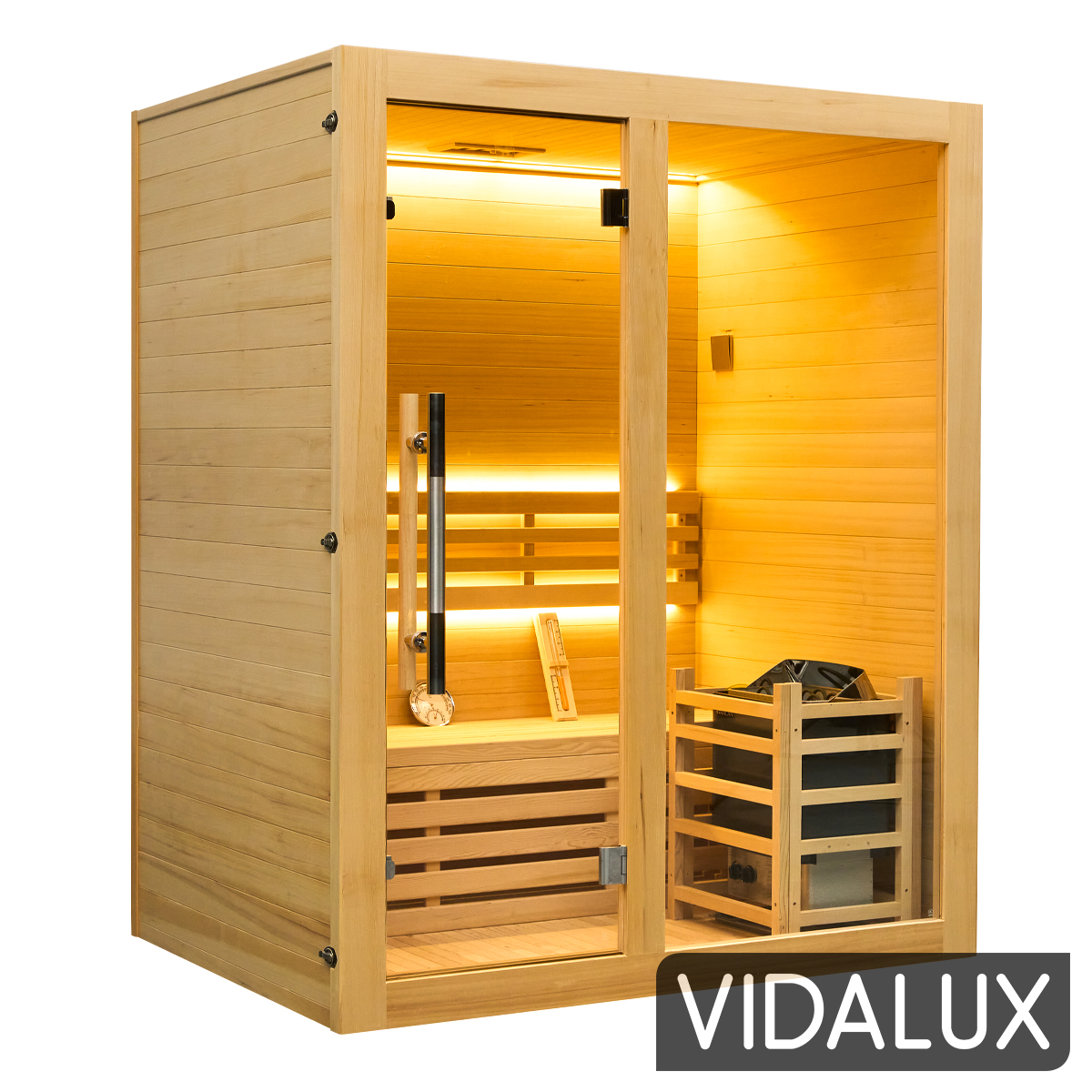
A hybrid sauna gives you two ways to heat the same cabin. The 2 Person Hybrid Sauna With Traditional & Full Spectrum Infrared Complete Heat, for example, pairs a 3kW traditional stove and 15kg of sauna stones with the Complete Heat infrared heaters in a cabin measuring 1200mm deep, 1200mm wide and 1900mm high. You use one mode or the other, never both at once, and the infrared heaters must be off when the stove is running.
The two modes also work to different ranges. On this model the infrared range runs from 20°C up to 65°C, and the traditional range runs from 20°C up to 85°C. In infrared mode, then, the display tops out lower by design, and a reading in the 50s or low 60s sits inside that range.
Why does the stove side feel quicker?
A stove’s job is to heat the air, so the number on the display is the number you feel on your skin. With infrared, the warmth reaches you first and the reading follows behind. There’s more on how air heat and body heat differ if you’re weighing up one type against the other.

When a Slow Warm-Up Needs a Second Look
If the cabin still seems slow after you’ve turned the dial to 100%, closed the vent, checked the door and allowed for a cold room, look at how evenly it heats.
All the infrared panels in a cabin should heat to the same temperature. If some stay cool or only lukewarm while others get much hotter, and that doesn’t improve after several uses, contact the Vidalux technical helpline for advice. Uneven heating of this kind may be a warranty matter, and the helpline can advise on the next step.
That’s a different situation from a cabin that heats evenly and reads lower than you expected. The first needs a call, and the second usually needs nothing more than the checks above.
Choosing an Infrared Sauna With Warm-Up in Mind
A display that climbs gently is usually a sign that infrared is doing what it was built to do. Knowing that before you buy saves a lot of clock-watching later, and it helps you judge a cabin by how it feels to sit in.
When you’re comparing cabins, look at the heater layout, the temperature range and the room you’ll put it in. You can compare those details across the infrared saunas range.
For help getting the best from a cabin you already own, our sauna guides cover cleaning, sauna stones and day-to-day use.
Frequently Asked Questions
- About the Author
- UK’s best-rated?

With over 22 years in the home spa industry, Andrew has overseen every stage of the journey—from initial product design and manufacturing to final installation. An author of multiple technical publications and scientific papers, he founded Vidalux to replace industry hype with engineering-led reliability. His focus remains on delivering gym-quality wellness through honest design and technical truth.
DISCLAIMER: All specifications, claims, and advice relating to any internal or external procedure, practise, product, or service were true at the time of writing. For more accurate and up-to-date details in relation to Vidalux services, please visit the relevant dedicated on-site page. For any product-related information, specifications, or guidance, the information on the product page should be considered the governing source.