Hemlock vs. Red Cedar: Which Sauna Wood Actually Lasts Longer in UK Homes?
If you’ve spent any time researching home saunas, you’ve probably landed on the same two names: Hemlock and Cedar. And if you’ve gone a step further – reading forums, watching reviews, comparing spec sheets – you’ve likely come away thinking Cedar is the premium choice. It’s marketed that way. It looks beautiful. It has a reputation.
But here’s the thing. Walk into a Cedar-lined sauna in a spare bedroom and the scent can fill the room in minutes. Not in a good way.
The Hemlock vs Red Cedar debate isn’t really about which wood is “better.” It’s about which wood is right for where you plan to use it – and how you want your home to smell afterwards.
This is an honest comparison. No hype. Just what actually matters for UK homes.
Canadian Hemlock (Tsuga canadensis) is a light-coloured, fine-grained softwood. It’s virtually scentless, non-allergenic, and non-toxic – with a low VOC profile that makes it ideal for enclosed spaces. When kiln-dried properly, it holds its shape well through repeated heating cycles. It’s widely considered the standard timber for quality indoor saunas.
Western Red Cedar (Thuja plicata) is the richer, darker option. Reddish-brown with a striking grain pattern, it contains natural oils called thujaplicins that make it naturally resistant to rot, decay, and insects. It’s a traditional choice for outdoor structures and high-end sauna builds.
Both are softwoods. Both are used in saunas worldwide. Neither is objectively superior – they simply suit different environments.
So why does the choice matter so much?
Because where your sauna sits changes everything. And in the UK, most home saunas don’t sit in a ventilated outhouse. They sit in a bedroom.
The Smell Test – Why Aroma Matters More Than You Think
This is where the conversation gets personal.
Cedar smells wonderful to some people. Warm, woody, distinctive. In an outdoor cabin with fresh air circulating, that scent adds to the experience.
But indoors – in a sealed spare room or a bedroom with the door closed – Cedar’s natural oils don’t just linger. They saturate. The thujaplicin compounds that give Cedar its rot resistance are the same compounds responsible for that powerful aroma. And unlike a candle you can blow out, it’s built into the walls.
Hemlock is the opposite. It has a low VOC profile and minimal resin content, so it won’t fill your room with strong aromatic oils when heated. You may notice a faint “warm wood” smell during the first few sessions, but this fades after three or four uses as the natural surface oils cure.
Here’s the honest truth? For most UK indoor installations – where saunas commonly live in bedrooms, loft rooms, or living spaces – scent neutrality isn’t a luxury. It’s a practical requirement. Hemlock is non-allergenic and non-toxic, making it ideal for users who can’t tolerate the strong aromatic oils found in woods like Cedar.
If you’re sensitive to strong scents, or if anyone in the household is, this one difference could be the deciding factor.
Durability – How Each Wood Handles Heat, Moisture, and Time
Now the headline question. Which wood actually lasts longer?
The answer depends on context.
Cedar’s natural oil content gives it genuine advantages in exposed environments. Rain, frost, insects – Cedar handles all three well without treatment. According to the USDA Forest Products Laboratory, Western Red Cedar heartwood is rated as resistant to very resistant to decay, which is why it has long been a go-to timber for shingles, posts, and exterior cladding. For outdoor saunas in gardens and outbuildings, it’s a proven performer.
Hemlock is naturally rot-resistant too. It doesn’t need chemical treatment on internal surfaces – in fact, applying wood treatments inside a sauna is actively discouraged because heated chemicals can release fumes. Properly seasoned Hemlock is dimensionally stable, meaning it holds its shape through the expansion and contraction cycles that come with regular heating. Its low resin content also means surfaces stay clean and comfortable – no sticky residue building up over time.
But what about cracking?
Minor hairline cracks are normal in all natural sauna woods. Heat cycling causes wood to expand and contract – it’s the nature of the material. These cracks are cosmetic. They don’t affect structural integrity. This applies to both Hemlock and Cedar equally.
For indoor use, both woods perform well over the long term. Hemlock’s edge is stability – less warping, less shrinkage, and more predictable behaviour in the consistent environment of a UK home.
For outdoor use, Cedar’s oil content gives it a natural defence that Hemlock can’t match without ongoing treatment.
Put simply: indoors, Hemlock has the practical advantage. Outdoors, Cedar earns its reputation.
Indoor vs. Outdoor – Matching the Wood to the Setting
Think of it like choosing shoes for the occasion. You wouldn’t wear walking boots to a dinner, and you wouldn’t wear brogues on a hillside. Both are good shoes. Context decides.
Indoor saunas (bedroom, spare room, loft)
Hemlock is the preferred choice here. Non-allergenic, virtually scentless, and dimensionally stable in the consistent temperatures of a UK home. Its low VOC profile means a safe, clean environment every session. It won’t fill your bedroom with a woody aroma every time you run a session. It won’t warp in the dry warmth of a centrally heated house.
Outdoor saunas (garden, patio, outbuilding)
Cedar’s natural oils earn their keep outside. Exposed to rain, humidity shifts, and seasonal temperature swings, those thujaplicin compounds provide genuine weather resistance.
Worth noting: modern outdoor saunas increasingly rely on engineered weatherproofing – metal-clad roofing, ABS composite panels, sealed construction – that goes well beyond what any timber can offer alone. Wood still matters for the interior experience, but the structure’s long-term survival outdoors now depends on more than just the species you choose.
Other outdoor timber options exist too. Pine, for instance, is a traditional, proven timber for outdoor use – valued for its strength and accessibility.
Browse the full range of Vidalux outdoor saunas at https://vidalux.co.uk/outdoor-saunas/ to see what’s available for garden installations.
The Vidalux Approach – Why We Build With Hemlock

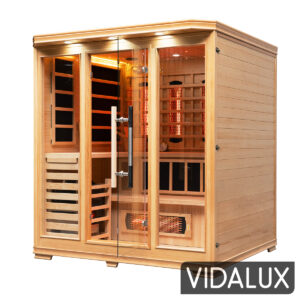
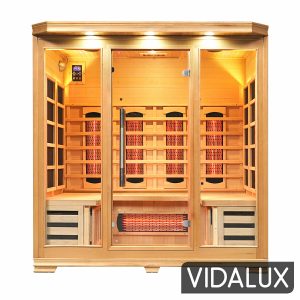
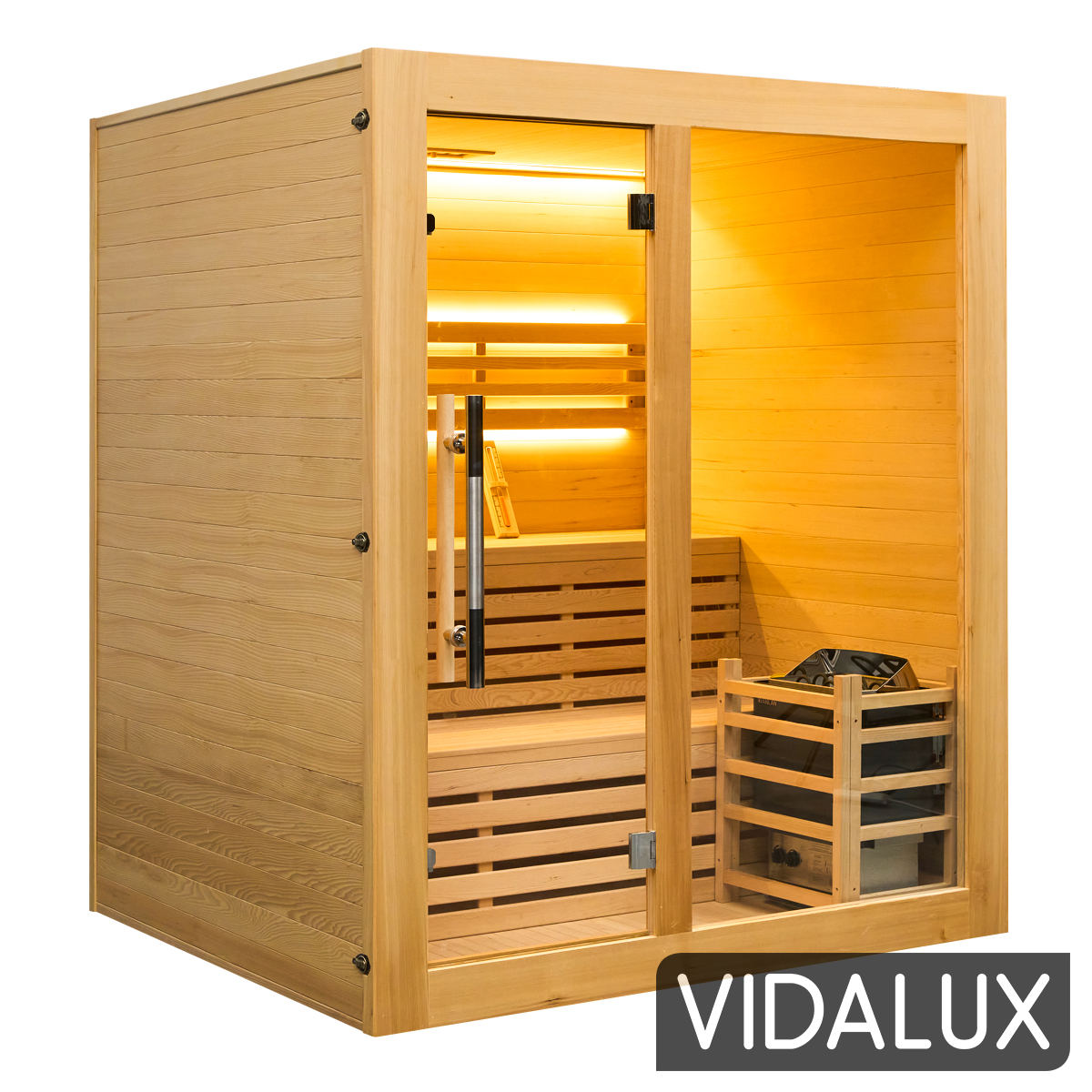
High-density, kiln-dried Canadian Hemlock is our premium indoor standard. It’s dimensionally stable – meaning it holds its shape where cheaper timbers warp. Some manufacturers hide low-grade spruce behind insulation layers and call it a sauna. Our wood does the work naturally, without needing to be masked or treated.
Does it need treating?
No. We advise against treating the internal wood at all. Heated chemicals release fumes. Hemlock’s natural rot resistance means treatment isn’t necessary – the timber performs without intervention. Its low resin content keeps surfaces clean, and its non-toxic, low-VOC composition means you’re not breathing in anything you shouldn’t be.
That stability is also part of what makes our saunas so straightforward to put together. A Vidalux infrared sauna assembles in roughly fifteen minutes with two people, needing only around 10cm of clearance above the roof – no specialist tools, no complicated fixings. The wood’s consistent dimensions are what make that clean, repeatable fit achievable.
The consistency of Hemlock isn’t just about durability. It’s about the daily experience. A sauna that doesn’t smell, doesn’t warp, and doesn’t need maintenance is a sauna you’ll actually use. That’s the point.
Explore the full Vidalux home sauna range at https://vidalux.co.uk/home-saunas/ to see the quality for yourself.
The Short Version
Both woods have genuine strengths. This isn’t a case of one being good and the other bad.
Cedar is a beautiful, aromatic timber with real advantages outdoors. If you’re building a garden sauna and you enjoy the scent, it’s a strong choice.
Hemlock is the quiet, reliable option for indoor saunas. Non-allergenic, virtually scentless, non-toxic, dimensionally stable, and naturally rot-resistant – it’s engineered for the way most UK homes actually use a sauna.
The right wood is the one that suits your space, your sensitivity, and your life.
Review the standards. Compare the craftsmanship. Explore Vidalux sauna accessories at https://vidalux.co.uk/accessories/ to complete your setup. Choose with confidence.
Frequently Asked Questions
Q: Is Hemlock or Cedar better for an indoor sauna?
A: Hemlock is generally the better choice for an indoor sauna because it is non-allergenic, non-toxic, and virtually scentless. Cedar’s natural oils produce a strong aroma that can overpower enclosed rooms – particularly bedrooms, where most UK home saunas are installed.
Q: Does Hemlock wood rot in a sauna?
A: Hemlock wood does not rot under normal indoor sauna conditions. It is naturally rot-resistant and requires no chemical treatment on internal surfaces. Proper kiln-drying further improves its stability against moisture and heat cycling over time.
Q: Does Cedar sauna wood smell strong?
A: Cedar sauna wood does have a strong, distinctive scent due to its natural thujaplicin oils. While pleasant in ventilated or outdoor spaces, the aroma can be overpowering in small indoor rooms – something worth considering before choosing Cedar for a bedroom sauna.
Q: How long does sauna wood last in the UK?
A: Sauna wood lasts many years in the UK when properly seasoned and maintained. Both Hemlock and Cedar are durable long-term choices. Minor hairline cracks from heat cycling are normal and cosmetic – they do not affect structural integrity.
Q: Can I use Cedar for an outdoor sauna in the UK?
A: Cedar can be used for an outdoor sauna in the UK thanks to its natural oil content, which resists rot and insect damage. However, modern alternatives like metal-clad roofing and ABS composite panels now offer longer-lasting, maintenance-free weatherproofing.
- About the Author
- UK’s best-rated?

With over 22 years in the home spa industry, Andrew has overseen every stage of the journey—from initial product design and manufacturing to final installation. An author of multiple technical publications and scientific papers, he founded Vidalux to replace industry hype with engineering-led reliability. His focus remains on delivering gym-quality wellness through honest design and technical truth.
DISCLAIMER: All specifications, claims, and advice relating to any internal or external procedure, practise, product, or service were true at the time of writing. For more accurate and up-to-date details in relation to Vidalux services, please visit the relevant dedicated on-site page. For any product-related information, specifications, or guidance, the information on the product page should be considered the governing source.
Ready to choose?
Browse the full Vidalux range of saunas, steam showers, baths and shower cabins, all in one place