Stove vs Infrared: The ‘Air Heat’ vs ‘Body Heat’ Engineering Guide
If you have spent a weekend reading about home saunas, you already know the noise. One camp tells you infrared is the only sensible choice. Another insists anything without a stove and stones is not a real sauna at all. Most of what you read is an argument dressed up as advice.
Here’s the thing. The question is not which type is better. It is which type solves the problem you actually have.
A Finnish sauna and an infrared sauna heat you in two fundamentally different ways. One warms the air around you. The other warms you directly. That single engineering difference shapes everything: temperature, session length, running cost, what the experience feels like, and whether it suits your home.
This guide explains the mechanism honestly, compares the numbers, and lets you pick without the pressure.
How a Finnish Sauna Actually Heats You (Convection)

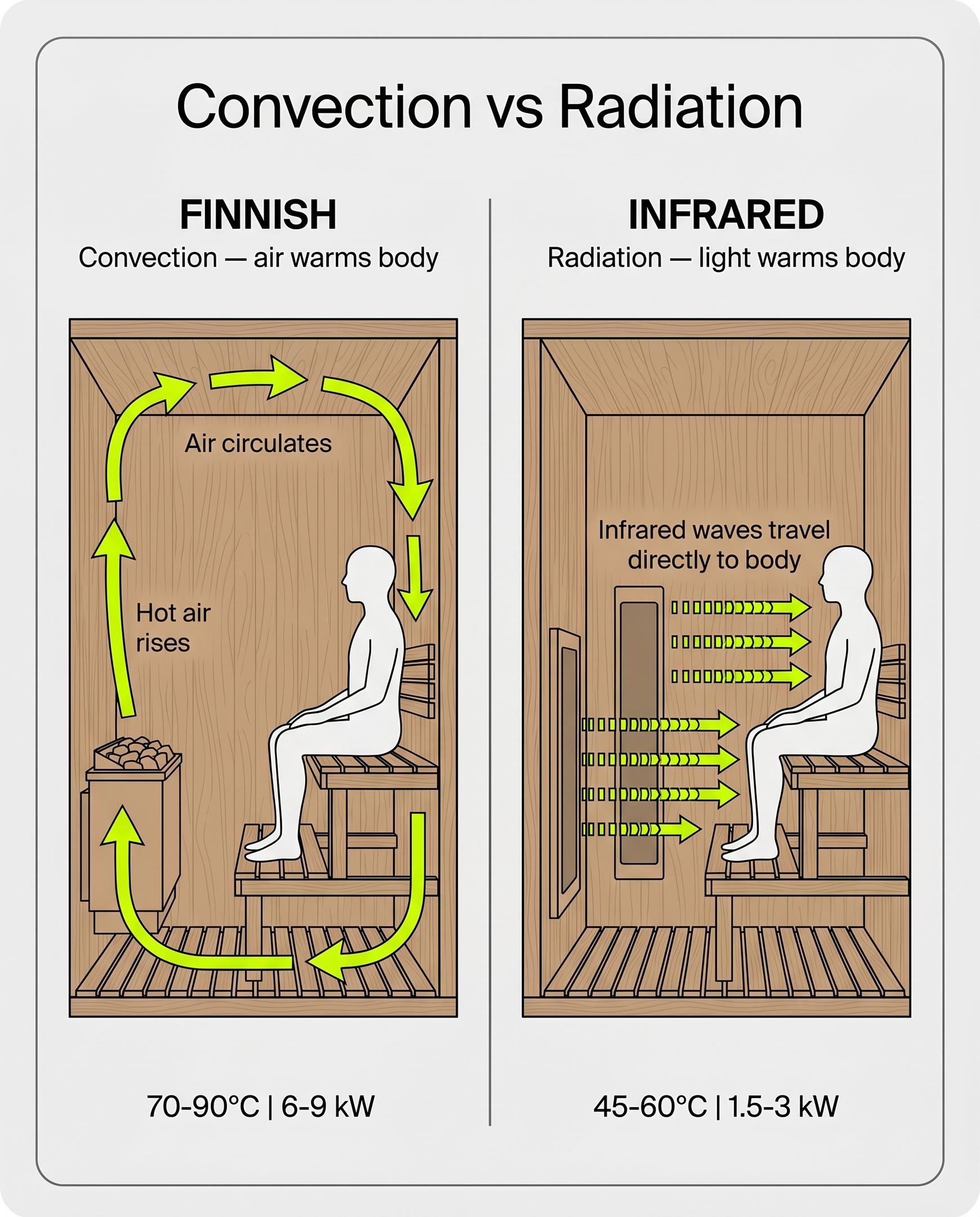
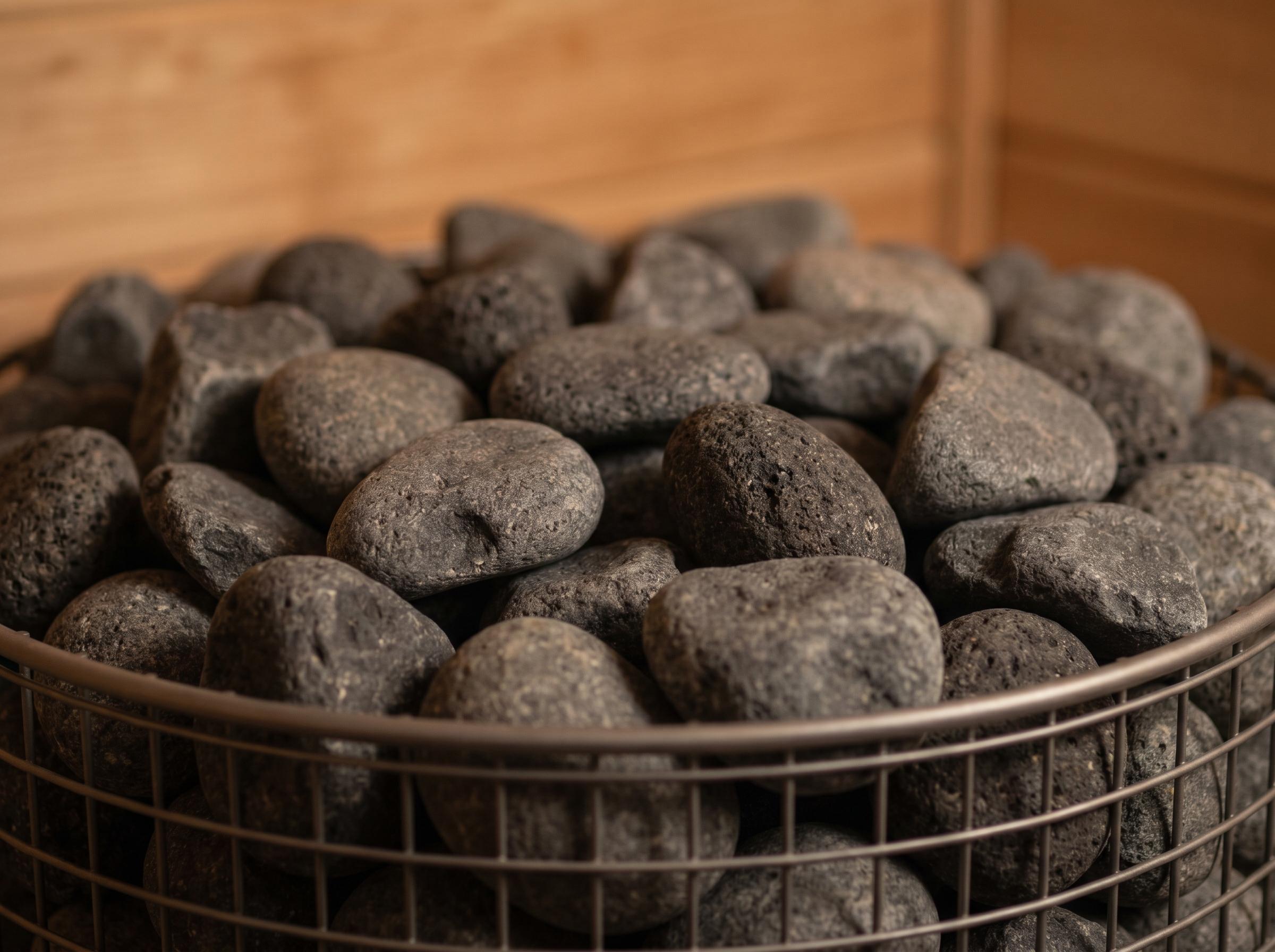
A Finnish sauna heats the air to 70-90°C using a stove and a bed of rocks, then lets that hot air surround and heat your body. The physics at work is convection – the transfer of heat through a moving fluid, in this case air.
Put simply: the stove is the engine. The air is the delivery mechanism. Your body is the destination.
Warm air rises off the stove, circulates around the cabin, and wraps you in heat from every side. Because the whole environment is hot, sweating is triggered by the room, not by anything targeting your skin directly. It is the same principle as standing in a warm greenhouse, only far more intense.
Pouring water onto the heated stones creates löyly – a burst of humidity that spreads heat more evenly and raises the perceived temperature without raising the thermostat. This is not a trick. It is the oldest part of sauna culture, and it matters: löyly is what separates a Finnish sauna from a dry electric heater in a timber box.
Sessions are short and intense. Fifteen to twenty minutes is typical. The combination of high air temperature and löyly makes longer sessions physically demanding, which is part of the design.
What does the research actually say?
A 20-year Finnish cohort study of 2,315 men, published in JAMA Internal Medicine in 2015, found that four to seven sauna sessions per week were associated with a 63% lower risk of sudden cardiac death compared to once-weekly use. The research is observational and specific to traditional Finnish sauna bathing – but it is the most substantial peer-reviewed dataset in the field, and it is why the Finnish sauna keeps its authority.
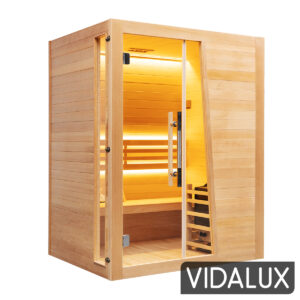
Vidalux supplies two traditional-only models, the Klassikko and the Elegant. Both arrive with a 4.5 kW traditional sauna heater, stones, water bucket, ladle, sandglass, and hygro-thermometer as standard. Everything you need to run the classic session, in the box.
How an Infrared Sauna Actually Heats You (Radiation)
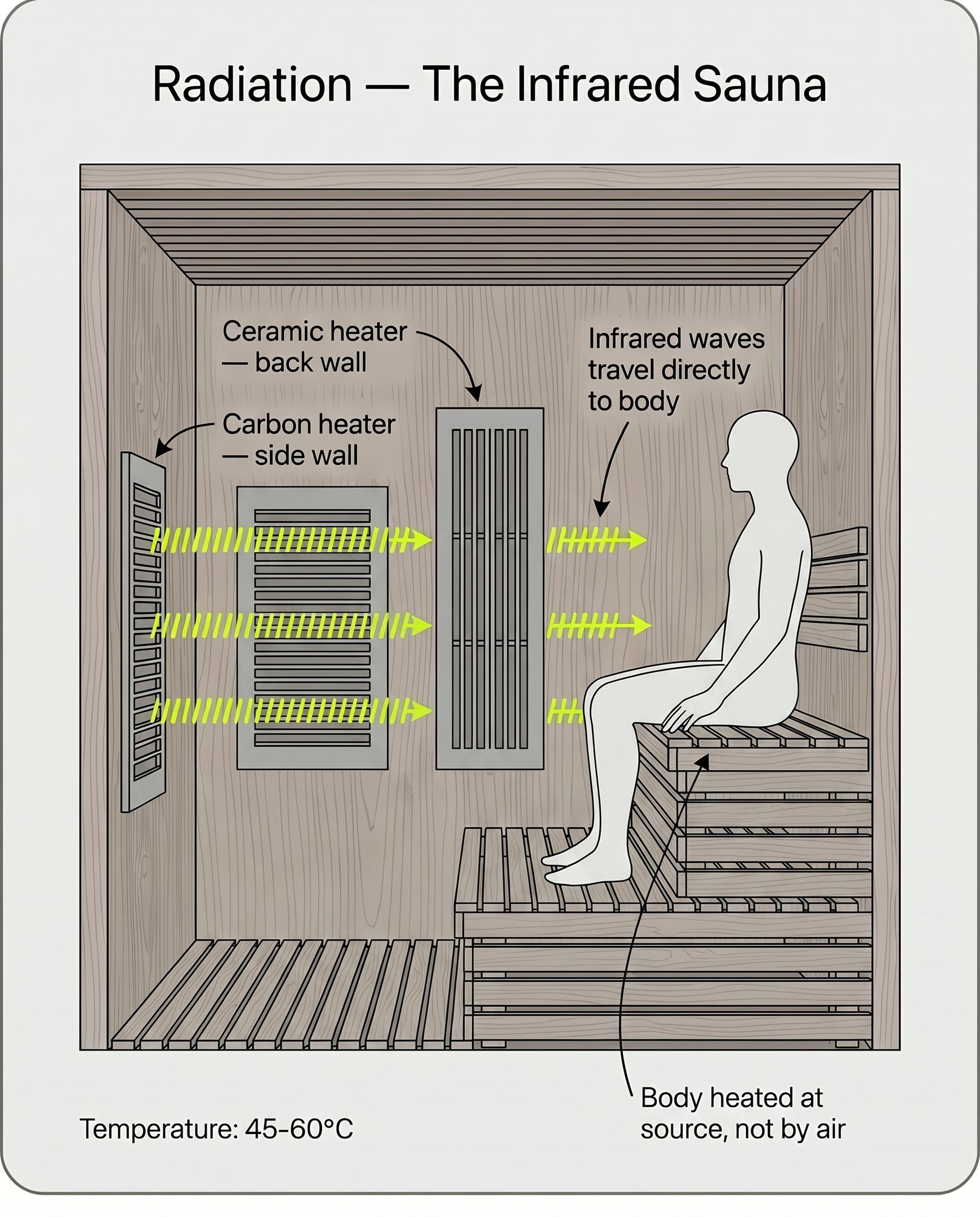
An infrared sauna does not heat the air. It uses infrared heaters to emit electromagnetic waves that pass through the surrounding air and are absorbed directly by your body. The physics is radiation – the same mechanism that lets sunlight warm your skin through a cold window on a winter morning.
Stepping from shade into sunlight is a useful analogy. The air temperature did not change. The radiation reaching your skin did.
Because the body is being warmed at source rather than through an intermediary, the cabin itself sits much cooler. Vidalux infrared saunas operate between 45°C and 60°C. The session feels gentler, the air stays breathable, and you can stay inside for 30-45 minutes without the cardiovascular demand of a 90°C Finnish stove session.
Infrared wavelengths come in three bands. Near infrared (NIR) reaches the skin surface. Mid infrared (MIR) penetrates slightly deeper, supporting circulation. Far infrared (FIR) reaches muscle tissue and raises core temperature from within. A full-spectrum system uses all three.
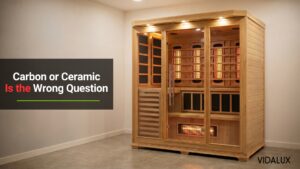
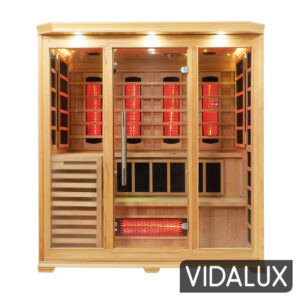
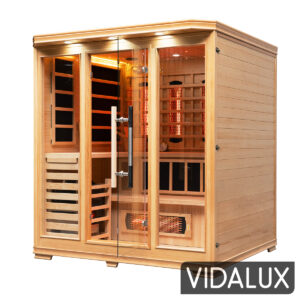
Vidalux’s Complete Heat system combines Carbon Fibre Ruby Quartz Glass Full Spectrum Heaters on the back wall for fast, direct penetration with carbon heaters on the side walls for wide, even coverage. Full-spectrum coverage, no cold zones. Vidalux pioneered the configuration, and it is now heavily copied across the industry.
But does infrared have research behind it?
It does, though the body of evidence is younger and smaller than the Finnish cohort studies. A review published in Canadian Family Physician (Beever, 2009) found preliminary moderate evidence for far-infrared sauna therapy in normalising blood pressure and supporting patients with congestive heart failure, and fair evidence for chronic pain. More recent systematic reviews have expanded the picture, particularly around musculoskeletal recovery.
Neither heat type replaces medical care. Both can support the groundwork – circulation, sweating, muscle relaxation, stress reduction – that underpins general wellbeing.
Convection vs Radiation, Side by Side
Here is what the engineering difference looks like in practice.
Feature | Finnish Sauna (Convection) | Infrared Sauna (Radiation) |
|---|---|---|
Heat mechanism | Air warms the body | Light warms the body directly |
Operating temperature | 70-90°C | 45-60°C |
Warm-up time | 30-40 minutes | 10-15 minutes |
Typical heater load | 6-9 kW | 1.5-3 kW |
Typical session length | 15-20 minutes | 30-45 minutes |
Löyly (water on stones) | Yes – core feature | No – no heated stones |
Running cost per session | ~£1.56-£2.24 | ~£0.41-£0.78 |
Humidity | Dry with steam bursts | Low and stable |
Running cost figures assume UK average electricity rates around 27-28p per kWh and typical session profiles. Your exact costs depend on cabin size, insulation, and how long you run the unit.
The installation varies as infrared saunas are mainly ‘plug-and-play’ and just require an available three-pin socket, where a traditional sauna will require a dedicated circuit installed by a Part P-certified electrician.
According to Checkatrade’s home sauna cost guide, professional installation typically runs around £2,160 on average for a custom build, with electrician hourly rates of £40-£45 for a unit installation. Traditional saunas usually need a higher-amperage supply due to the 4.5 – 9 kW heater load.
Worth noting: the running cost gap is real but often overstated in marketing. At UK rates, a three-times-a-week Finnish habit costs roughly £20-£25 per month to run. That is less than a lot of streaming subscriptions and roughly a third of what most people imagine. The cost case for infrared is genuine – but the Finnish sauna is not the energy bogeyman some content makes it out to be.
For a full breakdown of what any specific Vidalux model costs to run, our sauna running costs article works through the maths model by model.
Which Tool for Which Goal?
Both saunas work. They just work on different problems. Here is how to self-select.
Choose a Finnish sauna if you want:
- The intense, enveloping heat of a gym or spa sauna at home
- Authentic löyly – water on stones, steam bursts, the full ritual
- Short, invigorating 15-20 minute sessions
- The cardiovascular research base that the JAMA study built
- A Nordic authenticity that infrared cannot replicate by design
Choose an infrared sauna if you want:
- Gentler heat for longer, daily sessions
- Lower running costs and faster warm-up
- A tolerable temperature if 90°C is too much to sit with comfortably
- Targeted support for muscle recovery, circulation, and chronic discomfort
- A unit that fits into an evening routine without the commitment of a full Finnish session
One honest caveat. If you cannot comfortably sit at 90°C, a traditional sauna will become a frustrating purchase, however authentic the design. Heat tolerance is personal, and it changes with age. We have seen plenty of customers in their sixties who loved the gym sauna at 40 and now find infrared far more sustainable. That is not a compromise. That is matching the tool to the user.
The Vidalux Approach – Why We Build All Three
Not every customer fits neatly into one camp. Plenty want the gentle daily rhythm of infrared during the week and the intense Nordic session at the weekend. That is why we build three paths into the sauna collection: traditional-only, Complete Heat infrared, and Hybrid.
The Hybrid is the honest answer to “why choose?”. It is a full Complete Heat infrared system and a full-size Finnish traditional stove in one cabin, with the same Canadian Hemlock construction as the rest of the range. You use one mode at a time – never both together, for engineering and safety reasons – but each mode performs identically to its standalone counterpart. There is no reduced power. No compromised coverage. No quiet corners.
Why not run both at once?
Because the two systems are engineered as separate thermal environments. Infrared operates at 45-60°C. A Finnish stove session runs at 70-90°C. Running the infrared panels during a traditional session serves no wellness purpose – the body is already saturated with convective heat, and infrared benefits do not occur at Finnish sauna temperatures. One mode at a time protects the components and keeps both systems performing to their full specification.
For customers who know exactly what they want, the traditional-only Klassikko or Elegant models deliver the pure Finnish experience at entry-level pricing. For those who want infrared done properly, the Complete Heat range sets the standard. And for everyone in between, the Hybrid range removes the need to choose at all.
Browse the full home saunas collection to see each family side by side, or explore the outdoor saunas range if a garden installation fits your space better.
Making the Decision
Neither heat is better. They are different engineering answers to different questions about how you want to warm your body and what kind of ritual you want the sauna to become.
If you want intense, authentic, cardiovascular-grade Finnish heat – the stove is your tool. If you want gentle, sustainable, daily radiant warmth – infrared is your tool. If you want both, the Hybrid exists.
The only wrong choice is buying a sauna that does not match how you will actually use it. Now that you understand the mechanism, that choice is yours to make with confidence.
Review the options.
Frequently Asked Questions
Q: Is an infrared sauna better than a Finnish sauna? A: An infrared sauna is not better than a Finnish sauna – they use different heat transfer mechanisms for different goals. Finnish saunas heat the air via convection for short, intense sessions. Infrared heats the body directly via radiation for longer, gentler sessions.
Q: What temperature does a Finnish sauna run at? A: A Finnish sauna typically runs at 70-90°C with a traditional stove heating the air and rocks. Pouring water on the rocks creates löyly – a burst of humidity that intensifies perceived heat. Session length is usually 15-20 minutes.
Q: How much does an infrared sauna cost to run compared to a Finnish sauna? A: An infrared sauna costs roughly £0.41-£0.78 per session to run, compared to £1.56-£2.24 for a Finnish sauna, based on UK average electricity rates. The difference reflects lower operating wattage (1.5-3 kW vs 6-9 kW) and lower temperatures.
Q: Can you pour water on the stones in an infrared sauna? A: No – an infrared sauna has no heated stones because it uses electromagnetic radiation, not air heat, to warm the body. Only traditional Finnish saunas support löyly. A Vidalux Hybrid sauna includes a full Finnish stove for authentic löyly use.
Q: Is a hybrid sauna a compromise between infrared and Finnish? A: A Vidalux Hybrid sauna is not a compromise – it combines a full Complete Heat infrared system and a full Finnish traditional stove in one cabin. Only one mode runs at a time. Each system performs identically to its standalone counterpart.
- About the Author
- UK’s best-rated?

With over 22 years in the home spa industry, Andrew has overseen every stage of the journey—from initial product design and manufacturing to final installation. An author of multiple technical publications and scientific papers, he founded Vidalux to replace industry hype with engineering-led reliability. His focus remains on delivering gym-quality wellness through honest design and technical truth.
DISCLAIMER: All specifications, claims, and advice relating to any internal or external procedure, practise, product, or service were true at the time of writing. For more accurate and up-to-date details in relation to Vidalux services, please visit the relevant dedicated on-site page. For any product-related information, specifications, or guidance, the information on the product page should be considered the governing source.