Full Spectrum vs. Far Infrared: What Are You Actually Paying For?
Full spectrum. Far infrared. Two terms that appear on nearly every sauna listing – and two terms that most brands use as if they’re interchangeable.
They’re not.
If you’ve been comparing full spectrum vs far infrared saunas and found yourself wondering whether “full spectrum” is a genuine engineering difference or a marketing label designed to justify a higher price, you’re asking exactly the right question. The honest answer is: it depends entirely on who built the sauna and what’s actually inside it.
Some brands engineer genuine full spectrum systems using dedicated heaters that produce three distinct infrared wavelength bands. Others bolt a red light bulb onto a far infrared panel and charge an extra £300 for the privilege.
This article explains the real difference – what each wavelength does, why most saunas are FAR-only, how to spot a genuine full spectrum system, and whether the price gap is worth it.

The confusion starts with the language.
Infrared is non-visible light – part of the electromagnetic spectrum, sitting just beyond what your eye can see. It’s the same warmth you feel from sunlight without the UV. Infrared saunas use these wavelengths to warm your body directly, rather than heating the air around you the way a traditional sauna does.
Here’s the thing. Not all infrared is the same. It comes in three distinct bands, each with a different wavelength range and a different depth of penetration.
Near Infrared (NIR) – 0.75 to 1.5 microns. This is the shortest wavelength. It penetrates just below the skin’s surface, supporting skin rejuvenation and encouraging the body’s initial sweating response.
Mid Infrared (MIR) – 1.5 to 5.6 microns. This reaches deeper into soft tissue. It supports circulation, muscle recovery, and mobility – the kind of benefits you’d notice after a long session.
Far Infrared (FIR) – 5.6 to 15 microns. The deepest penetration of the three. Far infrared raises core body temperature, supports detox pathways through deep sweating, and stimulates metabolic activity. This is the wavelength most associated with that satisfying, whole-body warmth.
Think of it like a three-layer system. Near works the surface. Mid works the middle. Far goes deepest. A FAR-only sauna gives you one layer. A genuine full spectrum infrared sauna gives you all three.
So what does “full spectrum” actually mean?
Put simply: full spectrum means all three wavelength bands – near, mid, and far infrared – working together in the same session. It’s the complete infrared profile, not just the deepest part of it.
The key word is “genuine.” And that’s where the problems start.
Why Most Infrared Saunas Are FAR-Only (And Why That’s Not a Problem)
Before we get into what goes wrong with full spectrum claims, it’s worth understanding something important.
FAR infrared is not the budget option.
It’s the most studied infrared wavelength for wellness. It’s the most efficient to produce. And it’s the foundation of every serious infrared sauna on the market – including full spectrum models. Far infrared saunas deliver deep, comfortable sweating, muscle relaxation, enhanced circulation, and genuine recovery support at air temperatures between 45°C and 60°C.
Most infrared saunas sold in the UK – including many expensive ones – produce FAR infrared only, using carbon panel heaters. These panels provide wide, even heat distribution, consistent warmth across the whole body, and energy-efficient performance that keeps running costs low.
Does FAR-only mean you’re missing out?
Not necessarily. A well-engineered FAR-only sauna delivers real wellness benefits for daily use. It’s a perfectly valid choice – particularly if you want gentle, long sessions focused on relaxation, stress relief, and recovery.
The difference is scope. FAR-only gives you one wavelength band. Full spectrum gives you three. Both work. One simply covers more ground – if the engineering behind it is genuine.
And that “if” is the whole point of this article.
The “Full Spectrum” Problem – When a Label Isn’t What It Claims
This is where the market gets messy.
“Full spectrum” has become one of the most profitable labels in the sauna industry. It sounds premium. It implies science. And it justifies a higher price tag – sometimes £200 to £500 more than the equivalent FAR-only model.
But here’s the honest truth. Many saunas labelled “full spectrum” aren’t delivering three distinct wavelength bands from properly engineered heaters. They’re adding a near-infrared bulb – sometimes a basic red LED strip – to a standard carbon panel setup, then calling the whole thing “full spectrum.”
That’s not full spectrum. That’s a bolt-on.
A red light panel and a near infrared heater are related but not identical. A coloured LED attached to the cabin wall does not transform a FAR-only heater into a multi-band system. The carbon panels still produce only FAR. The bulb adds a narrow band of near infrared in one small area. Mid infrared? Often missing entirely.
How can you tell the difference?
Ask one question: “What specific heater type produces each wavelength band?”
A genuine full spectrum system will have a clear answer. Dedicated heaters – not accessories – producing NIR, MIR, and FIR across measurable wavelength ranges. If the brand can’t explain how each band is generated by the heater itself, the label may not reflect the reality.
This isn’t about accusing any particular brand. It’s about giving you the knowledge to evaluate claims for yourself. The 3-Band Verification – checking that near, mid, and far wavelengths each come from purpose-built heater technology – is the simplest way to separate engineering from marketing.

So if a bolt-on bulb doesn’t count, what does real full spectrum look like from the inside?
It starts with the heater system. A genuine full spectrum sauna doesn’t rely on a single heater type doing everything. It uses a combination of heater technologies, each optimised for a specific part of the infrared spectrum.
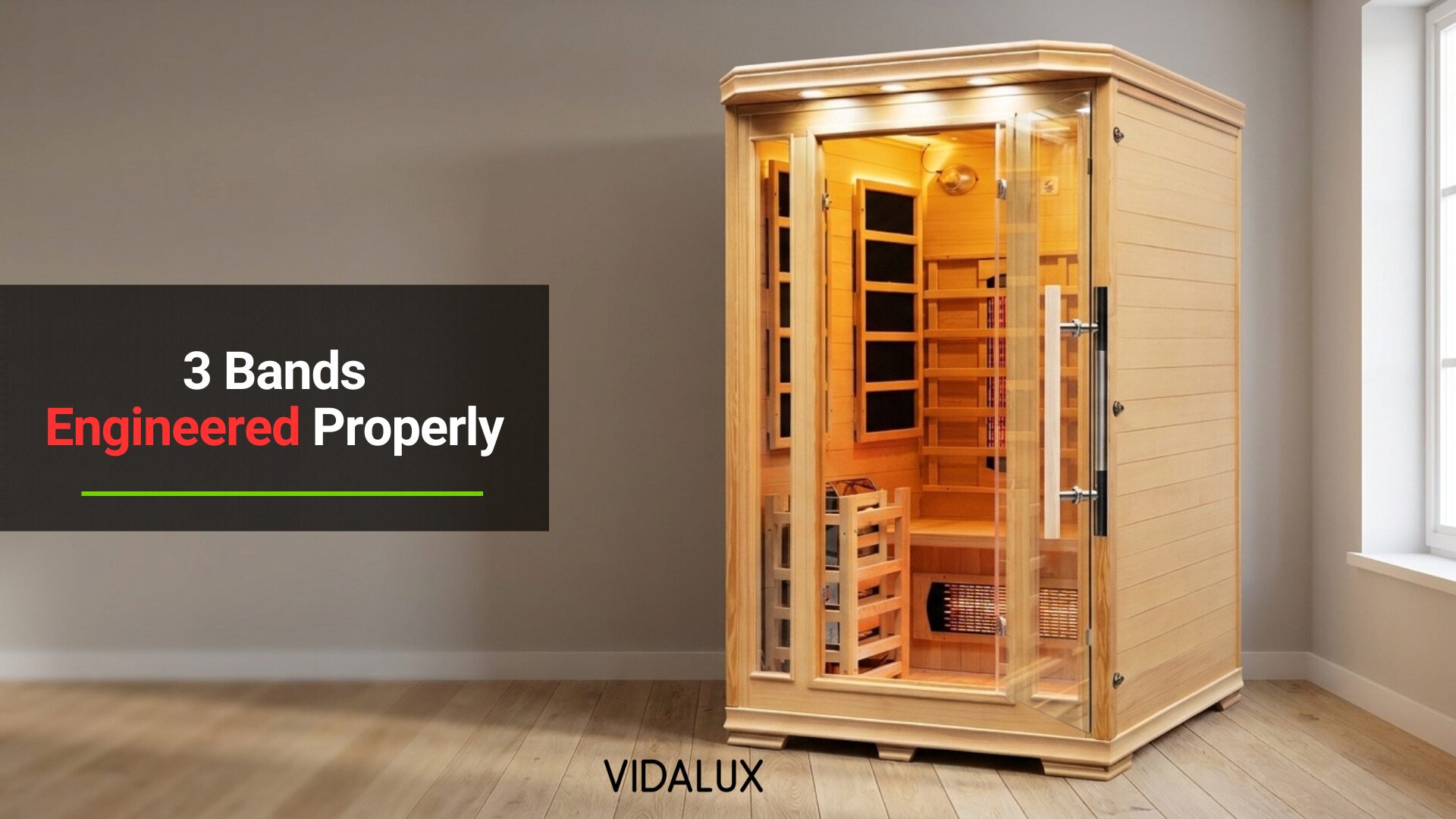
In a Vidalux Complete Heat system, this means ceramic and carbon heaters working together by design – each handling a different part of the infrared spectrum.
Layer one: Nano-carbon crystal heaters (the carbon element) line the walls and floor. These next-generation panels produce high-quality FAR infrared with wide, even coverage. They eliminate cold spots, run efficiently, and provide the stable, enveloping warmth that makes long sessions comfortable. They’re the foundation – the consistent heat that fills the cabin.
Layer two: Full-spectrum carbon fibre ruby quartz heaters (the ceramic element) sit behind the backrest, positioned close to your large muscle groups. These heaters deliver all three bands – near, mid, and far infrared – and they begin producing heat almost instantly. They’re designed to raise core body temperature faster, penetrate deeper into tissue, and enhance the effectiveness of the FAR wavelengths already working around you.
But does the heater shape matter?
More than most people realise. Standard infrared rays travel in a straight line – which means flat heaters (used by the majority of the market) leave dead zones where the body doesn’t receive direct coverage. Vidalux full spectrum heaters use a concave, coiled design with surgical-grade stainless steel deflectors behind the elements. This focuses and scatters the infrared to cover as much of your body as possible.
The output itself is tuned to concentrate in the 6 to 12 micron range, peaking at 9.4 microns. That specific wavelength matters because it matches the infrared frequency the human body naturally emits – a principle called bio-resonance. The body absorbs these wavelengths more efficiently rather than simply reflecting them off the skin.
One thing to consider: most brands offering full spectrum treat it as a paid upgrade – typically £200 to £500 per heater on top of the base price. Vidalux includes full spectrum as standard across most of its infrared sauna range through the Complete Heat system. The redeveloped carbon fibre also delivers a 20% increase in infrared output compared to regular carbon heaters.
It is thought that genuine full spectrum provides an additional 10 to 15% benefit compared to FAR-only systems. Not because FAR is weak – but because full spectrum enhances what FAR already does well.
You can explore the full range of Vidalux home saunas at https://vidalux.co.uk/home-saunas/ to see how Complete Heat is implemented across different models.
Full Spectrum vs. Far Infrared – The Honest Comparison
Now that you understand what each term means – and what separates a genuine system from a label – here’s how they compare in practice.
FAR infrared saunas use carbon panel heaters producing one wavelength band (5.6 to 15 microns). They offer gentle, even warmth across the whole body. They’re energy efficient, comfortable for long daily sessions, and support relaxation, recovery, circulation, and deep sweating. They tend to have a slower warm-up time and a lower price point. For many people, this is all they need.
Genuine full spectrum saunas use dedicated heaters producing all three infrared bands – near, mid, and far. They deliver a broader wavelength range, which means faster core temperature rise, deeper muscle relaxation, more complete recovery support, and shorter sessions for the same effect. They warm up faster, particularly if using a hybrid heater system. The initial cost is higher.
What does that difference feel like in practice?
In a FAR-only sauna, the warmth builds gradually. You settle in, and over 20 to 30 minutes the heat deepens steadily. It’s gentle, consistent, and well-suited to longer sessions where you want to read, listen to music, or simply decompress.
In a genuine full spectrum sauna, you’ll typically feel the heat engage faster – particularly from the backrest heaters close to your body. The session tends to feel more intense at the same air temperature because near and mid infrared wavelengths are reaching different tissue depths simultaneously. Some users find they achieve the same level of deep sweating in a shorter session.
Neither experience is “better.” They serve different preferences. The FAR-only session rewards patience. The full spectrum session rewards those who want depth and efficiency from a tighter window of time.
So which is better?
Neither is “better” in an absolute sense. It depends on what you’re looking for.
If you want daily, gentle wellness sessions at the lowest cost, a well-engineered FAR-only sauna delivers genuine, proven value. If you want the most complete infrared profile available – covering skin health, deep tissue penetration, circulation, and core temperature in a single session – genuine full spectrum is the broader tool.
The important question isn’t “full spectrum or far infrared?” It’s “is the full spectrum label on THIS sauna backed by real heater engineering – or is it a marketing add-on?”
What to Check Before You Buy
Whether you’re leaning towards FAR-only or full spectrum, these checks apply to any infrared sauna purchase.
Ask what heater type produces each wavelength. If the answer is vague or doesn’t distinguish between how NIR, MIR, and FIR are generated, be cautious. Genuine full spectrum requires purpose-built heaters, not accessories.
Check whether full spectrum is standard or an upgrade. A paid “full spectrum upgrade” often signals a bolt-on rather than integrated engineering. This isn’t always the case, but it’s a question worth asking.
Look at heater placement. Full spectrum heaters should be positioned near large muscle groups for maximum effect – typically behind the backrest. Random placement suggests less thought has gone into the design.
Check for even coverage. Cold spots in any sauna – FAR or full spectrum – indicate poor heater engineering. Good coverage means good engineering, regardless of the spectrum.
Ask about EMF. No sauna produces zero EMF – that’s physically impossible. But low-EMF design shows a brand is paying attention to the details that matter. If a brand claims “zero EMF” or “EMF certified” on full spectrum heaters, that’s worth questioning.
Consider whether you need full spectrum at all. FAR-only is a genuine, effective wellness choice. Not everyone needs the broader coverage – and an honest brand will tell you that.
Let’s be clear: the best sauna for you is one built with genuine engineering behind its claims, whichever spectrum it covers.
Now you know what to look for.
Whether you choose FAR-only or full spectrum, the most important thing is that the engineering behind the label matches the promise. A well-built sauna – honestly described and properly engineered – is the one that delivers real, long-term value.
Compare craftsmanship. Review the standards. Choose with confidence.
Frequently Asked Questions
Q: What is the difference between full spectrum and far infrared saunas?
A: The difference between full spectrum and far infrared saunas is the wavelength range. Far infrared saunas emit one band (5.6-15 microns) for deep heat, while full spectrum saunas emit three bands – near, mid, and far infrared – for broader wellness coverage.
Q: Is a full spectrum infrared sauna worth the extra cost?
A: A full spectrum infrared sauna is worth the extra cost if the heaters genuinely emit three wavelength bands. Genuine full spectrum provides an estimated 10-15% more benefit than FAR-only – but many “full spectrum” labels are just a bolt-on bulb at a premium price.
Q: How can I tell if a full spectrum sauna is genuine?
A: A genuine full spectrum sauna uses dedicated heaters engineered to produce near, mid, and far infrared wavelengths. Ask the manufacturer what specific heater type produces each band – if they cannot answer clearly, the full spectrum claim may not be genuine.
Q: What does far infrared do in a sauna?
A: Far infrared in a sauna penetrates deep into the body at wavelengths between 5.6 and 15 microns, raising core temperature and supporting deep sweating, muscle relaxation, circulation, and recovery – all at comfortable air temperatures of 45-60°C.
Q: Do I need full spectrum or is far infrared enough?
A: Far infrared is enough for effective daily wellness, relaxation, and recovery – it is the most studied infrared wavelength. Full spectrum adds near and mid infrared for broader coverage, but a well-engineered FAR-only sauna still delivers genuine, proven benefits.
- About the Author
- UK’s best-rated?

With over 22 years in the home spa industry, Andrew has overseen every stage of the journey—from initial product design and manufacturing to final installation. An author of multiple technical publications and scientific papers, he founded Vidalux to replace industry hype with engineering-led reliability. His focus remains on delivering gym-quality wellness through honest design and technical truth.
DISCLAIMER: All specifications, claims, and advice relating to any internal or external procedure, practise, product, or service were true at the time of writing. For more accurate and up-to-date details in relation to Vidalux services, please visit the relevant dedicated on-site page. For any product-related information, specifications, or guidance, the information on the product page should be considered the governing source.
Ready to choose?
Browse the full Vidalux range of saunas, steam showers, baths and shower cabins, all in one place