DIY Sauna Installation: The Hardwire vs Plug Safety Guide
The box arrives. You unwrap it, lift out the manual, and read the line nobody warned you about: “This unit must be hardwired into a dedicated circuit by a Part P qualified electrician.”
You paid £3,000 for a sauna. Now you’re being told you need a sparky too.
Here’s the thing. Some saunas genuinely plug into a normal socket. Others legally cannot – even if they happen to ship with a 13-amp plug attached. The line between the two isn’t obvious, and most retailers don’t explain it before delivery. So homeowners end up Googling at 11 pm, panicking that they’ve bought the wrong thing.
This guide settles it. By the end, you’ll know exactly which side of the line your sauna sits on, why UK regulations draw it where they do, and what the honest cost looks like. No hype. No legal jargon you don’t need. Just the actual answer to “Do I need an electrician for sauna installation UK?”
The Honest Answer — Which Saunas Plug In, Which Need a Sparky
In the UK, sauna installation falls into two camps. Small infrared saunas – typically 1 to 3 person models – generally plug into a standard 13-amp socket on a dedicated circuit. Traditional saunas, hybrid saunas, and most 4-person infrared models (any sauna over 3KW) must be hardwired into a dedicated circuit by a qualified electrician. The split is determined by heater wattage, fixed-appliance status, and the Building Regulations – not by what the box happens to contain.
Worth understanding why.
A standard UK 13-amp socket has a continuous load limit suitable for small appliances. Most 1-3 person infrared saunas sit comfortably under this – the Solara 3 Person Corner Full Spectrum Infrared, for example, ships with a 2-metre power cable and a standard 3-pin plug ready to use.
But here’s where it gets interesting. A 1 person Klassikko traditional sauna uses a heater that, on paper, might appear to fit within the socket’s limit. Yet it still must be hardwired. Why? Because traditional sauna stoves are classed as fixed appliances under BS 7671, the UK wiring standard.
Fixed appliances of this type require a permanent connection to a dedicated circuit, regardless of theoretical plug compatibility. The same logic applies to every model in the Klassikko range, every hybrid sauna, and every sauna with a traditional stove.
Why Saunas Are Classified as ‘Special Locations’ Under UK Regs
Most homeowners have never heard the phrase “special location,” yet it’s the single most important regulatory term for anyone planning a sauna installation UK. Get this right and the rest of the article makes sense. Miss it and you’re heading for trouble.
A “special location” under Approved Document P of the Building Regulations is any room that carries elevated electrical risk. The list is short: rooms containing a bath or shower, rooms containing a swimming pool, and rooms containing a sauna heater. Saunas qualify because of the combination of high temperatures, moisture, and enclosed space – exactly the conditions where a small wiring error becomes a serious fire or shock hazard.
According to the Government’s Approved Document P, any new circuit OR alteration to an existing circuit anywhere in a room containing a sauna heater is notifiable electrical work. That’s a critical distinction. In a regular room you can add a socket without notification. In a sauna room, you cannot.
But what counts as “work in a sauna room”?
It covers the full installation: running the supply cable, fitting the dedicated circuit, installing the isolator switch, and making the final connection to the sauna’s electrical box. All notifiable. All regulated.
You have two compliance routes. Either use an electrician registered with a Competent Person Scheme – NICEIC, NAPIT, or ELECSA – who can self-certify the work, or notify your Local Authority Building Control before work begins and pay separately for inspection. The first route is faster, cheaper, and what 95% of homeowners use.
Skipping compliance isn’t a minor risk. The Building Safety Act 2022 introduced 10-year liability and unlimited fines for non-compliant electrical work. The local authority can serve an enforcement notice, take you to court, or force the work to be redone at your expense. This isn’t theoretical pressure – it’s the legal framework you’re operating inside the moment your sauna lands.
The Vidalux Range — Which Models Plug In, Which Don’t
Here’s the clearest breakdown we can give you, model by model.
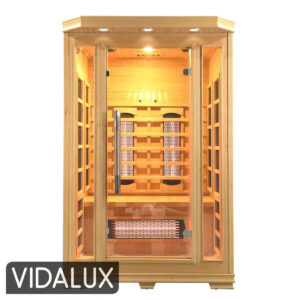
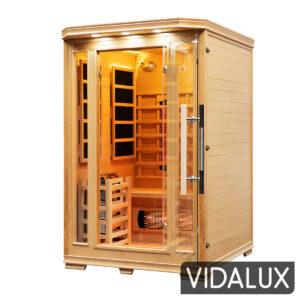
The plug-and-play group is straightforward. The 1-3 person Solara, Solara 4 person corner, Premier to 3 person, and Platinum 1 to 4 person infrared saunas all run from a standard 13-amp socket on a dedicated circuit. (Infrared models under 3000w)
These units sit comfortably under standard socket limits, ship with a factory-fitted power cable, and are designed for the simplest possible installation. The Solara 3 Person Corner Full Spectrum Infrared, for instance, has a 2-metre lead extending from the electrical box housed in the roof. Plug it in, switch on, done.
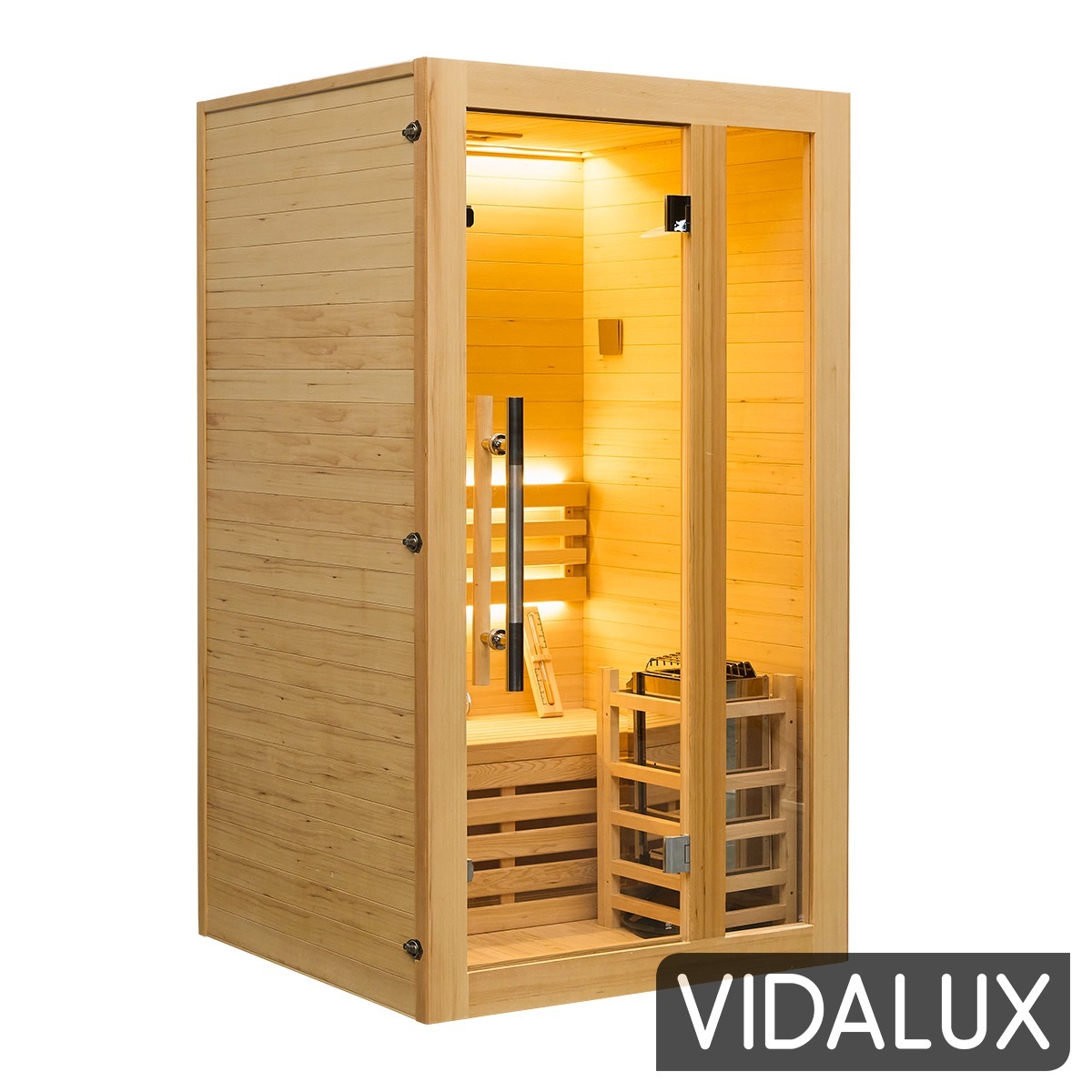
The hardwired-traditional group covers the entire Klassikko range, the entire Nordic range, all Hybrids models, the 4-person Solara and Premier and the 4-5 person Solara Bench. Every Klassikko and Nordic model uses a traditional stove, which must be hardwired into the electricity supply. There are no exceptions. The 1 person Klassikko cannot plug into a wall socket, because the stove itself is classified as a fixed appliance. But not only this, even if a sauna stove pulls 3KW, this is at the very top end of the demand on a standard socket and will almost certainly cause issues if attempted (which you must not).
The hardwired-hybrid group includes every Vidalux Hybrid model. These combine a traditional stove with a full-spectrum infrared system, used independently rather than simultaneously. Always hardwired. Always with an isolator switch as specified in the manual. Specific wattage figures vary by model size – check the product page for the unit you’re considering.
The hardwired-large-and-outdoor group includes the 4-person Solara, Premier and the 4-5 person Solara Bench infrared saunas and every outdoor model. Larger heaters need more current. Outdoor units add cable-routing considerations – typically Steel Wire Armoured (SWA) cable buried in a trench from the consumer unit to the sauna location.
When in doubt, the home sauna range product pages list the electrical requirements for each model clearly.
What ‘Hardwiring’ Actually Means in Practice

The word “hardwired” sounds intimidating until someone explains it in plain English. Most people picture exposed wires, complex panels, and disruption. The reality is simpler.
A hardwired sauna is a bit like an electric oven. You don’t plug a 7kW cooker into the wall – it has its own dedicated circuit running from your consumer unit, its own isolator switch nearby, and a permanent connection. A traditional or hybrid sauna heater works on exactly the same principle.
The Vidalux installation manual specifies the dedicated supply requirement for each model. Your qualified electrician will confirm the correct breaker, RCD, and cable size for your specific consumer unit and cable run.
They’ll run the supply from your consumer unit to a fused spur or isolator switch positioned outside the sauna room, then make the final connection to the sauna’s electrical box (housed in the roof on most models). No plug. No socket. A permanent, dedicated supply.
One technical point worth flagging – the dedicated circuit matters. We’ve seen plenty of cases where homeowners try to share an existing circuit with the sauna, or have two RCDs stacked on the same supply trying to “double up” the protection. Both setups cause nuisance tripping. The sauna will work for a few minutes, then trip the breaker. Customers assume the sauna is faulty. It isn’t. The setup around it is.
A clean install uses a dedicated circuit with appropriate RCD protection, not a shared circuit and not stacked RCDs. Your electrician will know the correct configuration – it’s worth confirming with them before they start, just so you’re on the same page about avoiding nuisance trips down the line.
The Real Cost of Getting It Wrong
Time to talk numbers, because vague reassurances don’t help anyone budget.
According to Checkatrade’s 2026 cost guide, UK electrician hourly rates run £35-£70, with London averaging £55+ per hour. A standard hardwired sauna installation – running a dedicated circuit a reasonable distance to an indoor sauna – typically costs £300-£500 including the certificate.
Outdoor installations push higher, generally £600-£1,200+, because of the trenching, SWA cable, and longer cable run involved. If your consumer unit is full or outdated, an upgrade adds around £485 on average. An EICR, if you ever need one to satisfy a buyer or insurer, runs £125-£300.
Those are the visible costs. The hidden costs are where things get expensive.
Voided warranty. Vidalux warranty registration requires a Part P registration number, submitted within 90 days of delivery, for any unit with an electrical connection. No registration number means no warranty registration. No registration means no extended warranty. The 12-month manufacturer warranty may also be affected if a fault relates to electrical installation that wasn’t certified.
Insurance complications. UK home insurance providers may treat uncertified electrical work as a coverage issue – particularly if a fire investigator traces the cause back to an unregulated installation. Worth checking your specific policy, because the cost of rebuilding a kitchen, an extension, or an entire house out of pocket dwarfs anything you saved by skipping the electrician.
House sale problems. Your buyer’s solicitor will request the Electrical Installation Certificate. If you can’t produce one, you’re looking at one of three options: paying for retrospective certification (rarely possible), paying for an EICR plus indemnity insurance, or having the work redone by a registered electrician before completion. Every option costs money. Every option causes delay.
Building Safety Act fines. Unlimited. The local authority has the legal power to take you to court, force the work redone, and levy fines without statutory ceiling.
The honest maths: a £400 electrician callout protects you from tens of thousands in downstream risk. It’s the cheapest insurance on the project.
What Vidalux Tells Every Customer About Sauna Installation UK
Here’s what we say to every customer who calls about installation, regardless of which model they’ve bought.
We are supply-only. That’s the foundation everything else rests on. We don’t fit. We don’t survey. We don’t remove old units. We don’t recommend installers. Every product page on our site lists the power requirement for that specific model.
Every manual confirms the connection method – plug-in or hardwired. Every diagram shows where the electrical box sits on the unit. The information is there before you order, not buried in fine print after delivery.
Every electrical connection – even a simple 1 person infrared on a dedicated 13-amp circuit – should be commissioned by a qualified electrician. This isn’t us being cautious for its own sake. It’s because warranty registration requires it.
Your electrician’s registration number is a mandatory field on the form. No number, no registration, no extended warranty. That’s the rule for every brand operating legitimately in the UK, not just Vidalux.
The 90-day registration window is non-negotiable. Register inside 90 days of delivery, your full warranty activates. Miss the window, the extended warranty is void. We can sometimes accommodate late registration as a goodwill gesture, but the rule exists for a reason – it ensures the unit was commissioned correctly while the install is still recent.
If a wiring issue surfaces during installation that’s clearly our fault – a faulty stove element, a miswired control box, a packaging error – Vidalux arranges and pays for the local electrician’s callout directly. We coordinate the appointment and settle the invoice.
That policy exists because we know our products are designed for DIY assembly but still need professional electrical sign-off, and we won’t leave customers stranded if something on our end caused the problem.
The trade observation worth sharing: most installation problems we see aren’t with the sauna itself. The unit works fine. It’s the supply around it that causes trouble – shared circuits, stacked RCDs, undersized cable, missing isolators. Get the supply right and the sauna runs reliably for years.
For more articles like this one, our sauna guides cover everything from heater choice to running costs to how to use Complete Heat properly.
Choosing the Right Sauna for Your Setup

Now you have the information, the question becomes simpler. Which side of the plug-vs-hardwire line do you want to be on?
If you want plug-in simplicity, the 1-3 person Solara, Premier, and Platinum infrared saunas are the cleanest answer. Standard 13-amp socket on a dedicated circuit, factory-fitted plug, minimal disruption. We still recommend an electrician’s sign-off for warranty purposes, but the install itself is straightforward.
If you want full traditional heat – the proper 70-90°C Finnish experience with löyly and steam bursts – the Klassikko range is the proven choice. Hardwired stove, sparky required, additional install cost. Worth it for buyers who want the authentic experience and understand they’re committing to a fixed installation.
If you want both, the Hybrid range is our flagship. Full Complete Heat infrared system AND a full traditional stove in one cabin, used separately at the user’s choice. Always hardwired with isolator. Highest specification, broadest experience, longest install. Right product for the homeowner who wants the most flexibility.
If you want it outdoors, the requirement follows the model. A smaller infrared sauna within plug-in spec can run from an outdoor-rated IP-rated socket on a properly protected circuit. Traditional, hybrid, and higher-wattage infrared models are hardwired only. SWA cable, trenching, isolator at the sauna end, considered cable run. More involved, more expensive, but unlocks the proper garden-spa experience.
The honest split is the same whether you buy from Vidalux or anywhere else. The difference is whether the brand explains it before delivery, or leaves you to find out from the manual.
See the quality. Compare the range.
Closing Note
Vidalux is supply-only. Your qualified electrician makes the call on what your specific home setup needs. The information here is the framework – it’s not a substitute for professional sign-off on your install.
If you’ve read this far, you now know more about UK sauna electrical compliance than 90% of customers walking into a showroom. Use it.
Frequently Asked Questions
Q: Do I need an electrician to install a sauna in the UK?
A: For most saunas, yes. Traditional, hybrid, and 4-person infrared models must be hardwired by a qualified electrician. Only 1-3-person infrared saunas plug into a standard 13-amp socket, and even then, the circuit should be checked.
Q: Can I plug a sauna into a normal UK socket?
A: Only small infrared saunas are designed for plug-and-play operation. The 13-amp socket has a continuous load limit. Traditional stoves and hybrid saunas exceed this and are classed as fixed appliances requiring hardwiring under BS 7671.
Q: Is sauna installation notifiable under Part P?
A: Yes. A room containing a sauna heater is classified as a special location under Approved Document P. Any new circuit or alteration to an existing circuit in that room must be notified to Building Control or completed by a Competent Person Scheme-registered electrician.
Q: How much does a qualified electrician cost for a sauna?
A: A standard hardwired sauna installation runs £300-£800 in the UK in 2026. Outdoor saunas with cable runs, SWA cabling, or consumer unit upgrades push this to £600-£1,200+. London rates run higher. Always get three quotes from registered electricians.
Q: Will my sauna warranty be void if I don’t use a qualified electrician?
A: Yes for any unit with an electrical connection. Vidalux warranty registration requires your electrician’s registration number within 90 days of delivery. Without it, the extended warranty is void. The 12-month manufacturer’s warranty may also be affected.
- About the Author
- UK’s best-rated?

With over 22 years in the home spa industry, Andrew has overseen every stage of the journey—from initial product design and manufacturing to final installation. An author of multiple technical publications and scientific papers, he founded Vidalux to replace industry hype with engineering-led reliability. His focus remains on delivering gym-quality wellness through honest design and technical truth.
DISCLAIMER: All specifications, claims, and advice relating to any internal or external procedure, practise, product, or service were true at the time of writing. For more accurate and up-to-date details in relation to Vidalux services, please visit the relevant dedicated on-site page. For any product-related information, specifications, or guidance, the information on the product page should be considered the governing source.
Ready to choose?
Browse the full Vidalux range of saunas, steam showers, baths and shower cabins, all in one place