Why So Many Gym-Goers Are Adding Infrared to Their Recovery Routine
Monday was leg day. It’s Wednesday, and you’re negotiating the stairs one careful step at a time. Sitting down requires concentration. Standing back up requires commitment.
Most people call it lactic acid build-up. Most people have been told that for years. And most people, it turns out, have been chasing the wrong thing.
There’s a growing number of serious athletes – runners, lifters, cyclists, triathletes – who now use infrared as a core part of their post-exercise recovery routine. Not because it was on their training app, but because they understood what was actually happening in their muscles. And more importantly, what would actually help.
Here’s the thing. The reason infrared earns a place in a recovery routine has a slightly counterintuitive answer. Because the soreness you’re trying to fix isn’t caused by what most people think.
The Lactic Acid Myth – What’s Really Going On
Most people have heard it so many times it feels like settled biology: hard training causes lactic acid build-up, and that’s what makes you sore for days afterward.
It’s not quite right.
Lactic acid – more precisely, lactate – is produced during intense exercise. But it’s cleared from muscle tissue remarkably quickly. Within roughly an hour of finishing your session, it’s largely gone.
The physical therapists and sports scientists who correct this myth are unambiguous: elevated blood lactate clears fast, and anyone selling you a “lactic acid flush” treatment for pain that arrives two days later is selling you something that doesn’t match the timing. As one peer-reviewed review of the research notes, studies as far back as the 1980s largely discredited the role of lactate in delayed muscle soreness, even though the belief persists in the general public and beyond
So what is causing that deep, heavy soreness?
What you’re experiencing 24 to 48 hours after intense training sessions is delayed onset muscle soreness – DOMS. It’s driven by microscopic damage to muscle fibres, localised inflammation, and the body’s repair response to that damage. The muscles were pushed beyond what they were accustomed to. They’re rebuilding.
The distinction matters.
Because if lactic acid isn’t the target, “flushing it out” isn’t the goal. The real recovery objective is supporting blood flow to damaged muscle tissue, giving cells the energy they need to repair, and helping the body clear genuine metabolic waste products efficiently. That’s a different brief – and infrared addresses it through a different mechanism entirely.
What Near Infrared Light Actually Does at the Cellular Level
Infrared is not conventional heat. That’s worth pausing on, because it changes how the recovery mechanism works.
A traditional hot environment – a steam room, a hot bath – raises air temperature and transfers heat to the skin from outside. Infrared saunas work differently. They use non-visible wavelengths of light that the body absorbs directly, warming tissue from within rather than from the surface in.
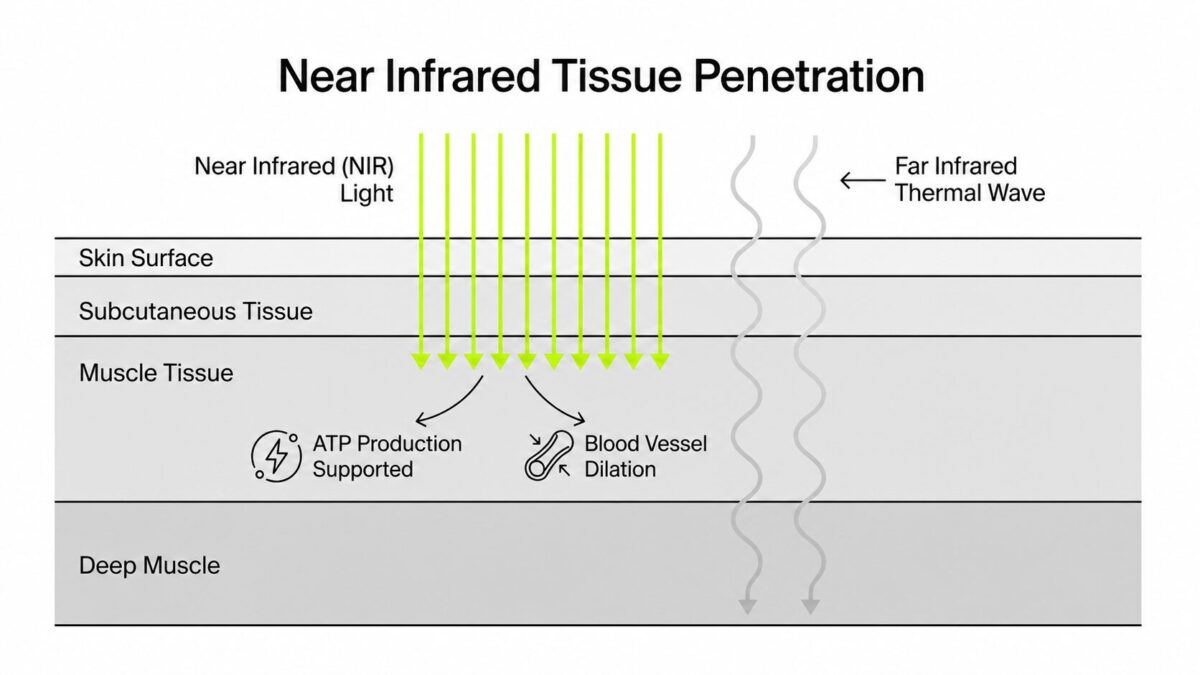
Near infrared light, specifically, penetrates just below the skin surface, reaching muscle tissue.
Think of it like the difference between warming your hands over a radiator versus wrapping them around a warm mug. The radiator heats the air around you. The mug warms the tissue directly. Infrared operates on the second principle.
At the cellular level, near infrared wavelengths are absorbed by cytochrome c oxidase – a key enzyme within the mitochondrial chain responsible for producing ATP. That’s cellular energy. The energy your muscles need to repair themselves.
There’s a second mechanism worth understanding.
Near infrared may also support blood vessel dilation – improving blood flow to worked muscle groups. When circulation improves in recovering tissue, the body can deliver oxygen and nutrients to damaged muscle more efficiently, and clear metabolic waste products faster.
Worth noting: the body naturally absorbs far infrared best in the 6 to 12 micron wavelength range, with peak absorption around 9.4 microns – the same wavelength the human body itself emits. Vidalux heaters are engineered to concentrate output in precisely this range, which means the light is absorbed rather than deflected. That is an engineering choice, not a marketing claim.
Far infrared adds a complementary layer – gently raising core temperature, encouraging deep sweating, and supporting the body’s natural detox pathways. The combination of near infrared cellular stimulation and far infrared circulatory and thermal support is what makes full-spectrum infrared particularly suited to post-exercise recovery.
But does the science actually hold up?
The honest truth is that the clinical evidence on infrared and athletic recovery is still building. Individual responses vary. Anyone who tells you otherwise – in either direction – is getting ahead of the data. What the mechanism literature does support is a clear, well-understood basis for cellular energy support and improved circulation. That’s what active users are responding to. And it’s the only claim worth making.
Why Passive Recovery Is the Strategic Advantage
Here’s something most recovery conversations miss.
The best recovery tool is not necessarily the most intense one. It’s the one you’ll actually use consistently, without it competing with your training load.
Ice baths have their advocates. Cold plunge is popular. Both have merit. But both also require the body to work – to withstand, to adapt to cold, to recover from the recovery. For athletes training three to five times per week, that matters. Every tool that demands physical effort is drawing from the same energy reserves your next session needs.
Infrared asks nothing of you.
You sit. You stay warm. The specific wavelengths do the work at a cellular level. A session of 20 to 40 minutes – a duration most active users report works well – in the evening slots into a daily routine without friction.
That last point is significant. Sleep is one of the most underrated factors in athletic recovery. The body does its most important repair work during sleep – muscle tissue rebuilds, growth processes activate, inflammation resolves. Infrared sauna use may support sleep quality through the body’s natural temperature regulation cycle – the gentle cooling that follows a warm session supports the drop in core temperature that signals the body towards rest.
This is what serious athletes mean when they talk about a protocol. Not a single tool. A sequence of consistent, low-effort inputs that compound across training weeks and months. Infrared is passive. That’s not a weakness. That’s the feature.
FAR-Only vs Full Spectrum – Does It Actually Matter?
Not all infrared saunas are the same. For general wellness users, this distinction is secondary. For active, recovery-focused people, it becomes relevant.
Most infrared saunas on the market produce far infrared only. FAR infrared supports deep thermal penetration, sweating, and general circulation. It’s well-studied and genuinely effective. If that’s what you have, it’s worth using.
Full-spectrum saunas add near infrared (NIR) and mid infrared (MIR) to that foundation.
NIR is the wavelength specifically associated with the cellular recovery mechanism described above – the cytochrome c oxidase pathway, ATP production, and improved blood flow to recovering muscle tissue. MIR reaches soft tissue, supports circulation further, and adds to the muscle recovery and mobility picture.
It is thought that a full-spectrum system may provide up to 10 to 15% additional benefit compared to a FAR-only model. That’s not a dramatic headline number. But for someone training hard and using their sauna daily, those sessions accumulate – and so does that margin.
So why doesn’t everyone have full spectrum?
Most brands sell it as a premium upgrade – typically an additional £200 to £500 per heater. The result is that many buyers either skip it to reduce cost, or unknowingly buy a FAR-only model without understanding what they’re missing.
The other variable is heater placement. Knowing that full-spectrum heaters deliver NIR is one thing. Positioning them directly behind the backrest – facing the major muscle groups that absorb the most load during training – is an engineering choice that determines whether the wavelength actually reaches the tissue that needs it.
Build quality matters here too. The recovery community has a healthy scepticism of premium-priced infrared saunas that don’t deliver on their marketing. That scepticism is earned. Poor engineering – regardless of what wavelength claims appear on a spec sheet – produces legitimate buyer’s remorse. The mechanism is real. The benefit depends on the execution.
The Vidalux Approach – Built for Consistent Recovery, Not Occasional Use
There’s a reason Vidalux built the Complete Heat system the way it did.
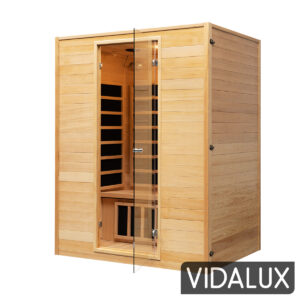
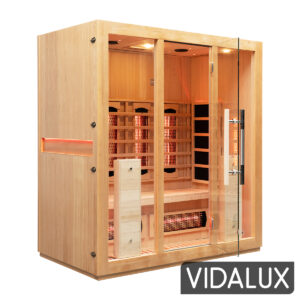
Complete Heat uses two heater types working together – nano-carbon FAR panels across the walls and floor for wide, even coverage with no cold spots, and full-spectrum carbon fibre ruby quartz heaters positioned behind the backrest.
That second placement is deliberate. The back heaters face the largest muscle groups directly – the muscles that accumulate the most post-exercise damage during compound training. NIR output concentrated at the source, not scattered generally around the cabin.
Full spectrum is standard on Complete Heat. Not an upgrade, not an add-on.
The operating temperature – 45°C to 65°C – makes daily post-training use genuinely accessible. This is not the intense air heat of a traditional Finnish sauna at 90°C. It’s a comfortable, long-session environment. Most users find evening timing works best – the fatigue that can follow a morning session dissipates, and the pre-sleep timing supports the sleep quality benefits described above.
For active users specifically, carbon-only models – while well-engineered and appropriate for general daily wellness – don’t carry the near-infrared component that underpins the cellular recovery mechanism in this article. For recovery-focused use, Complete Heat is the right specification.
Vidalux has been building and supplying home saunas for over 15 years. The spare parts commitment, the in-house engineering development, the real-world testing that informs heater placement – these aren’t marketing lines. They’re the answers to the question serious buyers should be asking before spending on any recovery equipment.
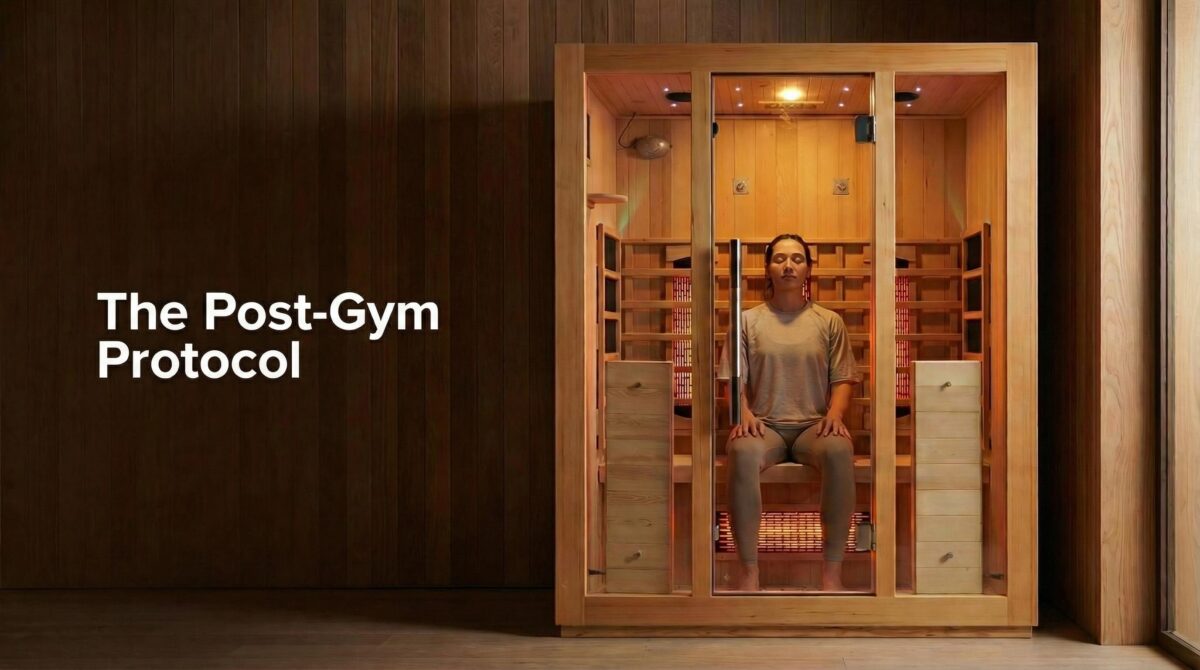
The protocol is simple. Train hard. Sit down. Let the light and heat do what they’re designed to do. Repeat.
Explore the full range of Vidalux home saunas to see what’s available: https://vidalux.co.uk/home-saunas/
Frequently Asked Questions
Q: Does an infrared sauna help with lactic acid?
A: An infrared sauna supports post-exercise recovery, but lactic acid itself clears from muscle tissue within roughly an hour of stopping exercise. The soreness felt 24-48 hours later is delayed onset muscle soreness (DOMS), driven by micro-tears and inflammation – not residual lactic acid.
Q: What is the difference between lactic acid and DOMS?
A: Lactic acid is a by-product produced during intense exercise and is cleared rapidly by the body after training stops. DOMS – delayed onset muscle soreness – develops 24-48 hours later and is caused by microscopic muscle damage and the resulting inflammatory repair response.
Q: How does near-infrared light support muscle recovery?
A: Near infrared light supports muscle recovery by being absorbed at the cellular level, where it may stimulate cytochrome c oxidase – a key part of the mitochondrial chain that produces ATP (cellular energy). It may also support improved blood flow to recovering muscle tissue, helping the body deliver nutrients and clear metabolic waste more efficiently.
Q: Is a full-spectrum sauna better than FAR-only for athletic recovery?
A: A full-spectrum infrared sauna adds near infrared (NIR) and mid infrared (MIR) to the FAR infrared produced by most standard models. For recovery specifically, NIR is the wavelength associated with cellular energy support and improved circulation – making full spectrum a more complete option for active, recovery-focused users.
Q: How long should I use an infrared sauna after a workout?
A: Most active users report that sessions of around 20-40 minutes work well, with evening timing preferred over immediate post-training use to avoid daytime fatigue. Infrared saunas operate at 45-65°C – significantly lower than traditional saunas – making sessions genuinely accessible without adding cardiovascular stress to a fatigued body.
Q: Can I use an infrared sauna every day for recovery?
A: Infrared saunas are designed for consistent daily use. The lower operating temperatures (45-60°C) and light-based heating mechanism make regular sessions comfortable to maintain. Vidalux infrared saunas are engineered specifically for long, daily-use sessions – making a consistent post-training recovery protocol practical to build at home.
Q: Why do some infrared sauna owners feel it doesn’t work?
A: Infrared sauna recovery benefits depend heavily on engineering quality – specifically heater type, placement, and wavelength coverage. Models that use basic FAR-only heaters without proper placement or build quality may not deliver the full cellular recovery mechanism associated with near infrared. Engineering standards matter as much as infrared claims.
- About the Author
- UK’s best-rated?

With over 22 years in the home spa industry, Andrew has overseen every stage of the journey—from initial product design and manufacturing to final installation. An author of multiple technical publications and scientific papers, he founded Vidalux to replace industry hype with engineering-led reliability. His focus remains on delivering gym-quality wellness through honest design and technical truth.
DISCLAIMER: All specifications, claims, and advice relating to any internal or external procedure, practise, product, or service were true at the time of writing. For more accurate and up-to-date details in relation to Vidalux services, please visit the relevant dedicated on-site page. For any product-related information, specifications, or guidance, the information on the product page should be considered the governing source.