Ceramic vs. Carbon vs. Full Spectrum: What Your Sauna Heater Actually Does (And Why It Matters)
Ceramic. Carbon. Full spectrum.
If you’ve been comparing infrared saunas, you’ve seen these terms on almost every product listing – often without much explanation of what they actually mean for your experience.
The ceramic vs carbon vs full spectrum question is one of the most common things people get stuck on. And honestly, it’s not surprising. The market tends to throw heater specs at you like they’re self-explanatory, when the reality is most buyers just want to know one thing: which one will actually give me a proper session?
Here’s the thing. Each heater type has genuine strengths – and genuine limitations. The answer isn’t about which single type is “best.” It’s about how they work together.
We’ve tested them all. Here’s what we found.
How Infrared Sauna Heaters Actually Work (The 60-Second Version)

Forget everything you know about traditional saunas for a moment.
Infrared saunas don’t heat the air around you. They use infrared radiation – part of the electromagnetic spectrum – to warm your body directly. That’s why infrared saunas operate at much lower temperatures (45-65°C) compared to traditional saunas (70-90°C). The heat penetrates rather than surrounds.
The infrared spectrum is split into three ranges, and each one reaches a different depth:
Near Infrared (NIR) – just below the skin surface. Supports skin health and rejuvenation.
Mid Infrared (MIR) – reaches soft tissue. Supports circulation and muscle recovery.
Far Infrared (FIR) – the deepest penetration. Raises core body temperature and supports detoxification.
Most infrared saunas on the market produce far infrared wavelengths only. Full spectrum systems deliver all three. The type of heater inside your sauna determines which wavelengths you receive, how the heat spreads across the cabin, and how quickly you reach your desired temperature.
That distinction matters more than most product pages let on.
Ceramic Heaters – Fast and Focused
These were the first infrared sauna heaters on the market – and they’re still widely used.
Ceramic infrared heaters produce a high surface temperature. They deliver strong, direct intensity close to the body and begin emitting infrared almost immediately. If you want fast heat, ceramic gets there quickly.
But what about coverage?
This is where ceramic heaters struggle. They have a short infrared throw – powerful up close, but the energy drops off sharply with distance. The result is uneven heat distribution. You’ll feel intense warmth on the parts of your body nearest the ceramic rods, while areas further away receive noticeably less.
In practical terms, that means cold spots.
Longer sessions can feel harsh too. That concentrated, close-range intensity is effective for short bursts, but it’s less comfortable when you want to sit and relax for 30 or 40 minutes.
Worth noting: ceramic heaters can be FAR-only or full spectrum, depending on the model. Full-spectrum ceramic is a premium upgrade – not standard. FAR-only ceramic is what you’ll find in most mid-range and older saunas.
Think of ceramic like a powerful torch. Brilliant where it’s pointed, but it can’t light the whole room evenly.
Carbon Panel Heaters – Even and Efficient
Carbon panels solved the coverage problem – but introduced a different trade-off.
Unlike ceramic, carbon fiber heating elements produce a lower surface temperature spread across a much larger panel area. The result is wide, even heat distribution with minimal cold spots across the cabin. For long, gentle sessions, carbon panels are genuinely comfortable.
They’re also energy efficient. Lower surface temperatures mean lower energy consumption, which adds up over weeks and months of regular use.
So what’s the catch?
Carbon heaters only produce far infrared. No near infrared. No mid infrared. You’re getting one part of the infrared range – the deepest penetrating wavelength – but missing the benefits that NIR and MIR provide to skin, soft tissue, and circulation.
They’re also slower to warm up than ceramic. If you want to step into a ready cabin quickly, carbon panels take longer to reach operating temperature.
And here’s something most product listings won’t tell you: quality varies enormously. The carbon fibre panels in a well-engineered sauna are not the same as the thin carbon sheets used by budget sellers. Refined nano-carbon materials, optimised placement, and proper engineering make a measurable difference to output and longevity. Not all carbon is created equal.
Carbon panels are consistent and comfortable – but they’re only telling part of the infrared story.
Full Spectrum Heaters – The Complete Infrared Range
This is where the conversation changes.
Let’s be clear: full spectrum infrared means the heaters produce all three wavelength ranges working together in a single system:
Near Infrared (0.75-1.5 microns) penetrates just below the skin. It supports skin rejuvenation and encourages sweating.
Mid Infrared (1.5-5.6 microns) reaches soft tissue. It enhances circulation and supports muscle relaxation and recovery.
Far Infrared (5.6-15 microns) delivers the deepest penetration. It raises core temperature, supports detoxification pathways, and stimulates metabolic activity.
The honest truth? Full spectrum enhances far infrared – it doesn’t replace it. Research suggests up to 10-15% more benefit from a full-spectrum sauna versus a FAR-only system. That’s because each wavelength does something the others can’t. NIR handles the surface. MIR reaches the middle. FIR goes deepest. Together, they deliver a more complete infrared profile than any single wavelength alone.
But isn’t full spectrum expensive?
It shouldn’t be. Most brands charge £200-£500 per full spectrum heater as an optional upgrade. That pricing model treats full spectrum as a luxury add-on rather than what it should be: a standard part of any properly engineered infrared sauna.
Full spectrum should be built in, not bolted on.
So Are More Heaters Actually Better?
No. And this is one of the most persistent misconceptions in the infrared sauna market.
You’ll see product listings boasting “12 carbon panels” or “8 heating elements” as though the number alone proves quality. It doesn’t.
A sauna with 10 FAR-only carbon panels still can’t deliver near or mid infrared wavelengths. You could fill every wall with carbon and you’d still only get one-third of the infrared spectrum. Quantity doesn’t change the physics.
Cold spots don’t come from having too few heaters. They come from design limitations – the wrong heater type, poor placement, or flat elements that send infrared in a straight line and miss parts of the body entirely.
Put simply: it’s the combination of heater types, their placement, and the wavelengths they deliver that determines your experience. The engineering behind each heater – materials, reflector technology, and output tuning – matters far more than the raw number on the spec sheet.
More heaters is a marketing metric. Better engineering is a wellness one.
The Vidalux Approach: Complete Heat

Every old-fashioned infrared sauna had a weakness. Ceramic was fast but uneven. Carbon was even but slow and FAR-only. Full spectrum was usually a paid extra.
Vidalux engineered Complete Heat to remove every one of those limitations.
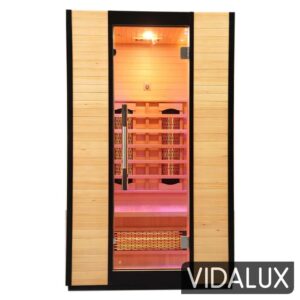
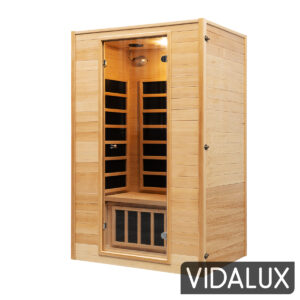
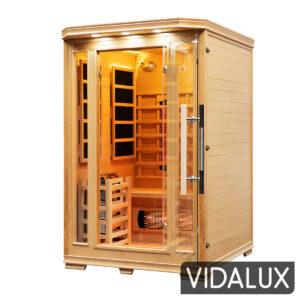
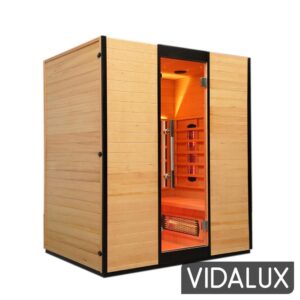
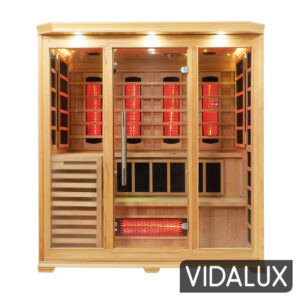
Complete Heat combines two heater systems working together by design. Nano-carbon crystal heaters line the walls and floor, providing wide, even far-infrared coverage across the whole cabin – no cold spots, high energy efficiency, and strong, comfortable heat for long sessions.
Behind the backrest, full-spectrum carbon fibre ruby quartz heaters deliver near, mid, and far infrared simultaneously. These begin heating instantly, raise core temperature faster, and penetrate deeper into large muscle groups.
What about the engineering details?
The full-spectrum heaters are coiled in a concave shape – not flat like 90% of the market – with surgical-grade stainless steel deflectors behind them. This focuses and scatters infrared waves to reach every part of the body, eliminating the dead zones that flat heaters create.
Output is tuned to concentrate in the 6-12 micron range, peaking at 9.4 microns. That’s the same wavelength the human body naturally emits – known as bio-resonance – which allows for maximum absorption rather than heat simply bouncing off the skin.
The carbon fibre itself has been redeveloped to deliver a 20% increase in emissivity compared to regular carbon fibre heaters. And full spectrum is included as standard in most Vidalux home saunas – not offered as a £200-£500 upgrade.
One thing to consider: the back heaters can be independently controlled. If you prefer a gentler, carbon-only session, you can turn them down or off with each heater’s own control dial. The choice is yours.
What to Look For When Choosing a Sauna Heater
Whether you buy from us or not, these are the questions worth asking before you commit.
First, ask what wavelengths the sauna produces. Is it FAR-only or genuine full spectrum? If the listing doesn’t say, assume FAR-only.
Second, check heater placement. Are the heaters positioned to cover the whole body – front, back, sides, and legs – or concentrated in one zone? Placement determines coverage.
Third, ask about heater materials. Refined nano-carbon and carbon fibre ruby quartz are not the same as generic carbon sheets. The material quality directly affects output and session quality.
Look for low-EMF engineering as a genuine design principle, not just a marketing claim on a spec sheet. And be wary of “full spectrum” offered as an expensive add-on. If it’s truly important – and it is – it should be standard.
The right sauna isn’t the one with the most heaters. It’s the one with the right combination, properly engineered.
Frequently Asked Questions
Q: What is the difference between ceramic and carbon infrared sauna heaters?
A: Ceramic and carbon infrared sauna heaters differ in heat delivery. Ceramic heaters produce fast, intense heat with a shorter throw, while carbon panels provide wider, more even coverage at a lower surface temperature – making carbon more comfortable for longer sessions.
Q: What does full spectrum infrared mean in a sauna?
A: Full spectrum infrared in a sauna means the heaters produce near, mid, and far infrared wavelengths together. This delivers a more complete infrared profile than FAR-only systems, with up to 10-15% more benefit from the combined wavelength range.
Q: Are more heaters better in an infrared sauna?
A: More heaters are not necessarily better in an infrared sauna. What matters is the combination of heater types, their placement, and the wavelengths they produce – not the total count. A well-engineered system with fewer heaters can outperform a poorly designed one with many.
Q: Do carbon heaters use less electricity than ceramic heaters?
A: Carbon heaters generally use less electricity than ceramic heaters due to their lower surface temperature and wider heat distribution. Carbon panels are considered more energy efficient for regular, longer sauna sessions – though ceramic heaters warm up faster.
Q: What causes cold spots in an infrared sauna?
A: Cold spots in an infrared sauna are caused by heater design and placement, not heater count. Ceramic heaters have a shorter infrared throw, leaving areas unheated. Vidalux’s Complete Heat pairs nano-carbon panels with Carbon Fibre Ruby Quartz Glass Full Spectrum Heaters and reflector technology to eliminate these gaps for even body coverage.
Compare craftsmanship. See the full range of Vidalux home saunas and outdoor saunas.
- About the Author
- UK’s best-rated?

With over 22 years in the home spa industry, Andrew has overseen every stage of the journey—from initial product design and manufacturing to final installation. An author of multiple technical publications and scientific papers, he founded Vidalux to replace industry hype with engineering-led reliability. His focus remains on delivering gym-quality wellness through honest design and technical truth.
DISCLAIMER: All specifications, claims, and advice relating to any internal or external procedure, practise, product, or service were true at the time of writing. For more accurate and up-to-date details in relation to Vidalux services, please visit the relevant dedicated on-site page. For any product-related information, specifications, or guidance, the information on the product page should be considered the governing source.