The Science of Fever Mimicry: How Heat Therapy Activates Your Body’s Immune Response
When your body detects a threat – a virus, a bacterial infection, something it doesn’t recognise – it does something deliberate.
It raises its temperature.
That’s a fever – the oldest immune response you have. It’s uncomfortable, but it works. White blood cells mobilise faster. T-cells multiply. Proteins called interferons ramp up to neutralise threats. Your body temperature climbs for a reason.
Here’s the thing. You don’t have to be ill to trigger that response.
When you sit in a sauna, and your core body temperature rises, your immune system doesn’t check whether the heat came from a virus or an infrared heater. It simply reacts. That’s the science behind fever mimicry – and it’s more straightforward than most wellness marketing would have you believe.
What Is Fever Mimicry?
The concept is disarmingly simple.
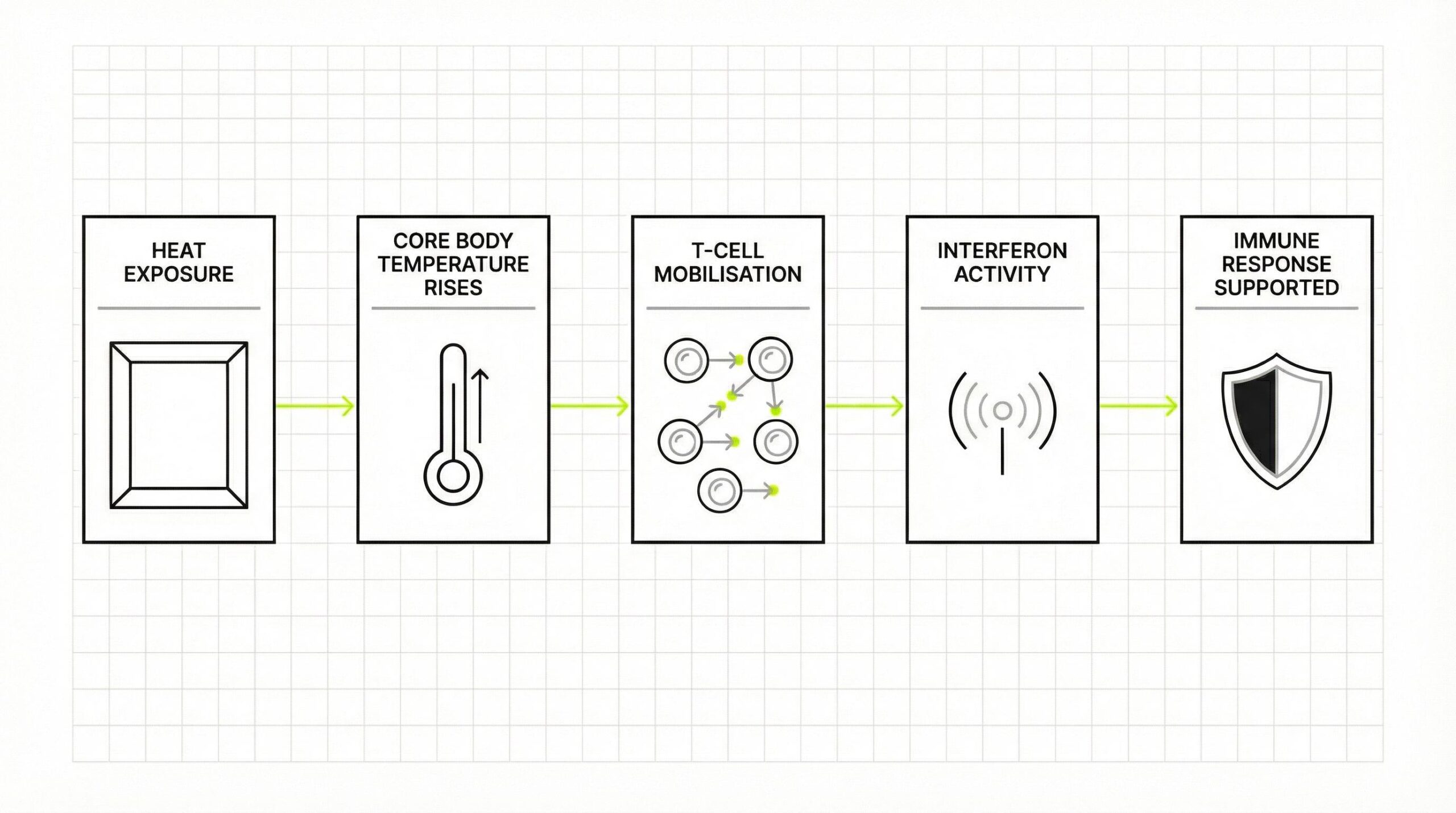
When your body detects a pathogen, it raises its internal temperature. That elevated body temperature triggers a cascade of immune responses – more white blood cells are produced, T-cells become more mobile and active, and interferon proteins increase to help fight toxins and threats.
Heat therapy triggers the same sequence. Sit in a sauna for 20 to 30 minutes and your core temperature rises by 1 to 2°C. Your body doesn’t know it’s a sauna. It responds exactly as it would to a mild fever – activating immune defences and increasing circulation to move those defences around faster.
Think of it like a fire drill for your immune system. The alarm sounds, the response kicks in, and your body practises the routines it needs when a real threat arrives.
But does this actually make a difference?
The approved science says yes – with an important caveat. Heat supports the immune system’s natural function, helps the body better combat daily viruses, and enhances overall health. It does not cure illness. It does not replace medical treatment. It supports what your body already knows how to do.
T-Cell Activation and Interferon Response – What the Science Shows
Most people have heard of T-cells. They’re a critical type of white blood cell – the part of the immune system that identifies threats and coordinates a response. What’s less widely known is that heat exposure measurably affects how T-cells behave.
When your core temperature rises during a sauna session, two things happen at the immune level.
First, T-cell production and mobility increase. More of them are produced, and the ones already circulating move faster and respond more readily. This is the same mechanism your body uses during a genuine fever – the immune system interprets elevated temperature as a signal to mobilise. Research from the US National Institutes of Health confirms that at fever temperatures, T-cells proliferate more, T helper cells produce more signalling cytokines, and the broader immune response is enhanced.
Second, interferon activity improves. Interferons are proteins your body produces to fight toxins and threats at the cellular level. Heat exposure increases their activity, strengthening the body’s first line of defence.
The approved science is deliberately measured: heat supports the immune system’s natural function, helps the body better combat daily viruses, and enhances overall health. It doesn’t cure anything. It doesn’t replace medical care. It supports what your body is already built to do.
There’s also clinical evidence that consistent infrared sauna use can produce short-term improvements in pain, stiffness, and fatigue. A pilot study published in Clinical Rheumatology by researchers at Saxion University of Applied Sciences in the Netherlands found that, across eight infrared sauna sessions over four weeks, patients with rheumatoid arthritis and ankylosing spondylitis reported statistically significant reductions in pain and stiffness during treatment, with no adverse effects or worsening of disease activity.
The improvements were short-term and clinically relevant – not a cure or treatment, and patients with diagnosed conditions should always consult a rheumatologist before starting heat therapy.
Is this the same for everyone?
Individual responses vary. Regular, consistent heat exposure appears to be more beneficial than occasional use – which is one of the reasons home sauna ownership tends to produce better outcomes than the occasional spa visit.
Beyond Immunity – The Wider Benefits of Regular Heat Exposure
Immune support doesn’t happen in isolation. The same physiological changes that activate your immune response also contribute to a range of wider wellness benefits – which is why regular sauna users report feeling better overall, not just less prone to colds.
Improved circulation. Heat causes blood vessels to dilate, increasing blood flow throughout the body. Better circulation supports cardiovascular health, helps deliver oxygen and nutrients to tissues, and assists recovery from physical exertion.
Stress reduction. Heat calms the nervous system. And because chronic stress suppresses immune function, lowering your baseline stress levels indirectly supports the immune benefits you’re already getting from the heat itself. It’s a compounding effect.
Respiratory comfort. Particularly in steam environments, warm, humid air can support respiratory comfort and help loosen mucus during cold and flu seasons.
Detoxification support. Research from Dr. Lyon has shown that heat-induced sweat is preferable to exercise-induced sweat – it’s produced mainly by the lymph and helps eliminate toxins through the skin without heavily involving the kidneys and liver. Heat supports detoxification pathways and aids the body in eliminating toxins through the skin.
Better sleep and recovery. Both feed back into immune function. Quality sleep is when the body does most of its repair work, and recovery time matters as much as the activity that preceded it.
None of these benefits are dramatic in isolation. Together, over months and years, they add up.
Infrared vs Traditional Saunas – Does It Matter for Immunity?
Short answer: not really. Both trigger the fever mimicry response.
The longer answer is more useful.
Traditional saunas operate at 70 to 90°C. They heat the air and the rocks, and your body absorbs that heat from the environment around you. The sessions are intense but typically shorter – 15 to 20 minutes for most users.
Infrared saunas operate at lower air temperatures, typically 45 to 60°C. They heat your body directly via light wavelengths rather than heating the surrounding air. Because the air stays cooler, sessions can be longer – 20 to 30 minutes is ideal, up to 40 minutes maximum.
Both raise core body temperature. Both trigger the same immune cascade. The fever mimicry response is driven by the rise in your core temperature, not by how hot the air around you is.
Where the choice matters is consistency. Regular sauna bathing – three to five sessions a week – is what builds the immune readiness over time. A single intense session doesn’t deliver the same effect. So the practical question isn’t which is better for immunity but which one will you actually use, regularly, for months and years?
For most home users, infrared wins on comfort and frequency. For others, the traditional experience is irreplaceable. Neither is wrong.
How Vidalux Engineers Heat for Consistent Wellness
If the goal is to raise core temperature evenly and trigger a whole-body immune response, the engineering has to deliver heat to the whole body – not just the parts nearest the heater.
This is where Vidalux’s Complete Heat system comes in. Most infrared saunas use either ceramic-only heaters or carbon-only heaters. Each has weaknesses. Ceramic is strong close-up but uneven, with hot spots and cold spots. Carbon is gentler and more even but slower to warm up and less intense.
Complete Heat combines both. Nano-carbon heaters provide wide, even heat distribution. Full-spectrum carbon fibre ruby quartz heaters add the close-range intensity and broader wavelength coverage that ceramic users value. The result is the strongest, deepest, most balanced infrared coverage available at this level – designed by an R&D team that spent years testing every heater configuration on the market.
The heaters are tuned to concentrate output in the 6-12 micron range, peaking at 9.4 microns – the same wavelength the human body naturally emits. That bio-resonance means your body absorbs more infrared energy rather than reflecting it.
The point isn’t the spec sheet. The point is consistency. If you’re using your sauna three to five times a week to build immune readiness, comfort and uniform heat are what make that routine sustainable.
Explore the full Vidalux sauna range.
Practical Guidance: Getting the Most from Heat Therapy
If you’re starting a sauna routine for immune support, a few principles matter more than any specific protocol.
Aim for three to five sauna sessions per week. For infrared, 20 to 30 minutes is ideal, up to 40 minutes maximum. For traditional saunas, 15 to 20 minutes is enough for most users.
Stay hydrated before, during, and after every session. Your body loses fluid through sweating, and dehydration undermines the benefits you’re trying to build.
Listen to your body. If you feel lightheaded or unwell, stop. Excessive heat exposure without adequate hydration or rest can do more harm than good.
Some users combine heat with cold exposure – a cold plunge or cool shower immediately after a sauna session. This contrast therapy is widely practised for circulation and recovery support, though it’s not essential.
One thing to consider: heat therapy supports wellness alongside a balanced diet, regular exercise, and quality sleep – not instead of them. And if you have existing health conditions, consult your GP before starting a regular heat routine.
Your Body Already Knows What to Do
The science of fever mimicry isn’t complicated. Your body fights threats with heat. A sauna gives it the same signal – without the illness.
Regular heat exposure supports T-cell activation, improved circulation, stress reduction, and immune readiness. It doesn’t replace medical care. It supports what your body is already built to do.
If you’re ready to make consistent heat therapy part of your routine, it starts with engineering you can rely on.
See the quality. Explore the full Vidalux sauna range.
Frequently Asked Questions
Q: What is fever mimicry in sauna therapy?
A: Fever mimicry is the process where sauna heat raises your core body temperature, triggering the same immune response as a natural fever. This activates T-cells and interferon proteins – supporting your body’s defences without illness.
Q: Does sauna heat boost your immune system?
A: Sauna heat supports immune function by stimulating white blood cell production and improving circulation during heat exposure. Regular sauna bathing – three to five sessions per week – helps maintain consistent immune support.
Q: Are infrared saunas better than traditional saunas for immunity?
A: Both infrared and traditional saunas trigger the fever mimicry response by raising core body temperature. Infrared saunas operate at lower air temperatures – typically 45 to 60°C – allowing longer, more comfortable sessions for regular use.
Q: How long should a sauna session be for immune support?
A: For immune support, 20 to 30 minutes is ideal in an infrared sauna, up to a maximum of 40 minutes. Traditional sauna sessions are typically 15 to 20 minutes. Core temperature typically rises 1 to 2°C during this time, which is enough to trigger the fever mimicry response.
Q: How often should you use a sauna for immune support?
A: For immune support, aim for three to five sauna sessions per week. Consistency matters more than intensity – regular heat exposure supports ongoing T-cell activity and circulation.
- About the Author
- UK’s best-rated?

With over 22 years in the home spa industry, Andrew has overseen every stage of the journey—from initial product design and manufacturing to final installation. An author of multiple technical publications and scientific papers, he founded Vidalux to replace industry hype with engineering-led reliability. His focus remains on delivering gym-quality wellness through honest design and technical truth.
DISCLAIMER: All specifications, claims, and advice relating to any internal or external procedure, practise, product, or service were true at the time of writing. For more accurate and up-to-date details in relation to Vidalux services, please visit the relevant dedicated on-site page. For any product-related information, specifications, or guidance, the information on the product page should be considered the governing source.