Nano-Carbon vs. Ceramic Rods: What Your Sauna Heater Actually Does (And Why It Matters)
Nano-carbon vs. ceramic rods. You’ve seen these terms on almost every infrared sauna product page. Carbon panels. Ceramic elements. Full spectrum. FAR only.
And yet nobody seems to explain what any of it actually means for you – the person trying to work out which sauna is worth the investment.
Here’s the thing. The heater type inside your sauna isn’t a minor detail. It determines how the heat reaches your body, how evenly it spreads, how quickly the cabin warms up, and ultimately how your session feels.
This article breaks down what each heater type does, where each one falls short, and why the most effective infrared saunas don’t rely on just one.
What Does a Sauna Heater Actually Do?
Most people assume a sauna just heats the air. Traditional saunas do. But infrared saunas work differently.
Instead of raising the air temperature to extreme levels, infrared heaters use light wavelengths to warm your body directly. That’s why infrared saunas operate at much lower air temperatures – typically 45-65°C – while still producing a deep, satisfying sweat.
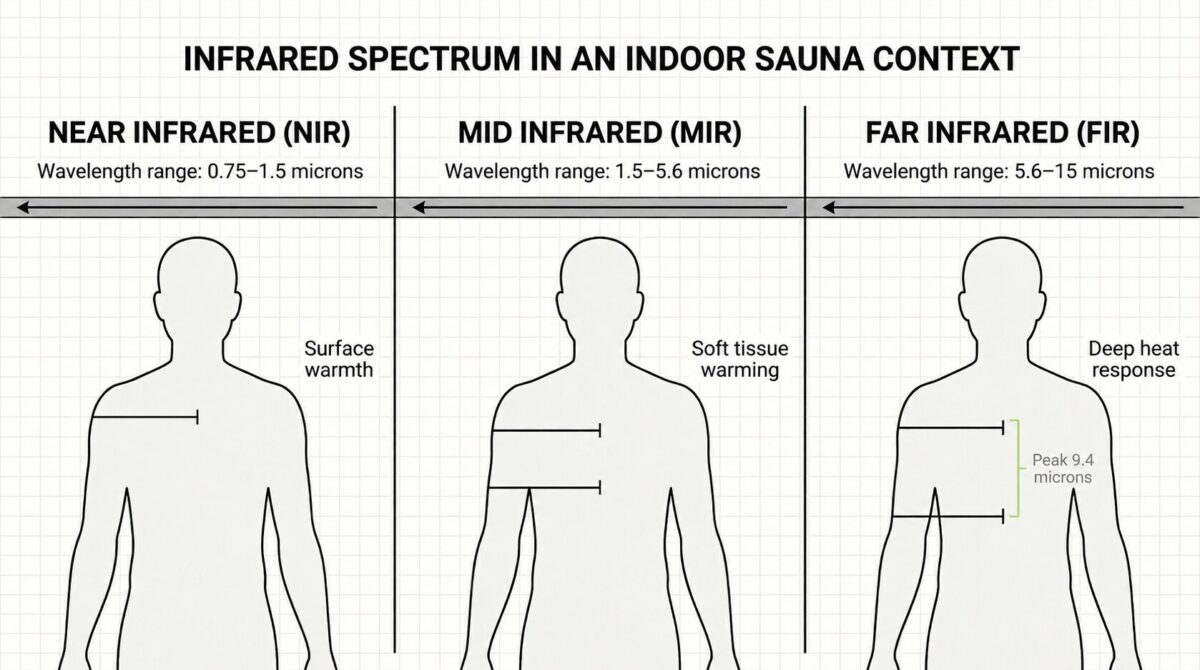
The infrared spectrum breaks down into three ranges:
Near Infrared (NIR) – penetrates just below the skin. Supports surface warmth and skin health.
Mid Infrared (MIR) – reaches soft tissue. Supports circulation and muscle recovery.
Far Infrared (FIR) – the deepest penetration. Raises core temperature and produces the strongest sweat response.
According to a 2024 review of far-infrared therapeutic parameters published in the journal Pharmacological Research, far infrared is absorbed by the high water content of human tissue and penetrates from a few millimetres to a few centimetres beneath the skin, where it is experienced as gentle radiant heat.
Most infrared saunas on the market produce far infrared radiation only. FIR is the easiest to manufacture, the most widely studied, and effective at lower temperatures. Full-spectrum systems – those delivering all three wavelengths – are less common and typically found in higher-end models.
But why does the heater type matter if it’s all infrared?
Because it determines how that infrared actually reaches you. How evenly. How quickly. And how deeply it penetrates. Two saunas can both produce far infrared – and deliver completely different experiences.
Carbon Heaters – Wide, Even, Gentle
Carbon panels changed the infrared sauna market when they arrived. And for good reason.
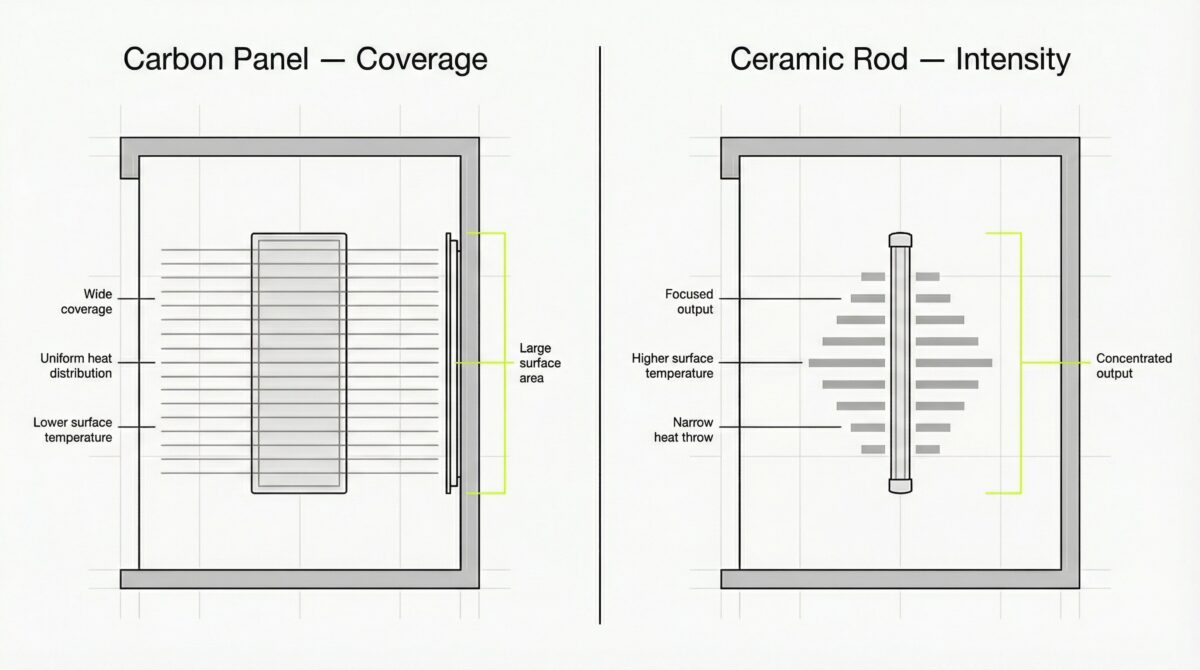
Mounted across the walls of the cabin, carbon heaters offer a large surface area. That’s the key advantage. Instead of heat coming from one concentrated point, it radiates from wide, flat panels – producing even heat distribution across the entire space.
The result is consistent warmth with minimal cold spots. You don’t get one side of your body roasting while the other stays cool. The infrared wavelength is longer, the surface temperature lower, and the overall experience is gentle enough for extended sessions.
Carbon panels are also energy efficient. Lower power draw, steady output, comfortable over 30-45 minutes without feeling overwhelming.
So what’s the catch?
Carbon heaters produce far infrared only. No near infrared. No mid infrared. That means you’re getting one part of the spectrum – the deepest penetrating wavelength, yes, but not the full range your body can benefit from.
They’re also slower to warm up. Where a ceramic element reaches operating temperature in minutes, carbon panels take longer to build that enveloping warmth.
And the sensation itself is gentler. For some users, that’s ideal. For those wanting a more intense, direct feeling – the kind you’d associate with a gym sauna – carbon alone can feel understated.
Worth noting: not all carbon panels are equal. Many budget saunas use thin carbon film heaters with poor placement and weak output. Vidalux carbon-only models use refined nano-carbon emitters with optimised positioning – a meaningfully different standard of engineering, even at the entry-level price point.
Ceramic Heaters – Fast, Intense, Focused
Ceramic rods were the original infrared sauna heater. They’ve been around for decades – and they’re still widely used for a reason.
The appeal is intensity. Ceramic heaters produce a higher surface temperature than carbon, delivering strong, immediate infrared output. They warm up fast. The heat hits you directly and deeply, particularly when positioned close to the body.
Ceramic can also be full spectrum. While basic ceramic elements produce far infrared only, premium ceramic heaters can deliver near, mid, and far infrared together. That’s a meaningful upgrade in the range of wellness support available.
But here’s where ceramic falls short.
The infrared throw is narrow. Ceramic rods produce intense heat close up, but the energy dissipates quickly over distance. Sit directly in front of one and you’ll feel it immediately. Move to the side of the cabin and you’ll notice cold zones – areas the heater simply can’t reach.
This creates hot spots near the element and cold spots further away. The heat distribution is uneven. For longer sessions, that imbalance can feel uncomfortable – too intense in one area, too cool in another.
Think of it like a desk lamp versus a ceiling light. The desk lamp is bright and focused where it points, but it leaves the rest of the room in shadow. That’s ceramic. Powerful, but limited in coverage.
Most brands that offer full-spectrum ceramic charge it as a premium upgrade – typically £200-£500 per heater on top of the base price. It’s effective technology, but the cost adds up quickly.
The Real Difference – Coverage vs. Intensity
So which is better? Carbon or ceramic?
Let’s be clear: that’s the wrong question.
The major difference between carbon and ceramic isn’t quality. It’s what each one prioritises.
Carbon heaters are the blanket. Wide, even, enveloping warmth that covers the whole cabin. Comfortable for long sessions. No harsh spots. But slower to heat, gentler in sensation, and limited to the far infrared spectrum.
Ceramic heaters are the spotlight. Fast, intense, deeply penetrating close-range heat. Powerful output and capable of full-spectrum delivery. But uneven in coverage, with cold zones that leave parts of your body underserved.
Does that mean every sauna buyer has to compromise?
Not necessarily. Most infrared saunas on the market pick one heater type – and live with the trade-off. That trade-off is the reason so many buyers end up disappointed. They read about infrared benefits, invest in a sauna, and find the experience doesn’t match expectations.
Not because infrared doesn’t work – but because the heater design only delivers half the picture.
The Vidalux Approach – Why We Combine Both Carbon Technologies
This is the question our R&D team spent years answering. Not “which heater is best?” but “what happens when you combine them properly?”
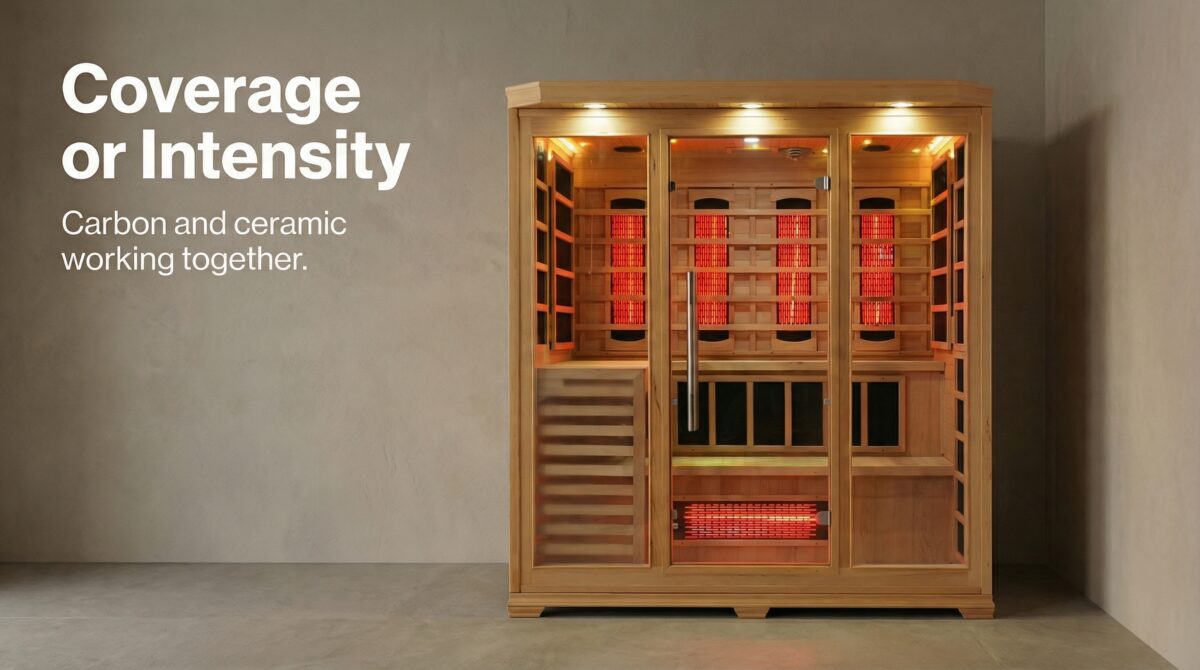
The result is Complete Heat – a system that pairs two heater types, working together by design.
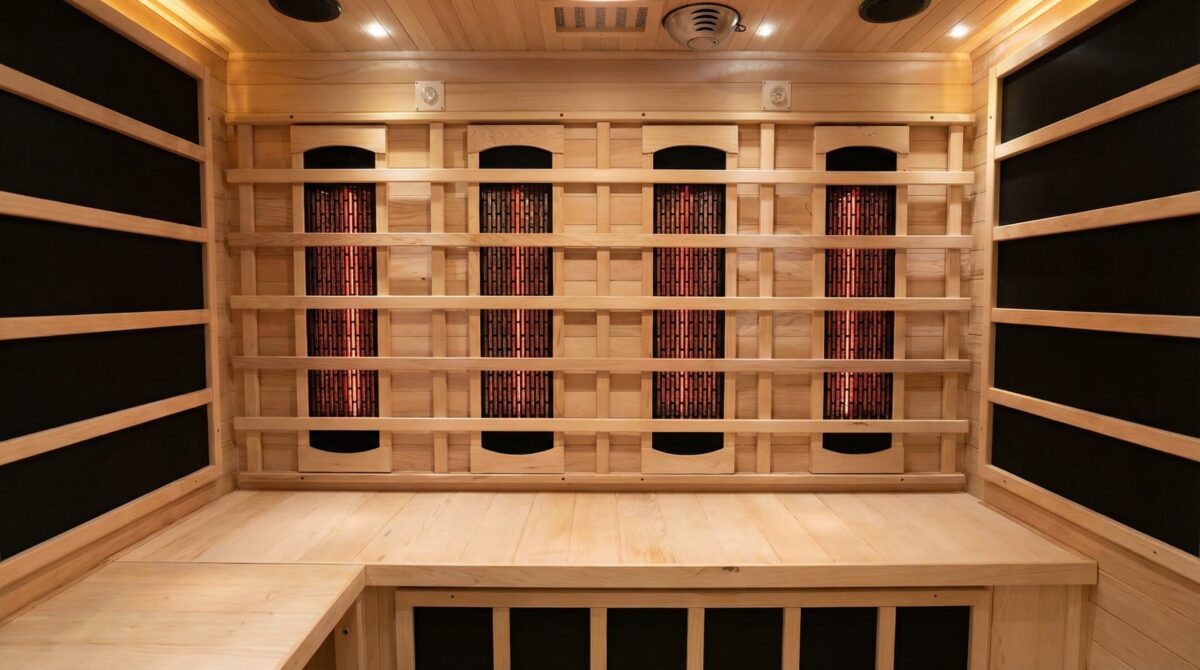
Nano-carbon crystal heaters line the walls and floor. These next-generation panels deliver wide, even far infrared coverage across the entire cabin. No cold spots. No dead zones. Stable, comfortable warmth that makes long sessions feel effortless. They’re energy efficient, produce low-EMF output, and are engineered for consistent, long-term performance.
Full-spectrum carbon fibre ruby quartz heaters sit behind the backrest, positioned close to large muscle groups. These high-output elements deliver all three infrared wavelengths – near, mid, and far – and begin heating instantly. They raise core temperature faster, penetrate deeper into tissue, and add the intensity that carbon panels alone can’t provide.
The combination eliminates the compromise. Wide coverage from the nano-carbon panels. Deep penetration and fast warm-up from the full-spectrum elements. No harshness. No slow starts. No cold zones.
What about the engineering behind it?
Put simply: two details matter here. First, the full-spectrum heaters are coiled in a concave shape with surgical-grade stainless steel deflectors behind them. Where flat or straight-tube heaters – used by the vast majority of the market – send infrared in a single direction and miss parts of the body, the concave design scatters and focuses the output to maximise body coverage.
Second, the heaters are tuned to concentrate output in the 6-12 micron range, peaking at 9.4 microns. That matches the wavelength the human body naturally emits – a principle called bio-resonance – which allows for greater absorption rather than the heat simply reflecting off the skin.
The carbon fibre itself has been redeveloped to deliver a 20% increase in infrared output (emissivity) versus standard carbon fibre heaters. And full-spectrum delivery – estimated to provide 10-15% additional benefit over FAR-only systems – comes included as standard in most Vidalux models. No upgrade fee. No add-on cost.
Most brands charge £200-£500 per heater for that same full-spectrum capability.
What to Look For When Comparing Saunas
Whether you end up choosing a Vidalux sauna or not, these are the questions worth asking before you commit.
What heater type is used? Carbon, ceramic, or a combination? Each has strengths, but a combined system addresses the limitations of both.
Is it full-spectrum or FAR-only? Full-spectrum infrared covers a broader range of wavelengths. If the sauna only offers FAR, you’re getting one part of the picture.
How is the heat distributed? Cold spots are a sign of poor heater layout. Ask about placement, not just heater count. More heaters doesn’t automatically mean better performance.
Is full spectrum included or sold as an upgrade? If it’s an expensive add-on, factor that into the real cost. A higher upfront cost with full spectrum as standard may offer better long term value than a cheaper cabin plus £500 in upgrades.
How quickly does it warm up? If you plan to use your sauna daily, warm-up time matters. A cabin that takes 30 minutes to reach temperature is less likely to get used than one that’s ready in 10-15.
One thing to consider: the sauna market is full of impressive-sounding specifications. But the quality of the heater – how it’s built, where it’s placed, how it’s tuned – matters more than the number of panels listed on a spec sheet.
Explore the full range of Vidalux home saunas at https://vidalux.co.uk/home-saunas/ to see what’s available, or browse the outdoor sauna range at https://vidalux.co.uk/outdoor-saunas/ if garden installation suits your space better.
The Honest Summary
The difference between a sauna that delivers and one that disappoints often comes down to the heater.
Carbon gives you coverage. Ceramic gives you intensity. The most effective infrared saunas don’t force you to choose – they combine both, engineered to work together rather than compromise.
Understanding heater technology won’t make the decision for you. But it will make sure the decision you make is an informed one.
Compare craftsmanship. Review the standards. Choose with confidence.
Frequently Asked Questions
Q: What is the difference between carbon and ceramic sauna heaters?
A: The difference between carbon and ceramic sauna heaters is how they deliver infrared heat. Carbon panels produce wide, even warmth across a large surface area, while ceramic rods produce fast, intense heat from a focused point – often leaving cold spots further away.
Q: Are carbon heaters better than ceramic for infrared saunas?
A: Carbon heaters are not better or worse than ceramic – they serve different purposes. Carbon provides gentle, even coverage for long sessions. Ceramic delivers faster, more intense heat. The most effective saunas combine both types for balanced performance.
Q: What is nano-carbon in an infrared sauna?
A: Nano-carbon in an infrared sauna refers to refined carbon crystal heating panels that produce wide, even far infrared coverage with low EMF output. They are more efficient than standard carbon film heaters and designed for comfortable, long-duration sessions.
Q: Do ceramic sauna heaters create hot spots?
A: Ceramic sauna heaters can create hot spots because they produce high surface temperatures with a short infrared throw. Areas close to the element feel intense, while spots further away remain cooler – resulting in uneven heat distribution across the cabin.
Q: What is full-spectrum infrared in a sauna?
A: Full-spectrum infrared in a sauna means the heaters produce near, mid, and far infrared wavelengths together. This provides a broader range of wellness support than far-infrared-only systems – estimated at 10-15% additional benefit.
- About the Author
- UK’s best-rated?

With over 22 years in the home spa industry, Andrew has overseen every stage of the journey—from initial product design and manufacturing to final installation. An author of multiple technical publications and scientific papers, he founded Vidalux to replace industry hype with engineering-led reliability. His focus remains on delivering gym-quality wellness through honest design and technical truth.
DISCLAIMER: All specifications, claims, and advice relating to any internal or external procedure, practise, product, or service were true at the time of writing. For more accurate and up-to-date details in relation to Vidalux services, please visit the relevant dedicated on-site page. For any product-related information, specifications, or guidance, the information on the product page should be considered the governing source.
Ready to choose?
Browse the full Vidalux range of saunas, steam showers, baths and shower cabins, all in one place