
Sauna When Pregnant: What Reliable Sources Say (And Our Honest Advice)
You’ve just found out you’re pregnant – and you’ve remembered the sauna.
Maybe you used it this morning. Maybe last week. You’re sitting with your phone, looking for a straight answer that doesn’t sound like a wellness blog trying to sell you something or a forum thread trying to scare you.
We’re a sauna company. And on the question of using a sauna when pregnant, we’re going to do something that might feel unusual coming from a supplier – we’ll show you what the reliable medical sources actually say, then tell you plainly what we’d suggest you do.
This article is informational only. It is not medical advice. For decisions about your pregnancy, the only person who should guide you is a midwife, GP, or obstetrician who knows your circumstances.
The Short Answer
Major UK and international health bodies advise pregnant women to avoid saunas, hot tubs, and steam rooms – particularly during the first 12 weeks. The concerns include overheating, dehydration, fainting, and findings from research linking elevated maternal core temperature in early pregnancy to neural tube defects and miscarriage. The evidence is genuinely limited and somewhat contested, but the consistent message from the authorities is the same.
Our position: we’d suggest you don’t use a sauna while pregnant. If you’re considering it, speak to your healthcare provider first – and proceed entirely at your own risk.
What The UK Health Bodies Say
The NHS is unusually candid about the state of the evidence. Its pregnancy guidance states plainly: “Little is known about the safety of saunas, hot tubs and steam rooms in pregnancy.” Despite that, the recommendation is clear – avoid situations where you could overheat, particularly in the first 12 weeks.
The flagged concerns are overheating, dehydration, fainting, and reduced blood and oxygen flow to the brain. For hydrotherapy pools, NHS guidance states the temperature should not exceed 35°C – a ceiling the Royal College of Obstetricians and Gynaecologists (RCOG) supports.
Tommy’s, the UK pregnancy and baby loss charity, takes the same line. Emma Lees-Laing, a midwife for Tommy’s, has stated: “There’s a risk of fainting if you get too hot, so that’s another reason we do advise pregnant women to avoid hot tubs and saunas.”
The NCT is more cautious about claiming certainty. Citing BUMPS – the patient-facing service from the UK Teratology Information Service – the NCT acknowledges that “there is no clear evidence about the safety or risk of using saunas and hot tubs while pregnant.”
Worth noting: in countries like Finland, where sauna use is widespread during pregnancy, there is no observed higher rate of adverse birth outcomes.
What International Authorities Say
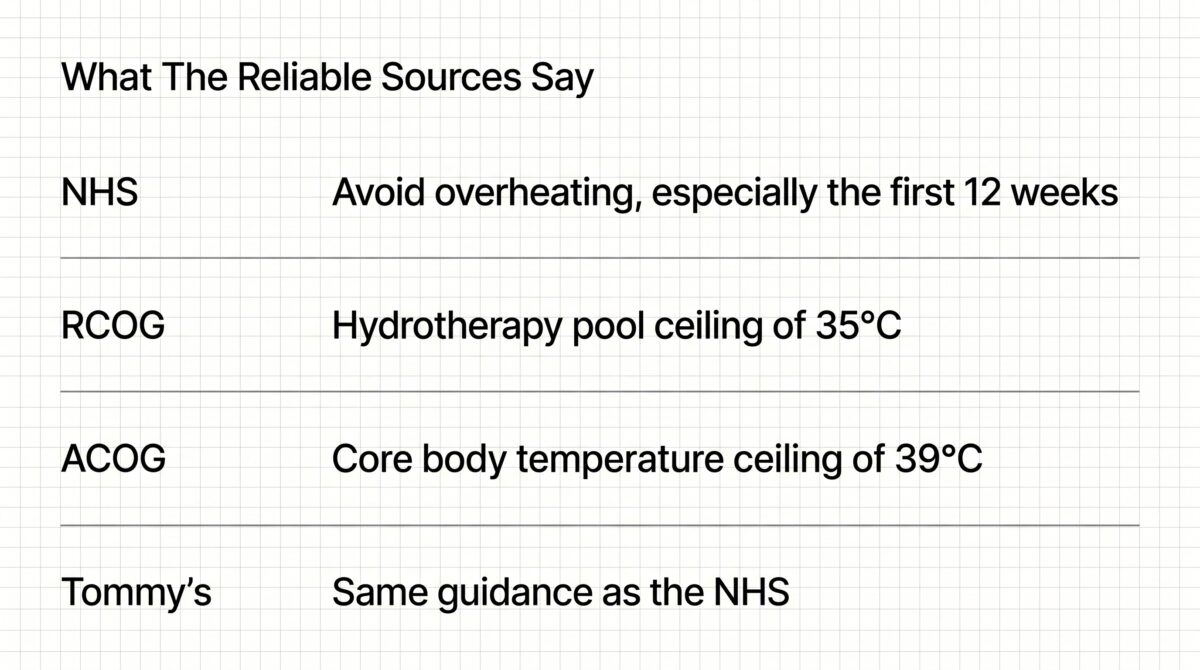
The pattern outside the UK is consistent. ACOG (the American College of Obstetricians and Gynaecologists) advises avoiding saunas, steam rooms, and hot tubs during pregnancy, particularly in the first trimester, and specifically recommends that pregnant women never let core body temperature rise above 102.2°F (39°C).
The CDC cautions against any activity that significantly elevates core temperature during pregnancy. OTIS (the Organisation of Teratology Information Services) flags 101°F (38.3°C) and above as a concern. WHO Europe identifies heat exposure as a pregnancy risk factor. The American Pregnancy Association recommends avoiding sauna use throughout all nine months.
Different countries. Different bodies. Same recommendation.
What The Research Actually Found
Here, the honesty has to get sharper. We’re going to show you both the concerning findings and the contradicting study – because that’s what reliable sources actually look like.
The most cited piece of research is Moretti et al. (2005), published in Epidemiology. It was a meta-analysis of 15 studies covering 1,719 cases and 37,898 non-cases.
The authors found that maternal hyperthermia in early pregnancy was associated with an odds ratio of 1.92 for neural tube defects – close to a doubling of risk – and concluded that maternal hyperthermia in early pregnancy may be a human teratogen. A more recent umbrella review reaffirmed this classification, placing hyperthermia among the “highly suggestive evidence” risk factors for neural tube defects.
A separate study – Li et al. (2003), published in the American Journal of Epidemiology – looked at 1,063 women in the Kaiser Permanente system in California. It found that hot tub use after conception was associated with a twofold increased risk of miscarriage, rising to 2.7 times for women who used a hot tub more than once a week.
Worth flagging: the study’s lead author, Dr De-Kun Li, noted that saunas may be less risky than hot tubs because the body can still sweat into the air to cool itself, though he still recommended avoidance.
But what about studies suggesting it might be okay?
There is one. Ravanelli et al. (2018), published in the British Journal of Sports Medicine, was a meta-analysis of 12 studies covering 347 pregnant women. The researchers found that across all studies, no woman exceeded the 39°C core temperature limit.
Their suggestion: pregnant women might safely sit in dry saunas at 70°C and 15% humidity for up to 20 minutes. The crucial caveat – and the researchers said this themselves – is that more studies are needed before official advice should be changed. One meta-analysis isn’t enough to overturn a multi-decade consensus on a question where the downside risk is severe.
Why Pregnancy Changes How Your Body Handles Heat
During pregnancy, the body already runs warmer due to hormonal changes and increased blood supply to the skin. In a hot environment, the body cannot lose heat as effectively, so core temperature rises faster. Vasodilation lowers blood pressure, which is why fainting is a flagged risk.
The foetus is the part most people don’t realise. A foetus cannot thermoregulate – sweat glands don’t begin forming until around week 16. Until then, the foetus relies entirely on maternal circulation to manage temperature. The first trimester is the critical window because the neural tube – the structure that becomes the brain and spinal cord – closes between roughly days 21 and 28 after conception.
Our Honest Advice
Let’s be clear. We sell saunas. We are not medical professionals.
The combined weight of the NHS, RCOG, ACOG, Tommy’s, and decades of research points one way: avoid sauna use during pregnancy. Yes, one study suggests short exposures may not exceed the danger threshold. We’ve shown you that study. But the authors themselves said it isn’t enough to change the advice.
Worth knowing: the same advice is written into our own paperwork. The Vidalux sauna installation manual states plainly that pregnant women should consult a physician before using any sauna, that fetal damage can occur with elevated body temperature, and that it is advised at any stage of pregnancy not to use a sauna. We took that position in our engineering documentation before we ever wrote this article.
Our default recommendation is don’t. We’d rather lose a sale than mislead you.
If you’ve already used a sauna before knowing you were pregnant, don’t panic – speak to your midwife or GP. Most one-off exposures are unlikely to cause harm, but they should be known. If you’re determined to consider sauna use during your pregnancy, do so only after explicit guidance from a qualified health professional who knows your full medical picture, and entirely at your own risk.
Safer Alternatives While You’re Pregnant
You probably came here because you wanted relaxation, relief from aches, or a way to unwind. Those needs don’t disappear during pregnancy – they often intensify.
Gentler options: a warm bath kept below body temperature, prenatal massage from a qualified practitioner, antenatal yoga, swimming in a properly temperature-controlled pool, and pregnancy-safe relaxation techniques. Your midwife can point you toward what’s appropriate for your stage.
After Pregnancy: When Your Sauna Is Yours Again
Pregnancy doesn’t last forever. The sauna will still be there. Most healthcare providers will have a view on when sauna use can be reintroduced after birth, particularly if you’re breastfeeding – have that conversation when the time comes. A home sauna is designed for the years and decades after these nine months are behind you. We’ll still be here when you’re ready.
Frequently Asked Questions
Q: I used a sauna before I knew I was pregnant – should I be worried?
A: One-off exposures are generally unlikely to cause harm, but you should still tell your midwife or GP. They can review the timing and your individual circumstances and offer reassurance. Don’t assume – ask.
Q: What about infrared saunas – are they safer during pregnancy?
A: Infrared saunas operate at lower air temperatures, but they still raise your core body temperature. The same authorities (NHS, ACOG) recommend avoiding heat exposure regardless of source. Speak to your healthcare provider before any use.
Q: Is a sauna safer in the second or third trimester?
A: Some practitioners suggest brief, low-heat sessions may be acceptable later in pregnancy with explicit medical approval. Others advise avoidance throughout. The American Pregnancy Association recommends avoidance for the full nine months. We’d suggest the cautious path.
Q: Can my partner still use the sauna at home while I’m pregnant?
A: Yes. The guidance discussed in this article applies only to the pregnant person. Partners and other household members can use a home sauna as normal, with the usual sensible precautions around hydration and session length.
Pregnancy is full of these moments – small decisions, big questions, and a lot of conflicting advice. When in doubt, choose the cautious path. Talk to a professional who knows you. Don’t take chances you don’t need to take.
The sauna will still be here.
- About the Author
- UK’s best-rated?

With over 22 years in the home spa industry, Andrew has overseen every stage of the journey—from initial product design and manufacturing to final installation. An author of multiple technical publications and scientific papers, he founded Vidalux to replace industry hype with engineering-led reliability. His focus remains on delivering gym-quality wellness through honest design and technical truth.
DISCLAIMER: All specifications, claims, and advice relating to any internal or external procedure, practise, product, or service were true at the time of writing. For more accurate and up-to-date details in relation to Vidalux services, please visit the relevant dedicated on-site page. For any product-related information, specifications, or guidance, the information on the product page should be considered the governing source.