Where Does the Steam Go When You’re Done? The Ventilation Answer That Surprises Everyone
Steam room ventilation causes a particular kind of worry, usually around 11pm. Three threads deep into a DIY forum, somewhere between a post about wood rot and a comment about industrial extraction, the same question keeps resurfacing. Where does all that steam actually go?
The mental picture is usually a bathroom filling up like a sauna at closing time. Someone mentions ducting through an outside wall. Someone else implies building work. By then, ventilation feels like a problem that should have been solved before the project started.
The answer is far simpler than the forums suggest. It comes down to one distinction almost nobody explains properly: the fan inside the cabin and the extractor in the bathroom are doing two completely different jobs.
Once that clicks, the whole worry deflates.
What Happens Inside the Cabin During Your Session
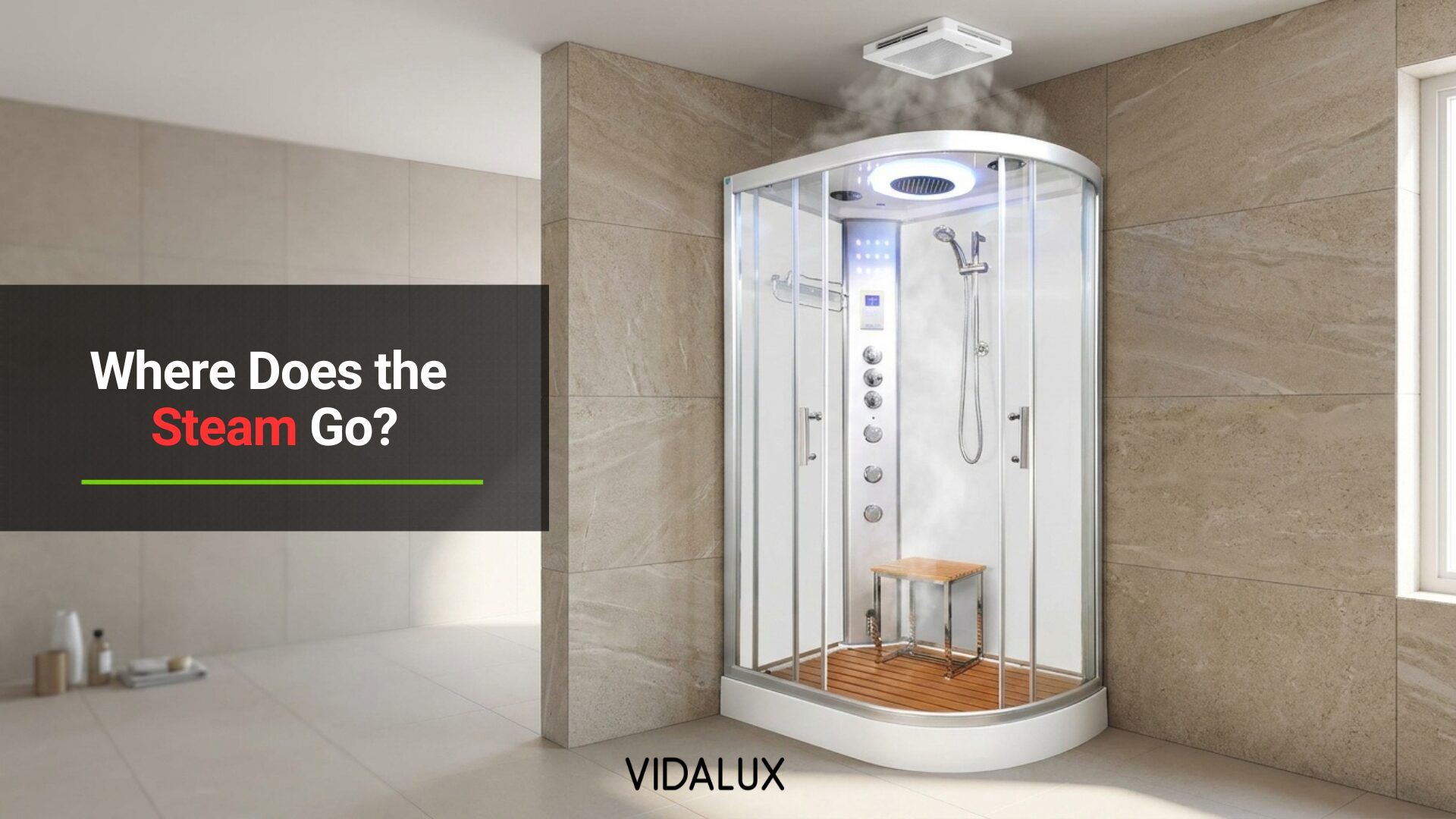
Steam does not fill your bathroom while you’re using the cabin. On a fully enclosed cabin it stays inside the enclosure, because the enclosure is closed and the door is shut.
That sounds obvious written down. It’s less obvious at 11pm.
A steam shower cabin is a self-contained unit. The generator produces steam inside it, and the cabin’s construction holds that steam where it belongs, by design: steam needs a contained environment to build to a useful temperature and humidity. A cabin that leaked into the room would be a poor steam experience and, frankly, a poor product.
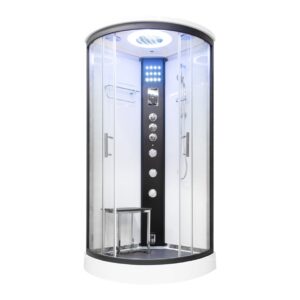
One distinction worth knowing before you choose: fully enclosed cabins keep the steam contained, while open-top models will release more of it into the bathroom during the session. Neither is a problem, but they behave differently, and it’s worth knowing which you’re looking at.
For a first-time user, a shorter session of 5 to 10 minutes is the recommended starting point. Twenty minutes works well as a general median once you’re used to it, with up to 30 minutes as the outer limit for experienced, well-hydrated users, and that applies across every model in the range.
So on a fully enclosed cabin, little is happening in your bathroom during those 15 minutes. The real question is where the steam goes afterwards.
So When Does Steam Actually Leave the Cabin?
When the session ends. The cabin’s built-in extractor fan clears residual steam out of the enclosure and into the bathroom, and every current Vidalux steam shower cabin has one fitted as standard.
That fan is doing a specific, limited job: emptying the cabin. It is not ventilating your room. TWO different jobs, two different pieces of equipment.
Think of it like the extractor hood over your hob. The hood clears steam at the source; the kitchen window and the house handle the rest. Nobody expects the hood to ventilate the whole kitchen, and nobody should expect the cabin fan to ventilate the whole bathroom.
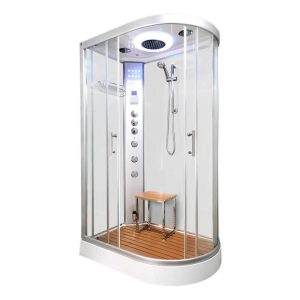
On the Aegean 1350, for example, the roof-mounted extractor fan removes steam from the unit while you shower.

But doesn’t a steam session produce far more moisture than a normal shower?
Less than you’d think, because most of it dissipates within the enclosure rather than escaping into the room. That containment is the design intent. What the fan clears afterwards is residual: a tail end, not the whole session’s worth.
Does My Standard Bathroom Extractor Handle the Rest?
For the overwhelming majority of installations, yes. Most customers rely on natural bathroom ventilation and make no amendments or connections to the cabin fan at all.
If your bathroom already has a working, compliant extractor fan, the one that clears the mirror after a shower, it is already designed to remove moisture-laden air. A steam session gives it a slightly bigger job on a slightly longer timescale. It does not give it a different job.
For context on what “compliant” means, the standard is set out in Approved Document F, the government’s statutory ventilation guidance for England. According to the Ministry of Housing, Communities and Local Government’s Approved Document F guidance, bathrooms require intermittent extract ventilation at a minimum rate of 15 litres per second. That figure comes from building regulations, not from us. It’s the benchmark your installer or building control will already be working to.
The single most useful habit costs nothing. Let the extractor run on after you’ve finished, rather than switching it off with the light.
A humidity-controlled extractor automates exactly that, running until the room’s moisture level drops back to normal and then stopping on its own. If you’re having any electrical work done in the bathroom, your Part P qualified electrician will confirm what’s suitable for your setup.
What About Mould… Is That a Real Risk?
Mould is a real risk in any poorly ventilated bathroom. It is a bathroom ventilation problem, though, not a steam cabin problem, and the distinction matters, because it changes what you’d actually fix.
The honest truth? The clearest early warning sign is the mirror inside the cabin. When the back panel mirror starts to blacken at the edges, that’s de-silvering, moisture getting behind the glass and attacking the mirror backing. It’s cosmetic rather than a safety issue, and it’s often down to a lack of ventilation in the bathroom after showering rather than anything the cabin has done.
An inadequate extractor, or one switched off the moment you leave, leaves a room damp. That’s the condition that causes it.
On a fully enclosed cabin, the containment works in your favour here. Because the steam stays inside during the session and is then cleared gradually by the cabin fan, moisture enters the bathroom over a period rather than all at once. A working extractor has time to keep up.
When Does Steam Room Ventilation Need More Than the Standard Setup?
Rarely, but honestly: yes, some bathrooms benefit from more. A small internal en-suite with no window and a tired old fan is a different proposition to a family bathroom with decent extraction.
If that describes your room, upgrading the bathroom extractor itself is the first and usually the only thing worth doing.
Beyond that, there are two optional routes, and both are genuinely optional:
- Universal ducting pipe. The cabin fan’s output can be connected to universal ducting to direct steam outside through a wall. Available, occasionally useful, not typically necessary.
- A linked extractor. The cabin fan can be linked to an additional extractor fan in the bathroom, if you want the belt-and-braces version.
Whether either makes sense depends on your bathroom’s size, layout, and which fixtures you’d rather keep dry.
And here’s what you don’t need: industrial extraction, dedicated steam room ducting to outside, structural work, or any modification inside the cabin. If someone has quoted you for that, it’s worth a second opinion.
The Vidalux Approach: Designed So You Don’t Have to Overthink It
The built-in fan, the Auto Drain function that clears the generator after use, and the enclosure design all exist for the same reason. Post-session ventilation should be a handled problem, not homework.
We build from hands-on installation experience, which means we’ve seen what actually goes wrong in real bathrooms. A good deal of it isn’t the cabin at all. It’s a room that never had adequate ventilation in the first place, and a fan that gets switched off too early.
You can see how the enclosures are put together across the steam shower range. The containment is structural, not an add-on.
The question “where does the steam go?” deserves a simple answer. The engineering was built so that it has one.
The Short Version
On a fully enclosed cabin, steam stays inside while you’re in it. When you finish, the cabin’s fan moves what’s left into the bathroom, and your existing extractor clears the room, the same way it does after any shower. For most homes, that’s the whole story, and no additional work is required.
If you’d like to go further into planning and installation, our steam shower guides cover the practical detail. Or read how we engineered leaks out of our cabins to see how the cabins are built.
Frequently Asked Questions
Q: Does a steam shower cabin need special ventilation in the bathroom?
A: A steam shower cabin does not require special ventilation beyond a standard compliant bathroom extractor fan. A fully enclosed cabin contains steam during the session; when it ends, the cabin’s built-in fan clears residual steam into the bathroom, where the existing extractor manages it.
Q: Where does the steam go when a steam shower session ends?
A: When a steam shower session ends, the cabin’s built-in fan moves residual steam from inside the cabin into the bathroom. Once in the room, it behaves like steam from any shower, rising and dispersing, then removed by the standard bathroom extractor fan.
Q: Do I need external ducting for a steam shower cabin?
A: Most steam shower cabin owners do not need external ducting. Natural bathroom ventilation handles post-session humidity for the majority of installations. Optional ducting via universal ducting pipe is available for those who prefer a more direct extraction route, but it is not a standard requirement.
Q: Can mould develop from a home steam shower?
A: Mould can develop if bathroom ventilation is inadequate, but this is a bathroom extractor issue, not a steam cabin issue. A fully enclosed cabin contains steam during use. Running a compliant bathroom extractor fan after each session, ideally humidity-controlled, helps prevent condensation settling on walls and ceilings.
Q: What is the fan inside a steam shower cabin for?
A: The fan inside a steam shower cabin is designed to clear steam from inside the cabin itself after use, not to ventilate the whole room. It works in sequence with the bathroom extractor: the cabin fan clears the enclosure; the room extractor removes moisture from the bathroom.
Q: How long should a bathroom extractor run after a steam session?
A: A bathroom extractor should continue running after a steam session ends, not just while it is in progress. Run it on for a period afterwards, or fit a humidity-controlled extractor that runs automatically until room moisture drops back to normal levels.
Q: Does UK Building Regulations Part F apply to steam shower bathrooms?
A: UK Building Regulations Part F applies to all bathrooms, including those with steam shower cabins. Approved Document F sets a minimum intermittent extract rate of 15 litres per second for bathrooms. A correctly installed, compliant standard bathroom extractor fan meets this without specialist equipment.
- About the Author
- UK’s best-rated?

With over 22 years in the home spa industry, Andrew has overseen every stage of the journey—from initial product design and manufacturing to final installation. An author of multiple technical publications and scientific papers, he founded Vidalux to replace industry hype with engineering-led reliability. His focus remains on delivering gym-quality wellness through honest design and technical truth.
DISCLAIMER: All specifications, claims, and advice relating to any internal or external procedure, practise, product, or service were true at the time of writing. For more accurate and up-to-date details in relation to Vidalux services, please visit the relevant dedicated on-site page. For any product-related information, specifications, or guidance, the information on the product page should be considered the governing source.
Ready to choose?
Browse the full Vidalux range of saunas, steam showers, baths and shower cabins, all in one place