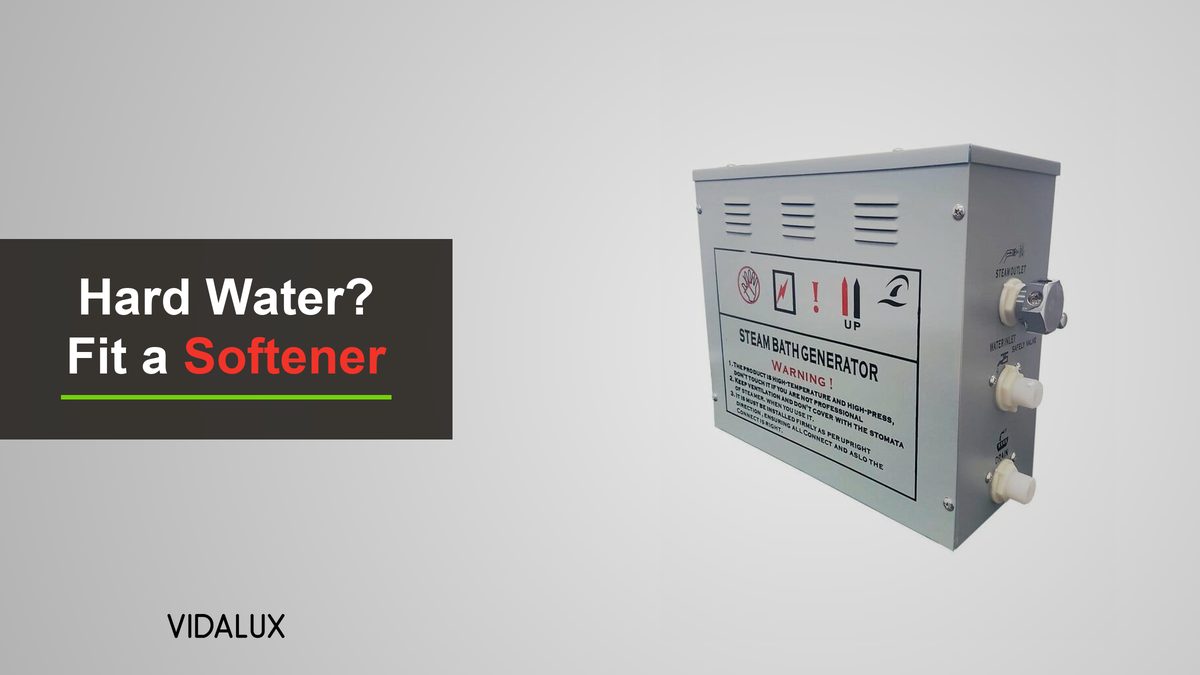
Hard Water and Steam Generators: What Causes Damage and How to Stop It
You’ve seen what hard water does to a kettle. A chalky crust builds on the element, flakes float in your tea, and the kettle takes longer to boil each month until it gives up.
A steam generator goes through the same process, with more at stake. It heats water to 100°C and relies on solenoid valves and electronic sensors to produce steam, and it costs a good deal more than a kettle to replace. If you live in a hard water area, the link between hard water and steam generators is the first thing to understand before you buy a steam shower or steam room.
This guide covers what limescale does inside the generator, the warning signs, and the step Vidalux advises for every hard-water home: a Vidalux water softener, the Clear & Bright.
Why Hard Water and Steam Generators Don’t Mix
Hard water carries dissolved calcium and magnesium, and heat pulls those minerals out as limescale. A steam generator boils water every session, so in a hard water area scale builds on its internal parts session after session.
According to the Drinking Water Inspectorate, water hardness is caused by dissolved calcium and magnesium, and scaling is defined as deposits of those minerals that build up on heating elements over time. The Inspectorate classes water at 200 to 300 mg/l as hard, with anything above 300 mg/l in its hardest band.
And a generator draws fresh water from the mains every time it fills. Each fill brings in a new dose of minerals, and each boil leaves some of them behind.
Which Parts Does Limescale Attack?
Limescale reaches three parts of a steam generator: the heating element, the inlet solenoid valve, and the water level sensor.
The heating element sits in the water, so scale forms on it first. That crust acts like a layer of insulation, and the element has to run hotter to push heat through it. Vidalux’s troubleshooting guidance describes the end of a failed element: the casing has cracked, water touches the live wire inside, and the RCD trips. At that point the element needs replacing. If you want the full fault story, our guide on why generators trip the RCD walks through it.
What about the valves and sensors?
The inlet solenoid valve controls the water coming into the generator, and it holds a tiny mesh filter. In a hard water area that filter can block with grit or scale, and once it does, the generator won’t fill with water at all.
In a steam shower cabin, the water level sensor is usually a set of three probes on top of the generator. When scale coats the sensor, it can’t read the water level and keeps filling the tank. The result is a generator that overfills and spits hot water from the steam outlet.
Is Descaling Enough on Its Own?
Descaling has a place, but it can only remove scale that has already formed. By the time you reach for a descaler, the element is coated and the water level sensor may already be giving false readings.
There’s a second risk. Vidalux’s guidance is to use approved descalers only, because aggressive acids will eat the heating element seals. A strong chemical aimed at one fault can create another.
Descaling also needs access, effort, and a sense of when to do it, and scale keeps building between sessions in the meantime. Stopping the minerals from causing scale in the first place is the more dependable route, and that’s where a softener comes in.
How a Water Softener Protects the Generator
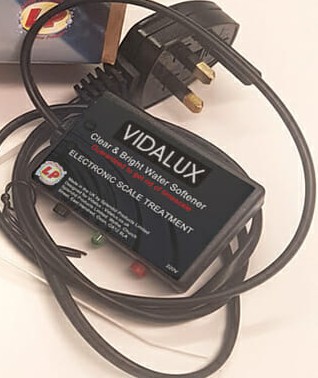
A water softener deals with the hard water before it reaches the generator. Vidalux recommends fitting the Clear & Bright softener to prevent scale build-up in the first place, and for a home in a hard water area the warranty terms describe fitting a softener as essential.
The Clear & Bright Water Softener is an electronic scale treatment unit, designed in partnership with a UK water softener manufacturer. It needs no plumbing and no chemicals. It uses computerised microchip technology, runs from a 2m mains lead, and works through a 1.5m aerial, and it costs about £2 a year to run. One unit treats a single appliance or a one-to-four-bedroom home, it’s made in the UK, and it has been tested over ten years and used by professionals. Vidalux describes it as designed to protect a new or existing shower.
What about the drain on a steam shower cabin?
Vidalux steam shower cabins have an Auto Drain function, and you should hear it drain after use. If the steam ever smells musty, that points to stagnant water, and the drain is the first thing to check.
Is Limescale Damage Covered by the Warranty?
No. Under the Vidalux warranty terms, any item where calcium build-up from hard water is suspected to be the cause of the reported issue is not covered, because it isn’t a product fault.
The same terms advise a water softener or another solution to deal with calcium build-up at the source, and say that if you are known to be in a hard water area, fitting a water softener is essential. If you’re unsure, the terms suggest contacting your water board. When a part is returned to base for testing and calcium build-up is present, the testing team takes images and sends them back with a report, and the customer is offered the original part back or a paid replacement. A seized thermostatic cartridge is treated the same way: Vidalux’s guidance lists a stiff temperature dial as a sign the cartridge has seized with limescale, and it’s not a warranty fault if hard water is the cause. Fitting a softener when the generator goes in is the simplest way to keep these costs off your list.
Signs Your Generator Is Already Scaling Up
If you already own a steam shower or steam room, a few symptoms point towards limescale.
A generator that won’t fill with water often has a blocked mesh filter in the inlet solenoid valve. Water spitting or spurting from the steam outlet usually means the water level sensor is scaled up and the tank is overfilling.
What if the steam stops after 15 minutes?
On a Vidalux steam shower, that’s normal. Steam sessions are capped at a maximum of 15 minutes by design. If the generator cuts out before the time you set, the time limit setting or a pressure or heat overload are the likely causes, and a steam outlet nozzle blocked with calcification is worth checking.
On a steam shower, an E2 error indicates a sensor fault that trips the safety shutdown. The most common causes are a water level sensor fault, including scale on the probe, or a failed temperature sensor. A stiff temperature dial points to limescale in the thermostatic cartridge, which tells you hard water is affecting the wider shower too.
Vidalux’s guidance covers replacing a failed heating element, a seized cartridge, or a drain valve that needs cleaning, and our guide to replacement parts for steam showers explains why that counts when you choose a cabin. Without a softener, though, new parts will face the same water.
How Vidalux Generators Fit Into the Picture
Vidalux steam room generators are designed for long-term domestic use, and no generator anywhere is immune to limescale. The aim is a well-built unit paired with treated water.
Each generator has a stainless steel case and internal reservoir that is corrosion-resistant, hygienic, and built to withstand repeated heating cycles. A fast-start function produces steam quickly, a temperature probe holds the temperature you select, and every unit is ISO9001 and CE certified. The range runs from 3kW to 15kW, and all units share the same engineering, with only the power output and room coverage changing. A 6kw Steam Room Generator, for example, is listed for rooms of 5 to 8 m³.
Room size, insulation, ventilation, and ceiling height all affect which output you need, so our guide to sizing a steam room generator is the place to start. For cabins with the generator built in, see the steam shower range.
Practical Steps for a Hard Water Home
Start by finding out how hard your water is. Your water company can tell you, and asking them directly gives a more accurate answer than a general map, because hardness varies locally.
If you’re in a hard water area, you need a Vidalux water softener, the Clear & Bright, fitted when the steam shower or generator goes in, so the generator isn’t running on untreated water. If you already own a generator, adding a softener now won’t reverse scale that has formed, but it helps stop further build-up.
Avoid aggressive descalers, and use approved products only if you do descale. On a steam shower cabin, listen for the Auto Drain after each session.
Finally, register your warranty within 90 days of delivery. Steam generators need a Part P installation certificate number on the registration form where new electrics have been installed in the bathroom, and the person who did the electrical work supplies it.
For more on choosing, fitting, and caring for a steam shower, browse our steam shower guides.
If you’re in a hard water area, the Clear & Bright Water Softener is the step to take before the generator goes in.
Frequently Asked Questions
- About the Author
- UK’s best-rated?

With over 22 years in the home spa industry, Andrew has overseen every stage of the journey—from initial product design and manufacturing to final installation. An author of multiple technical publications and scientific papers, he founded Vidalux to replace industry hype with engineering-led reliability. His focus remains on delivering gym-quality wellness through honest design and technical truth.
DISCLAIMER: All specifications, claims, and advice relating to any internal or external procedure, practise, product, or service were true at the time of writing. For more accurate and up-to-date details in relation to Vidalux services, please visit the relevant dedicated on-site page. For any product-related information, specifications, or guidance, the information on the product page should be considered the governing source.
Ready to choose?
Browse the full Vidalux range of saunas, steam showers, baths and shower cabins, all in one place