How Much Does a Sauna Cost in the UK? 2026 Price Guide
Type “how much does a sauna cost” into Google and you’ll get answers ranging from a few hundred pounds to five figures, with little explanation of why the gap is so wide. The honest answer is that a home sauna’s price is decided almost entirely by heater technology, not by size or looks alone.
Two cabins can be near-identical in dimensions and timber, and still sit £600 apart because one uses a single heater type and the other uses three working together. This guide breaks the UK sauna market down by heater technology, starting at the entry point and working up to the flagship option, so you can see exactly what you’re paying for at each step.
Prices below are supply-only, correct as a guide for 2026, and will move with seasonal sales… treat them as bands to plan around, not fixed quotes.
How Much Does a Carbon-Only Infrared Sauna Cost?
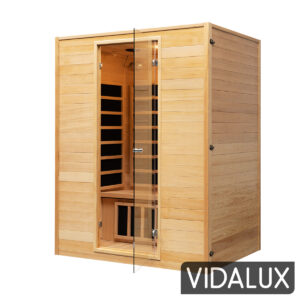
Carbon-only infrared saunas are the most affordable way into home sauna ownership, with cabins typically starting from around £1,100. A 3-Person Carbon Infrared model, for example, currently sits at around £1,600… entry-level pricing for a genuinely capable sauna.
Carbon-only means exactly what it says: nano-carbon panels producing far infrared (FAR) heat, and nothing else layered on top. That’s not a downgrade so much as a deliberate simplification. The panels spread heat wide and evenly across the cabin, the warm-up is gentle rather than fast, and running costs stay lower, but this is an entry-level and the most basic of sauna experiences.
Is carbon-only “worse” than the pricier options? Not worse, more limited in wavelength range. Carbon-only heaters produce FAR infrared only, so you miss the near and mid infrared bands that full-spectrum systems add. For daily, low-temperature wellness sessions, plenty of owners never notice the difference. For anyone who wants the fastest warm-up, the fullest wavelength coverage and most health rewards, this is the model to step up from, not settle on.
Worth noting: most FAR-only saunas on the wider market use thin, generic carbon sheets and basic electronics. Vidalux’s carbon-only range uses the same nano-carbon materials, timber quality and safety testing as the rest of the line-up… it’s an entry point within Vidalux, not a compromise on build.
How Much Does a Full-Spectrum Infrared Sauna Cost?

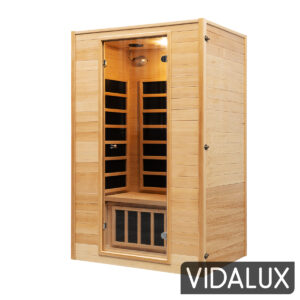
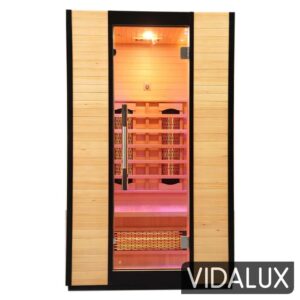
Full-spectrum infrared saunas… what Vidalux builds as “Complete Heat”… typically run from around £1,400 to £2,450 depending on cabin size, sitting a clear step above carbon-only pricing. A Solara 2-Person Complete Heat model currently comes in at around £1,500-£1,600, and the Platinum 2-Person version at around £1,750-£1,800, with smaller single-person cabins pricing in below that band.
Here’s the thing that actually justifies the extra spend: full-spectrum means near, mid and far infrared (NIR, MIR and FIR) working together, rather than FAR alone. Complete Heat pairs nano-carbon panels on the walls and floor with Carbon Fibre Ruby Quartz Glass Full Spectrum Heaters positioned close to the backrest, so you get the wide, even coverage of the nano-carbon panels plus the faster, deeper penetration of the Ruby Quartz Full Spectrum Heaters… without either heater type’s usual weak point. Most competitors sell full-spectrum as a separate upgrade, often adding £200 to £500 to the base price. Vidalux includes it as standard across the Complete Heat range.
Practically, that buys you a faster warm-up than carbon-only, no cold spots around the cabin, and a session that reaches a comfortable core temperature sooner. It’s the mid-pricing point of the range for a reason: strong enough for daily use, unbeatable in terms of health rewards and represents the leading technology within the market
Worth noting: Vidalux pioneered Complete Heat, combining nano-carbon panels and Ruby Quartz Full Spectrum Heaters in one cabin, and brought it to the market. It is a lot more commonplace now that many imitation brands look to mimic leading technology.
The Hybrid Option: Infrared and Traditional Heat, Combined
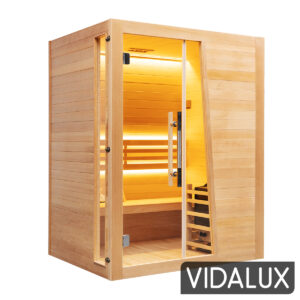
Hybrid saunas sit at the top of the range, typically pricing from around £2,100 for a 2-Person model up to around £2,800 as cabin size increases. A 2-Person Hybrid currently sits at around £2,000-£2,100, and the 3-Person version at around £2,250-£2,300… the clearest jump in the price ladder, because you’re paying for two complete heat systems in one cabin.
A hybrid pairs full Complete Heat infrared with a genuine traditional stove, combining the best of both worlds rather than compromising on either. The infrared side runs the same nano-carbon and full-spectrum heaters as the standalone Complete Heat range. The stove side is a proper Finnish-style unit… sized to the cabin, with exact wattage varying by model, so check the specific product page… capable of the same high-temperature, löyly-ready sessions as a dedicated traditional sauna.
Can you run both heat systems at once? No, and that’s by design. You switch between infrared mode and traditional stove mode, using one at a time. Neither heat source runs at a reduced level to accommodate the other… each performs exactly as it would as a standalone sauna, engineered to work independently rather than simultaneously.
That’s the honest trade-off with a hybrid: you’re paying the premium price of two heat systems, and you get the full performance of both, just not together in the same session. For households who genuinely can’t decide between gentle daily infrared and an intense weekend stove session, it removes the need to choose.
Worth noting: Vidalux was again the first to mark it with the hybrid sauna combination, and that is especially true when it comes to pairing Ruby Quartz Full Spectrum Heaters with nano-carbon panels. Our leading technology and innovations are often copied and we consider imitation to be the highest form of flattery. Whilst they imitate, we are happy to never be beaten.

What About a Traditional Stove-Only Sauna?
Traditional stove-only saunas, priced from around £1,450 to £1,850 depending on size, sit below hybrid pricing because there’s only one heater to build and wire. A 1-Person Klassikko Traditional model currently prices at around £1,450, fitted with a 3kW heater as standard (a 3.6kW upgrade heater is available as an option), rising to around £1,650 for the 2-Person version.
There’s no infrared here at all… just a stove heating the air, the cabin and a bed of stones to the classic 70°C-90°C Finnish range, with löyly available whenever you pour water over the hot stones. It’s the purist’s choice: strong, enveloping, dry heat with the option of a steam burst, rather than the gentler, lower-temperature session infrared delivers.
If intense heat and an authentic stove ritual matter more to you than infrared’s wellness benefits, this is the cheaper route to that experience than buying it bundled into a hybrid.
Sauna Price at a Glance
| Sauna type | Typical price band (as a guide) | What drives the cost |
|---|---|---|
| Carbon-only infrared | From around £1,100 | Single heater type (FAR only), simplest build |
| Full-spectrum infrared (Complete Heat) | Around £1,400-£2,450 | NIR + MIR + FIR as standard, no cold-spot engineering |
| Traditional stove-only | Around £1,450-£1,850 | Stove, stone bed, higher-temperature build |
| Hybrid (infrared + traditional) | Around £2,100-£2,800 | Two full heat systems in one cabin |
Prices vary by cabin size, current sales and which specific model you choose… treat this as a planning guide, and check the live price on the product page before you order.
What Actually Drives the Price Within Each Band?
Heater technology sets which band you’re in. Size and spec decide where you land within it.
A 1-person cabin in any heater category will typically undercut its 3 or 4-person sibling, simply because there’s more timber, more heater panels and a bigger control panel involved in the larger build. Beyond size, a few features tend to move the price: bench configuration (corner cabins cost more to engineer than straight benches), the control panel spec, and whether Bluetooth audio is included or you’re working with FM radio only… premium cabins get Bluetooth 5.0, lower-priced models stick with FM.
Does more heaters automatically mean better? No, and it’s a genuine misconception worth correcting. More heaters without proper placement just means more electricity for the same or worse coverage. What actually matters is engineering: heater placement, wavelength coverage and build quality, which is exactly why a well-built full-spectrum cabin can outperform a competitor’s larger, more expensive sauna running weaker components.
What Does a Sauna Cost to Run?
Running a home sauna costs a fraction of what most people expect… a full hour on maximum power typically costs less than a pound. At an average electricity rate of around £0.25 per kW (1,000 watts) per hour, a 2-Person Full Spectrum Infrared Sauna, which typically draws in the region of 2-3kW, costs a maximum of around £0.57 an hour to run, and a larger 4-Person model (2,650W to 3,500W depending on the model) costs a maximum of around £0.66 to £0.88… exact heater ratings vary by model, so check the specific product page. A 30-minute session works out at roughly £0.35.
Those are ceiling figures too. Saunas don’t run flat-out for the whole session… the heaters cycle on and off to hold the set temperature, so actual usage tends to cost less than the maximum-power number suggests.
Traditional and hybrid stoves draw more, simply because they’re heating air, stone and cabin rather than just the body. Using the same £0.25 per kW/hour rate, a 3kW Klassikko heater costs up to roughly 75p an hour at full power (the optional 3.6kW upgrade heater runs to around 90p), and a hybrid stove’s running cost depends on the model fitted, so check the specific product page… still less than most people spend on a coffee, for a session that would cost considerably more at a spa or gym. A monthly gym membership alone runs to around £40, before fuel and travel are added on top.

Installation and Delivery: What to Budget For
A sauna’s purchase price is only part of the budget. Installation and delivery both need factoring in, and neither is something Vidalux carries out… every sauna is supplied, not fitted, so the electrical connection is always down to your own qualified electrician.
Do you need an electrician to install a sauna? It depends on the model. Vidalux’s smaller infrared saunas… the 1-3 Person Solara, Solara 4 Person Corner, Premier up to 3-Person, and Platinum 1-4 Person… run from a standard 13A socket on a dedicated circuit, with no electrician needed for the connection itself. Everything else needs hardwiring: every traditional and hybrid model without exception, plus larger infrared units like the 4-Person Solara and the 4-5 Person Solara Bench.
Where hardwiring is required, UK law is unambiguous… the connection must be carried out by a Part P certified electrician, and skipping that step doesn’t just risk safety, it also voids the warranty. Costs vary by region and by how much extra work your consumer unit needs, so get a written quote from your electrician before you commit to a model, rather than after.
Delivery is kerbside on a pallet, so you’ll want at least one able-bodied person on hand to bring it in. Standard delivery is included in the price and runs at a 5- to 7-day turnaround, and next-day delivery is available for orders placed before noon for an additional £34.99 if you need it sooner.
Whichever band fits your budget, the heater technology inside the cabin is what decides how a session actually feels. Price tells you which tier you’re buying into… the wavelength range and heat style tell you what you’ll be stepping into every time you close the door. See the full range to compare carbon, full-spectrum, hybrid and traditional models side by side, and check current prices before you order.
- About the Author
- UK’s best-rated?

With over 22 years in the home spa industry, Andrew has overseen every stage of the journey—from initial product design and manufacturing to final installation. An author of multiple technical publications and scientific papers, he founded Vidalux to replace industry hype with engineering-led reliability. His focus remains on delivering gym-quality wellness through honest design and technical truth.
DISCLAIMER: All specifications, claims, and advice relating to any internal or external procedure, practise, product, or service were true at the time of writing. For more accurate and up-to-date details in relation to Vidalux services, please visit the relevant dedicated on-site page. For any product-related information, specifications, or guidance, the information on the product page should be considered the governing source.
Ready to choose?
Browse the full Vidalux range of saunas, steam showers, baths and shower cabins, all in one place