Should You Remove Bathroom Mirrors for Someone With Dementia? It’s Not That Simple
If someone you care for has become frightened or agitated by their own reflection in the bathroom, you’re not imagining a problem – and you’re not alone.
Mirror-related distress is one of the most consistently reported challenges in home dementia care. Carers describe loved ones shouting at the “stranger” in the bathroom, refusing to enter the room, or becoming deeply upset by a face they no longer recognise. It can turn every wash or toilet visit into a confrontation – exhausting for both the person with dementia and the carer beside them.
The good news: it’s well understood, there’s clear UK guidance, and practical changes can make a real difference. This guide covers what causes mirror distress, what organisations like the Alzheimer’s Society and Age UK recommend, and what you can do today.
Why Do Mirrors Cause Distress in Dementia?
As dementia progresses, the brain’s ability to process and recognise its own reflection can decline – and the person may genuinely believe there is a stranger in the room. This isn’t a hallucination in the psychiatric sense. It’s a visual-processing change tied to specific areas of the brain, and it’s a well-documented feature of the disease.
Around 982,000 people in the UK are currently living with dementia, according to Alzheimer’s Society figures, with that number expected to rise to 1.4 million by 2040. Mirror distress is consistently ranked among the most disruptive day-to-day challenges carers report.
Reactions vary. Some people become frightened or angry. Some try to talk to the “visitor” as though they’re a companion – which may or may not progress to distress over time. Others refuse to enter the bathroom entirely, believing someone is already in there.
Worth noting: mirrors aren’t the only trigger. Any reflective surface can cause the same response – chrome taps, glass shower screens, polished tiles, or uncovered windows after dark. If you’ve noticed your loved one reacting to reflections, the bathroom mirror is usually the most obvious starting point. It’s rarely the only one.
What UK Guidance Says About Mirrors and Dementia
The clear answer, where distress is present, is to cover or remove the mirror. UK organisations are aligned on this.
According to the Alzheimer’s Society, as dementia progresses, mirrors may start to be confusing and may need to be removed. Their practical guidance is direct: if the mirror causes distress, cover it or remove it. Age UK’s dementia-friendly home guidance goes a step further – cover bathroom mirrors and uncover them only when needed for grooming, shaving, or any routine where the person still benefits from seeing their reflection.
NHS guidance on dementia home environments aligns with both: check mirrors and cover or remove them if they’re likely to cause confusion, as the person may be distressed if they don’t recognise themselves.
The key word across all of this is “if.” This is not a blanket rule. In earlier stages of dementia, someone may still rely on a mirror for their daily routine – and that’s perfectly fine. The approach should always be tailored to the individual, and it may need to change as cognition changes over time.
Cover, Remove, or Adapt? A Practical Decision Guide
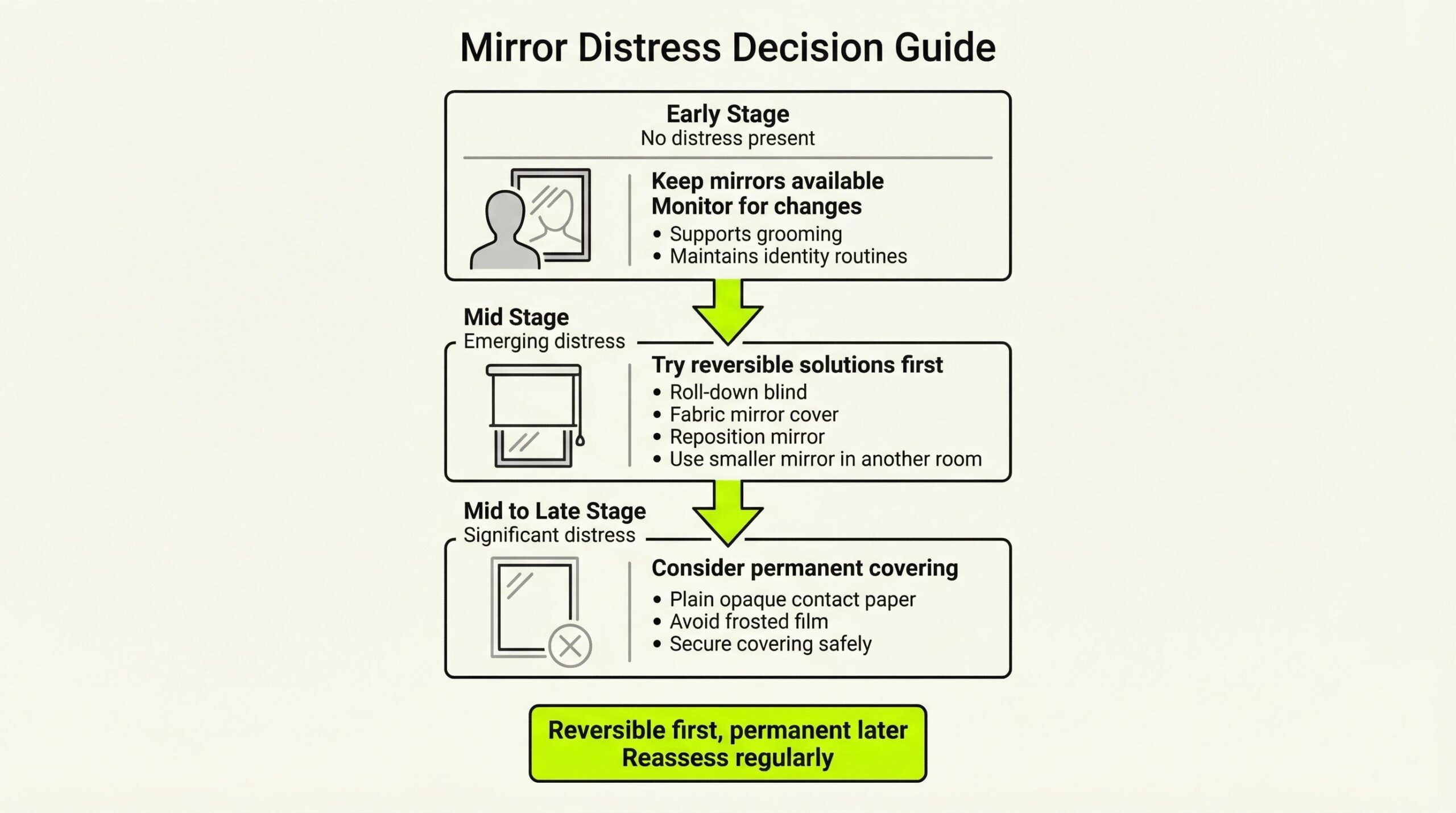
Early stage, no distress present. Keep mirrors available. They support grooming, identity, and familiar routines. Monitor for changes in how the person responds to their reflection, but there’s no reason to act pre-emptively if things are comfortable.
Emerging distress, mid-stage. Start with reversible solutions. A roll-down blind or plain fabric cover over the bathroom mirror works well – you can uncover it for grooming and cover it again afterwards. Consider repositioning so the mirror isn’t directly opposite the toilet or shower, where the reflection appears unexpectedly. A smaller mirror in another room can take over the grooming role if needed.
Significant distress, mid-to-late stage. Consider permanent covering or removal. Use plain, light-coloured self-adhesive contact paper rather than frosted film.
But why not frosted film?
This is where lived experience matters. Some carers and design professionals have found that semi-sheer or frosted treatments can create ambiguous, shadowy shapes that actually increase suspicion and agitation – particularly in low light. Plain, opaque coverings are safer. Make sure any covering is secure and can’t be pulled off.
The principle throughout: reversible first, permanent later. Reassess regularly. What works today may need adjusting in six months.
Beyond the Mirror – Reducing Reflective Triggers in the Bathroom
The mirror is usually the most obvious source of confusion, but it’s rarely the only reflective surface in the room.
Shiny chrome taps, handles, and towel rails can create small, distorted reflections. Where possible, consider matte or brushed finishes. Glass shower screens may be misperceived as open space or another room – UK environment design guidance groups these alongside mirrors and polished floors as surfaces that contribute to missteps and disorientation in people with dementia. Highly polished floor tiles can reflect overhead light and cause spatial confusion.
Windows are often overlooked. After dark, an uncovered bathroom window acts as a mirror. Carers frequently report their loved one believing someone is standing outside watching them – closing blinds before evening bathroom visits is a simple, effective change that costs nothing.
Lighting matters too. Soft, even, well-distributed light reduces startling reflections and glare. Harsh overhead spotlights amplify confusion by creating strong contrasts and sharp reflections across chrome and tile surfaces.
The Vidalux Approach – Designing Bathrooms Around Dignity
Mirror management is one part of a larger picture.
For families adapting a bathroom for someone with dementia, the bathing setup itself is just as important – reducing physical risk and emotional stress during every wash. Vidalux walk-in baths are designed specifically for elderly users and people with reduced mobility, built around three principles: safety first, fast dignified bathing, and true engineering reliability.
That engineering shows up in the details. Doors are designed for minimal force, with easy-grip handles suited to users with limited dexterity – and no awkward twisting or electronic components to fail. The internal base is slip-resistant and textured throughout. Built-in seating is positioned at a height optimised for stability. Hi-flow mixer taps and dual-waste outlets reduce the time spent sitting in a cold bath waiting to fill or empty – because waiting, in assisted bathing situations, isn’t just uncomfortable. It’s where risk accumulates.
Vidalux doesn’t claim to solve dementia-related challenges. But when you design products for people who need safe-access bathing – including carers and assisted bathing situations – every detail counts. A calmer, safer bathroom isn’t just about the mirror. It’s about the whole environment working together.
Explore the full range of walk-in baths at vidalux.co.uk/walk-in-bathtubs/
There’s No Single Right Answer – and That’s OK
Every person with dementia is different, and what helps today may need adjusting tomorrow. The fact that you’re researching this means you’re already making thoughtful choices for someone you care about.
Start with reversible changes. Follow the person’s responses. Reassess as things evolve. And remember – adapting their environment isn’t taking something away. It’s giving them comfort.
If you’re adapting a bathroom for a loved one, see how true engineering reliability supports safer, calmer bathing. Vidalux walk-in baths – built for exactly this kind of care.
Frequently Asked Questions
Q: Should you cover mirrors for someone with dementia?
A: Covering mirrors is recommended by the Alzheimer’s Society and Age UK when the reflection causes distress. Use a plain, opaque covering and uncover for grooming if the person still benefits. Frosted film is not recommended as it can create shadowy shapes that increase agitation.
Q: Why do mirrors upset people with dementia?
A: Changes in the brain can impair self-recognition as dementia progresses. The person may genuinely believe a stranger is in the room, triggering fear, agitation, or refusal to use the bathroom. This is a visual-processing change, not a psychiatric hallucination.
Q: Are mirrors bad for dementia patients?
A: Not in all stages. In early dementia, mirrors support grooming and identity. They become problematic when the person can no longer recognise their reflection and becomes distressed. The decision should be based on the individual’s response, not assumed.
Q: How do you reduce mirror-related confusion in a bathroom?
A: Cover or remove mirrors that cause distress, close blinds on reflective windows before evening visits, choose matte finishes on fixtures, and ensure soft, even lighting to reduce glare and startling reflections.
Q: What bathroom modifications help with dementia safety?
A: Practical modifications include covering or removing distressing mirrors, high-contrast toilet seats, non-slip flooring, clear signage, even lighting, matte fixtures, and safe-access bathing such as walk-in baths with slip-resistant surfaces, easy-grip doors, and low-force entry.
- About the Author
- UK’s best-rated?

With over 22 years in the home spa industry, Andrew has overseen every stage of the journey—from initial product design and manufacturing to final installation. An author of multiple technical publications and scientific papers, he founded Vidalux to replace industry hype with engineering-led reliability. His focus remains on delivering gym-quality wellness through honest design and technical truth.
DISCLAIMER: All specifications, claims, and advice relating to any internal or external procedure, practise, product, or service were true at the time of writing. For more accurate and up-to-date details in relation to Vidalux services, please visit the relevant dedicated on-site page. For any product-related information, specifications, or guidance, the information on the product page should be considered the governing source.