Tall, Short, or Small: Why Shower Head Height Matters for Every Family Member
We get asked this regularly: “My husband is 6 foot and I’m 5 foot. Can we both use it comfortably?”
It’s a completely practical question, and the honest answer comes down to one component most steam shower cabin listings never mention clearly. The choice between a shower riser rail and a fixed bracket decides whether the shower works for everyone in the house, or just for the person it happened to be set up for.
It’s a small part with an outsized effect on daily life. Worth checking before installation, not after.

The name causes confusion.
Both components hold the hand shower on the glass panel. That is where the similarity ends.
A fixed clip is exactly what it sounds like – a single static holder fixed to the panel at one point. The hand shower sits in it. It does not slide. It does not adjust. Whatever height the installer chose during assembly is the height it stays.
A riser rail is a vertical track with a sliding holder that travels freely along its length. You squeeze the bracket, move it to the height you need, and release. No tools. No disassembly. Done in two seconds.
In product photography, both look nearly identical.
That is the problem. A chrome holder on a glass panel photographs the same way whether it moves or not. A fixed clip is the cheaper option to produce and the faster one to assemble, which is why it appears on cabins built to a tight price. It is rarely spelled out in the listing, and buyers often only discover which one they have after delivery.
Worth noting: this detail is rarely flagged because the marketing emphasis falls on the monsoon overhead head, body jets, and steam function. The hand shower gets a line or two. The type of holder it sits in often gets none.
Who Gets Caught Out – and Why Steam Shower Cabins Compound It
A fixed shower head is an inconvenience in a standard tiled enclosure.
In an assembled steam shower cabin, it is significantly harder to resolve.
Fitters usually mount a fixed head at roughly two metres from the floor, which is a compromise pitched at average adult height rather than a standard anyone is required to meet. Users over roughly 1,880mm (6’2″) tend to want it higher; users under about 1,700mm (5’7″) tend to want it lower. A fixed clip delivers one number. A riser rail delivers all of them.
The people most affected are the ones most likely to be asking the question in the first place.
Couples with a meaningful height difference. A partner at 5’4″ and a partner at 6’3″ do not share the same comfortable shower head position. With a fixed clip, one of them makes do.
Families with young children. A hand shower fixed at adult height is unreachable for a small child. Lowering it for bath time and raising it again for adults requires a component that actually moves.
Elderly or seated users. Anyone who showers seated, or who needs the hand shower lower for comfort, is immediately disadvantaged by a holder positioned for a standing adult. If seated showering is part of the plan for your household, the shower seat trade-offsD are worth understanding before you settle on a model.
This isn’t only a comfort question. Approved Document M of the Building Regulations, published by the Ministry of Housing, Communities and Local Government (https://www.gov.uk/government/publications/access-to-and-use-of-buildings-approved-document-m), sets out how fittings and controls in bathrooms should be positioned so they remain usable by people with reduced mobility – and adjustability sits at the centre of that thinking.
But won’t the overhead monsoon head cover most of this?
For a standard rinse, yes. The monsoon head handles the general standing shower well. It is the hand shower that gets used for targeted washing, rinsing children, washing hair without soaking everything, and general flexibility in use. That is the component where height matters most.
The enclosed structure of a steam shower cabin also means you cannot step back or manoeuvre freely. Confined space makes ergonomics matter more, not less.
What Happens When the Slider Fails
Even when a riser rail is included, not all riser rails are equal.
A slider that no longer grips is a recurring complaint across the shower market. The handset creeps down the rail under its own weight, then settles wherever gravity puts it. In effect, a riser rail that no longer holds position is a fixed clip – just less predictable.
Think of it like a trouser belt without a working buckle. The mechanism is present. The functionality isn’t.
The honest truth? What matters here is not just whether a rail is fitted, but whether the parts stay available afterwards. In a standard tiled shower, a replacement slider is usually stocked by any plumber’s merchant. In a steam shower cabin, the rail is part of a designed assembly – so the question becomes whether the manufacturer still supports it years later.
Vidalux supplies the riser rail as a complete assembly through its spares partner, posh.co.uk. The handset holder is not sold as a loose part, because it isn’t one – it forms part of that assembly. Long-term parts support is the point, and it is worth checking on any cabin you’re considering, whoever made it.
One thing to consider: the quality of the riser rail assembly matters as much as whether one is included. This is the distinction that separates a well-specified cabin from one that looks similar on paper.
How to Check Before You Buy
The image will not tell you.
Fixed clips and riser rails photograph identically in product listings – same chrome finish, same glass panel, same silhouette. The only way to know is to look beyond the photography.
Check the specification for the words riser rail explicitly. Not “shower head holder,” not “handheld shower bracket,” not “shower head included.” Those phrases can describe a fixed clip. A riser rail is a specific component – if it is included, it should be named.
If the listing uses vague language, ask. Contact the retailer directly and ask: “Does the hand shower holder slide along a rail, or is it fixed in one position?” It is a simple question. If the answer isn’t immediate and clear, that tells you something too.
Ask how the rail mounts. A riser rail that fixes through dedicated holes in the glass panel is a decision made at manufacture – the glass is drilled specifically for it. That is meaningfully different from a clip-on holder added afterwards. Our installation guides (https://vidalux.co.uk/installation-planning/) cover the wider set of questions worth asking before a cabin is ordered.
Ask about parts. If a slider fails in three years, can the assembly still be supplied?
The question that anchors all of this: how many people of different heights will use this shower, and does the specification confirm adjustability for all of them?
How Vidalux Approaches This
Most Vidalux steam shower cabins include a fully adjustable riser rail as part of the integrated shower system, fitted as standard. The exceptions are the Fusion Steam 1200 and the Tempest Twin, which use fixed shower holders. On every other current model in the range, adjustability is built in rather than added on.
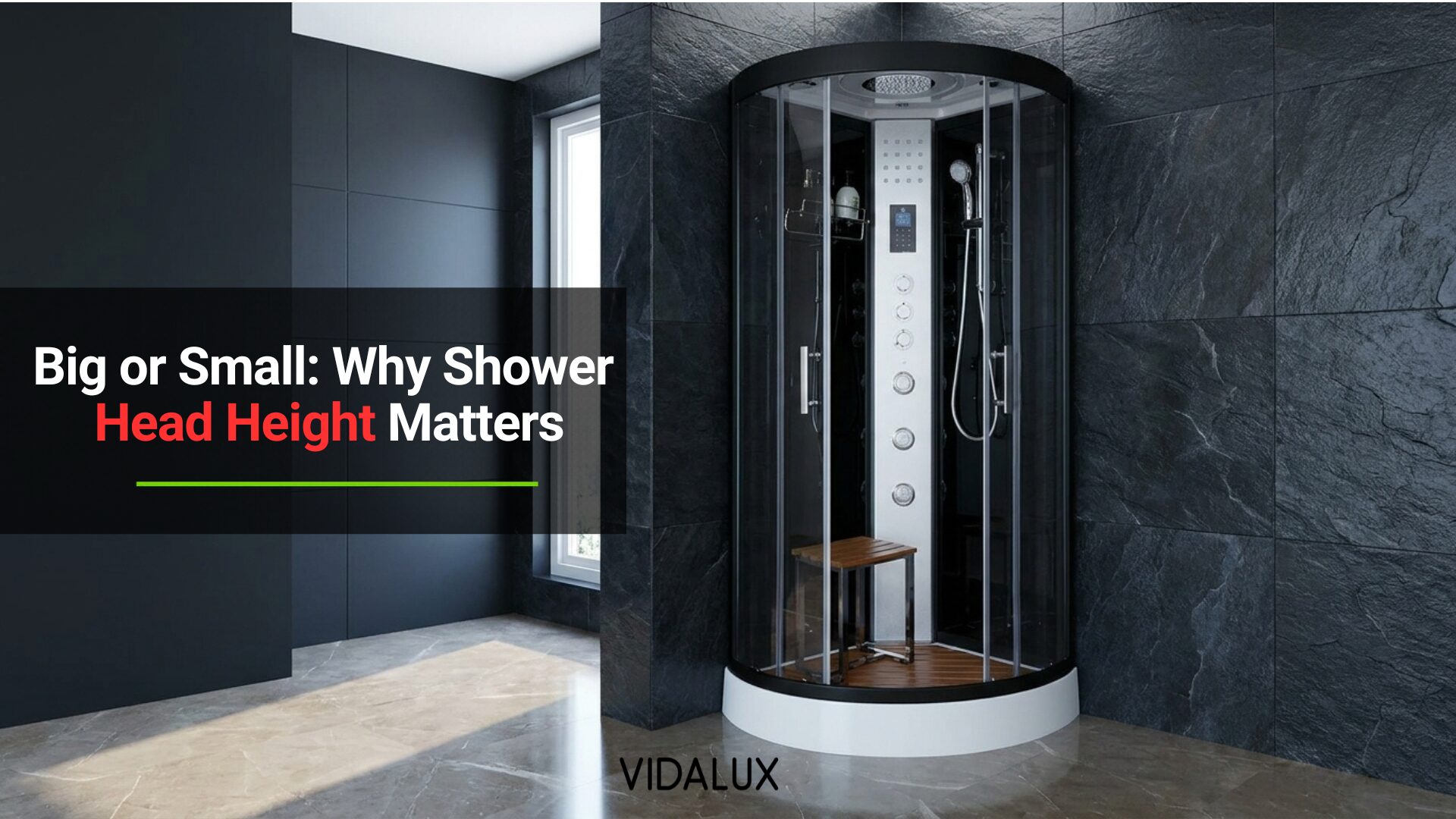
The glass panel is purpose-drilled for riser rail mounting – those holes you see in the glass are there by design, not incidentally. This is confirmed in Vidalux’s own technical documentation: the holes in the shower glass panel exist specifically for mounting the riser rail for the hand shower.
The hand shower holder is part of the complete riser rail assembly rather than a separate clip fitted to a static point on the panel. The holder slides along the rail and locks where you set it, without tools and without disassembly.
Vidalux doesn’t treat this as a premium feature. It is treated as a baseline requirement in a cabin designed for daily household use by real families.
So, back to the question that opens this article. On any Vidalux model fitted with a riser rail – which is most of the range – the hand shower height can be set to suit each person who uses it, whatever their height. If you’re choosing between models, confirm the riser rail on the specification for the exact cabin you want.
A Calm Summary
A fixed clip and a riser rail look the same in a photograph.
In daily use, they are completely different products.
One locks the hand shower at a single height. The other adjusts for whoever is using the shower, today and every day after. In a steam shower cabin – where the enclosed structure makes retrofitting impractical – this is the detail to confirm before you commit, not after.
If you’re choosing a cabin for a household where heights vary, it is worth reading the specification carefully and asking the right question.
Compare the craftsmanship across the steam shower range (https://vidalux.co.uk/steam-showers/) and check the riser rail on the model you have in mind.
For the wider set of buying and ownership questions, our steam shower guides (https://vidalux.co.uk/blog-steam-showers/) cover the details that specifications tend to leave out.
Frequently Asked Questions
Q: What is the difference between a shower riser rail and a fixed bracket?
A: A shower riser rail and a fixed bracket both hold the hand shower, but only a riser rail adjusts for height. A riser rail is a vertical track with a sliding holder. A fixed bracket is a static clip set at one permanent position.
Q: Can my whole family use a steam shower cabin with different heights?
A: Yes – on models that include a riser rail, which covers most of the Vidalux steam shower range. The hand shower holder slides along the rail to suit each user. The Fusion Steam 1200 and Tempest Twin are exceptions, using fixed holders. Check your model’s specification.
Q: Why do some steam shower cabins only have a fixed clip instead of a riser rail?
A: Some steam shower cabins include a fixed clip rather than a riser rail because it costs less to produce and is quicker to assemble. It provides no height adjustment. This distinction is rarely highlighted in product listings, which is why buyers miss it before purchase.
Q: What are the holes in my steam shower glass panel for?
A: The holes in a steam shower glass panel are for mounting the riser rail. This is an intentional design feature built into the panel at manufacture. On Vidalux models fitted with a riser rail, it fixes through these purpose-built holes as part of the shower assembly.
Q: Is the shower head holder the same thing as a riser rail?
A: Not always. A shower head holder can mean a fixed clip holding the handset at one static height. A riser rail is a vertical track with a sliding holder. On Vidalux cabins with a riser rail, the holder forms part of the complete assembly, not a standalone clip.
Q: What height should a shower head be set at for mixed-height users?
A: A fixed shower head is usually mounted at roughly two metres from the floor, which suits most adults but not all. Taller users prefer higher placement; shorter users and children prefer lower. An adjustable riser rail lets the hand shower be repositioned for each user.
Q: Can I retrofit a riser rail into a steam shower cabin that has a fixed clip?
A: Retrofitting a riser rail into a steam shower cabin that wasn’t designed for one is not straightforward. It needs purpose-built fixings in the glass panel, which the cabin either has at manufacture or doesn’t. Confirm riser rail inclusion before purchasing instead.
- About the Author
- UK’s best-rated?

With over 22 years in the home spa industry, Andrew has overseen every stage of the journey—from initial product design and manufacturing to final installation. An author of multiple technical publications and scientific papers, he founded Vidalux to replace industry hype with engineering-led reliability. His focus remains on delivering gym-quality wellness through honest design and technical truth.
DISCLAIMER: All specifications, claims, and advice relating to any internal or external procedure, practise, product, or service were true at the time of writing. For more accurate and up-to-date details in relation to Vidalux services, please visit the relevant dedicated on-site page. For any product-related information, specifications, or guidance, the information on the product page should be considered the governing source.
Ready to choose?
Browse the full Vidalux range of saunas, steam showers, baths and shower cabins, all in one place