Shower Silicone Mould: Why It Always Returns – And the Tray Design That Doesn’t Need It
You’ve done everything right. Stripped the old shower silicone mould back to bare surfaces. Cleaned with bleach. Dried thoroughly. Applied fresh sealant with a steady hand and a neat finish.
It looked great. For about six months.
Now the black spots are back – creeping along the same tray-to-wall junction, settling into the same corners, doing exactly what they did before. And you’re wondering whether you missed a step, used the wrong product, or whether this is simply how showers work.
Here’s the thing. The problem isn’t your technique. It’s the role silicone is being asked to play.
Why Shower Silicone Always Goes Mouldy
Silicone sealant looks waterproof on day one. And technically, it is. But bathroom sealant isn’t a solid barrier – it’s porous at a microscopic level, and mould knows how to exploit that.
Black mould doesn’t just sit on the surface. Its roots – called hyphae – penetrate into the silicone itself. That’s why bleach only whitens the top layer temporarily. The mould is living inside the sealant, not on it.
But why does it keep coming back even with “anti-mould” silicone?
Because the conditions never change. Shower corners and tray-to-wall junctions trap standing water in the exact spots where humidity is highest. Acrylic trays and tiles expand slightly with heat, then contract as they cool. Silicone bridges those micro-gaps – but over months of thermal cycling, it fatigues. Tiny fractures open up. Moisture gets underneath.
Even premium anti-mould silicone can degrade within 12-18 months under constant wet-zone conditions. The sealant isn’t failing because it’s cheap. It’s failing because no flexible sealant can permanently waterproof a joint that’s wet, warm, and moving – every single day.
The Mould Loop – Strip, Seal, Repeat
Most people go through the same cycle two, three, maybe four times before they start searching for a real answer.
Notice the black spots. Scrub with bleach. Strip the old silicone. Clean and dry the surfaces. Reapply fresh sealant. Admire the clean lines. Wait. Watch it return.
Each cycle costs an afternoon, a tube of sealant, and a growing sense of frustration.
The honest truth? In a traditional tiled enclosure, silicone is doing structural waterproofing work. It’s the only thing standing between the water in your shower and the wall behind the tray. That’s an enormous ask of a flexible sealant in a permanently humid environment.
Think of it like asking masking tape to hold a shelf. It might stick for a while – but it was never designed for that kind of load. Silicone in a wet shower junction is the same. It’s being asked to do a job it was never built to sustain.
So long as the design relies on sealant for water integrity, you’re locked in the loop.

This is where engineering changes the equation.
Some shower designs now build the tray so that water simply cannot escape the cabin – not because of sealant, but because of the physical structure of the tray itself.
The principle is straightforward. A raised internal lip sits inside the glass channel. Water runs down the glass panels, hits the tray inside the lip, and drains away through the waste. There is no junction for water to exploit. No gap for moisture to creep through.
So what handles the waterproofing?
Compression seals between the frame and the tray do the structural work. These are mechanical seals – they don’t degrade in humidity, they don’t grow mould, and they don’t need replacing every year.
If water somehow bypasses the compression seal – which is rare – return channels moulded into the tray direct it straight back inside the cabin. It’s a failsafe built into the tray itself.
The result: silicone becomes purely cosmetic. If it’s used at all, it’s an aesthetic finishing touch on joining faces – not a waterproof barrier. Remove the structural role, and you remove the mould loop entirely.

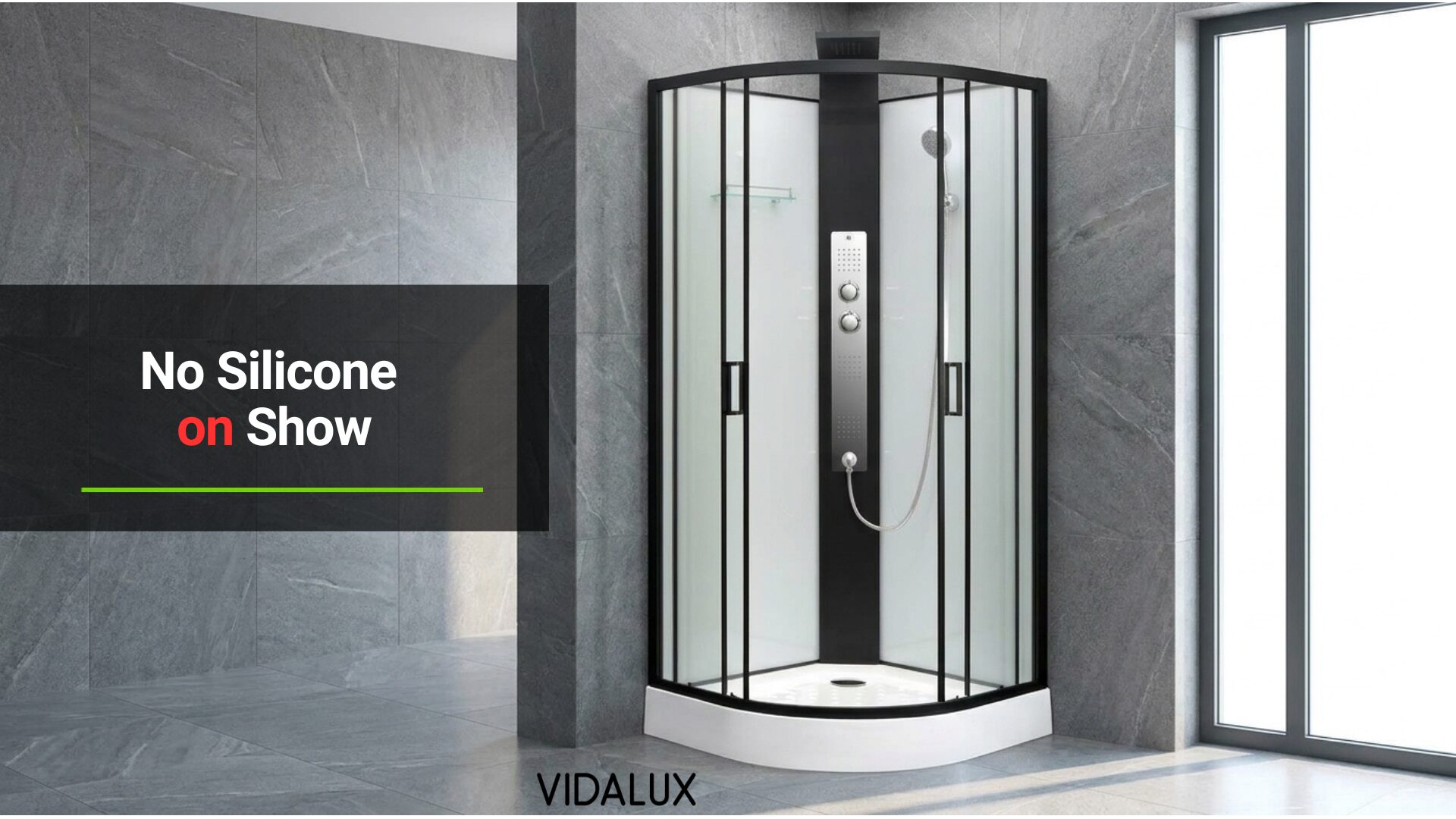
This is what Vidalux cabins are engineered to do. Leak-Seal™ technology uses compression seals, raised tray lips, and return channels to make silicone structurally unnecessary across the entire range of steam showers.
Zero exposed silicone. That’s not an aspiration – it’s a design guarantee. No mould. No peeling. No staining. No annual resealing.
But what if I still want silicone for peace of mind?
That’s fine. Silicone is offered as an optional extra for customers who want additional reassurance. It adds to the water integrity – but the shower won’t leak without it. And importantly, none will be visible. It can only be applied to joining faces, out of sight.
Worth noting: Vidalux continues to refine this design. The raised lip is being engineered even higher on newer models – a reflection of continuous improvement based on real-world installation feedback.
Because these are fully self-contained cabins, there’s no interaction with the wall structure behind them. No water gets behind tiles. No hidden damage. No rot discovered months later during a renovation. The cabin contains everything – by design, not by sealant.
What to Look for in a Mould-Free Shower
Even if you’re not ready to change your shower right now, these principles apply to any future decision.
Look for trays with raised internal lips – not flat edges that rely entirely on sealant for waterproofing. Compression seals are more durable than silicone-dependent junctions in wet environments. Self-contained cabins – like hydro shower cabins or electric shower cabins – eliminate tray-to-wall sealant altogether.
Good bathroom ventilation still matters regardless of tray design. An extractor fan running for 10-15 minutes after showering reduces the ambient humidity that feeds mould growth everywhere – not just on sealant.
If you’re sticking with a traditional tiled enclosure for now, use a high-modulus sanitary silicone (Dow Corning is a reliable choice). Apply to outside joins only – never seal the inside of a shower cabin, as trapped water in frame channels becomes stagnant. And make sure surfaces are completely dry before application.
The Short Version
Shower silicone mould isn’t a cleaning problem. It’s a design problem. As long as sealant carries the waterproofing load in a wet, warm, constantly moving environment, mould will return.
The permanent fix isn’t better silicone. It’s a tray that doesn’t need it.
Review the standards. Compare the engineering. Choose with confidence.
Frequently Asked Questions
Q: Why does black mould keep coming back on my shower silicone?
A: Black mould keeps returning on shower silicone because mould roots penetrate beneath the sealant surface – bleach only whitens the top layer. In constantly humid shower corners, silicone can degrade within 12-18 months regardless of brand or quality.
Q: Do shower trays need silicone sealant?
A: Whether shower trays need silicone depends on the tray design. Traditional flat-edge trays rely on sealant for waterproofing. Leak-free trays with raised internal lips and compression seals keep water inside without silicone acting as a structural barrier.
Q: What is a leak-free shower tray?
A: A leak-free shower tray uses a raised internal lip and compression seals to contain water by design. Water runs down the glass and inside the lip to drain – removing the need for silicone sealant as a waterproof barrier.
Q: Can silicone sealant cause mould in a shower?
A: Silicone sealant itself doesn’t cause mould, but it creates the conditions for it. Sealant junctions at tray edges trap moisture in corners where humidity is highest – giving mould a permanent, protected surface to colonise repeatedly.
Q: How do you stop shower silicone going black?
A: To stop shower silicone going black, the most effective solution is removing the need for exposed silicone entirely. Shower cabins with leak-free tray designs and compression seals eliminate the mouldy sealant problem at source – no resealing required.
- About the Author
- UK’s best-rated?

With over 22 years in the home spa industry, Andrew has overseen every stage of the journey—from initial product design and manufacturing to final installation. An author of multiple technical publications and scientific papers, he founded Vidalux to replace industry hype with engineering-led reliability. His focus remains on delivering gym-quality wellness through honest design and technical truth.
DISCLAIMER: All specifications, claims, and advice relating to any internal or external procedure, practise, product, or service were true at the time of writing. For more accurate and up-to-date details in relation to Vidalux services, please visit the relevant dedicated on-site page. For any product-related information, specifications, or guidance, the information on the product page should be considered the governing source.
Ready to choose?
Browse the full Vidalux range of saunas, steam showers, baths and shower cabins, all in one place