Will a Hydro Shower Work With Your Water Pressure? Here’s How to Tell
If you’ve been looking at a Vidalux Hydro Shower and quietly wondering whether your old-fashioned tank-in-the-loft setup is going to ruin the whole thing, that’s exactly the right question to be asking.
Because here’s what most product pages don’t say clearly enough: on a gravity fed system, a rainfall head and body jets will not perform as they’re designed to without a pump. The pressure simply isn’t there.
That might sound like bad news. It isn’t.
It’s a well-understood problem with a straightforward solution. Once you know why gravity falls short and what a pump does to fix it, the path forward is clear – and the shower you want is absolutely achievable.
What Is a Gravity Fed Water System?
Most people know roughly what system they have. Not everyone, though.
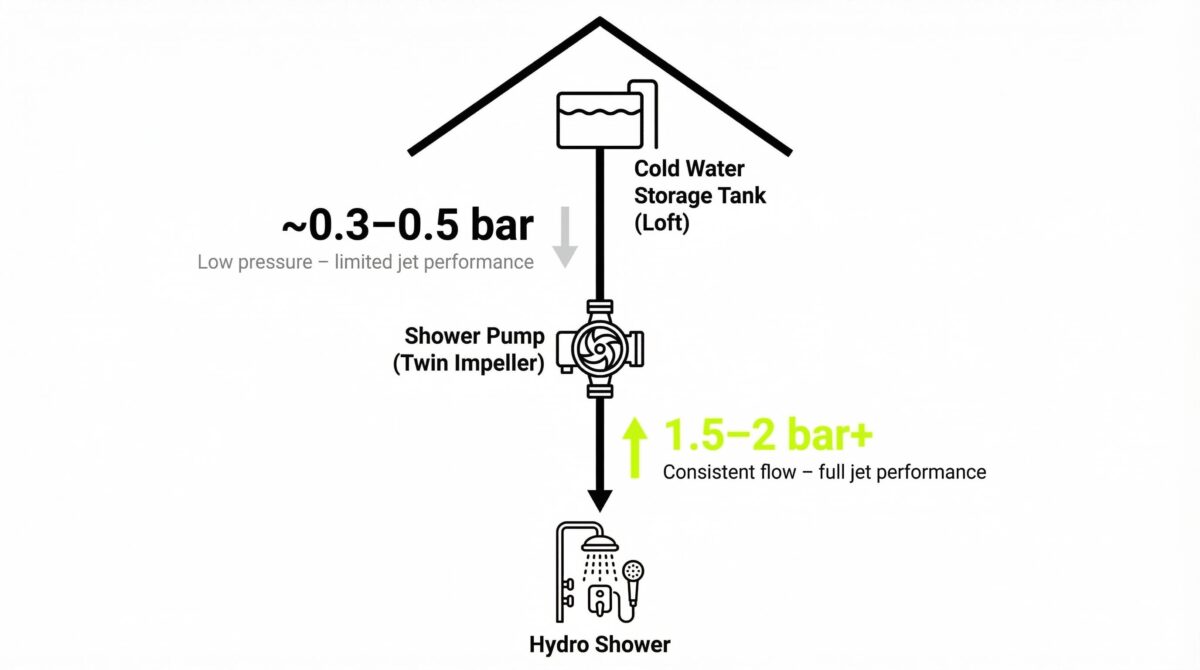
There are two main types of residential water supply in UK homes. The first is a combi boiler – no tanks, water heated on demand from the mains, typically delivering 1-3 bar without any boosting needed. The second is a gravity fed system – a cold water storage tank in the loft and a hot water cylinder usually in the airing cupboard, with pressure generated purely by the height difference between tank and outlet.
If you have a tank in your loft and a cylinder in your airing cupboard, you have a gravity-fed system.
Worth noting: many homeowners aren’t entirely sure which they have. If you can’t see any tanks anywhere and just have a boiler, you’re most likely on a combi. If you have both the loft tank and the cupboard cylinder – that’s gravity-fed, and this article is for you.
Why Gravity Alone Isn’t Enough for a Hydro Shower
The physics here is simple, and understanding it makes everything else obvious.
Pressure in a gravity fed water system is determined entirely by how far the water falls – the vertical height between the base of your cold water tank and the shower outlet below it. In most UK homes, that drop is somewhere between three and five metres. That produces roughly 0.3 to 0.5 bar.
Think of it like filling a watering can from a tap at knee height versus a tap at ceiling height. Same water. Very different flow.
A Vidalux Hydro Shower requires between 1 and 3 bar to operate correctly, with a flow rate above 7.5 litres per minute, and above 2 bar for optimum performance. At 0.3 to 0.5 bar, the rainfall head will be underwhelming, and the body jets will produce minimal useful pressure. In the words of homeowners who’ve been there: “no effect of massage.”
But is this a fault with the shower?
No. The shower is working exactly as designed. The supply is the limiting factor. And the supply can be fixed.
What a Shower Pump Actually Does
A shower pump doesn’t replace your cold water tank or hot water cylinder. It works alongside them.
It sits in the pipe run between your water tanks and the shower, boosting the pressure from whatever gravity delivers to the operating range the shower needs. The result is a consistent flow – enough to drive the rainfall head properly and give the body jets the pressure they require.
Pumps are typically installed in the airing cupboard, close to the hot water cylinder. They must not go under the shower tray – they’re not waterproof and need ventilation to run safely. Your plumber will confirm the right location for your setup.
One thing worth knowing: no shower cabin on the market comes with a built-in pump. An external pump is the standard, expected solution for gravity-fed homes – not a workaround, not an afterthought. It’s how these installations are designed to work.
For a gravity-fed system, a pump rated over 1.5 bar is required. Ideally 2 bar or above. A twin impeller pump is the recommended choice – it boosts both the hot and cold supplies simultaneously, which ensures balanced pressure at the shower rather than having one side stronger than the other.
Gravity Fed System: Positive Head or Negative Head – Which Do You Need?
This is where people get stuck. And it’s worth taking a moment to get it right, because the wrong choice means the pump simply won’t work.
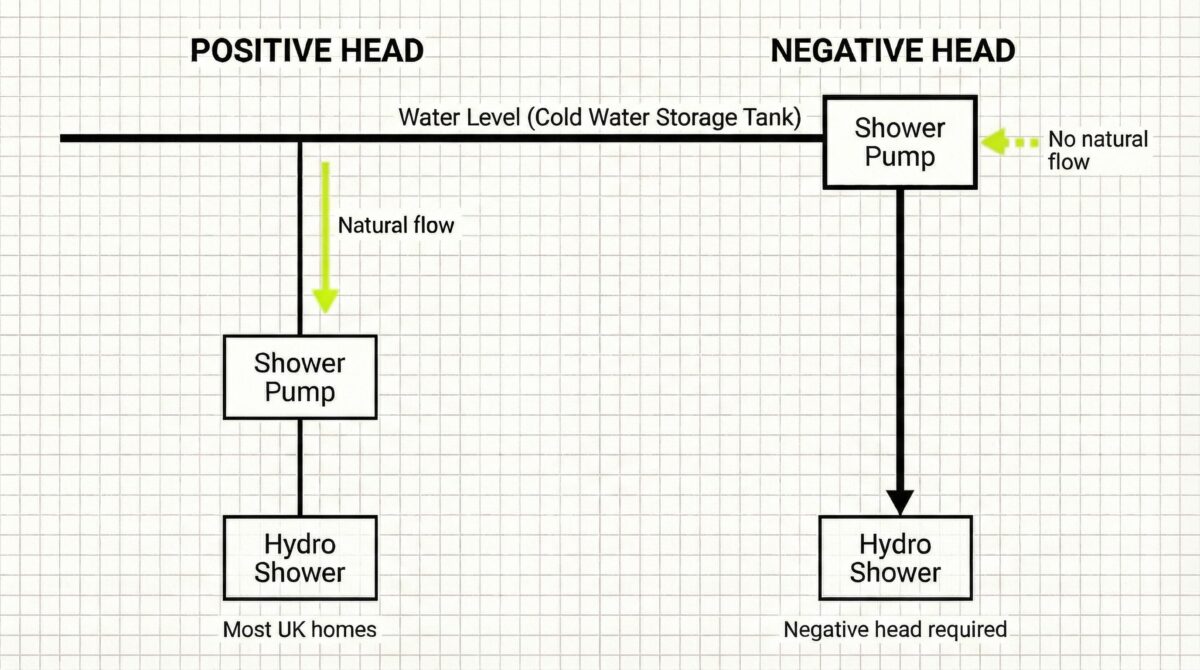
Positive head refers to an installation where the cold water storage tank sits above the pump and water flows downward naturally to trigger it when the shower is opened. This is the most common scenario in UK gravity-fed homes. The standard recommendation for most properties is a 1.5 bar twin impeller positive head pump.
Negative head is needed when the pump is installed at the same level as – or above – the cold water storage tank. Without that natural downward flow, a positive head pump’s pressure switch never activates. It won’t start. The result is the same weak trickle the homeowner had before spending money on a pump.
As a general plumbing rule of thumb, an outlet that sits comfortably below the base of the cold water storage tank usually points to a positive head setup, while an outlet at the same level – or above – points to negative head. This is exactly the kind of check your installer makes as a matter of course.
So how do you know which applies to your home?
Your installer or plumber will confirm this before the pump is sourced. It’s a straightforward check, and it’s the one decision that genuinely determines whether your pump performs correctly from day one. Getting this right matters – buying the wrong type and starting again costs both money and time.
Don’t guess. Ask your installer.
Universal head pumps that switch between positive and negative pressure are also available on the market for a small additional cost. They should be considered because they can potentially remove the guesswork when deciding between a negative or positive head pump.
What This Means for Your Body Jets
Let’s come back to the question that brought you here.
The Vidalux Hydro Shower is equipped with body jets designed for deep, targeted pressure – adjustable direction, built for real performance. On a gravity-fed system with the correct pump fitted, the shower operates within its designed 1-3 bar range. The jets deliver what they’re supposed to deliver. The rainfall head gives full coverage. The water flow is consistent every time.
Without a pump, you’d be running at 0.3-0.5 bar – well below the 1.5 bar minimum at which the jets perform usefully. That’s the outcome people regret. Not the shower. Not the decision to buy. The skipped step.
With the right pump: full performance. No compromise.
Here’s the thing. A gravity-fed home is not the wrong type of home for a Vidalux Hydro Shower. It’s simply a home that needs one additional component to unlock everything the shower is capable of delivering.
The Vidalux Approach
Vidalux Hydro Showers are built for real UK homes – including the majority that run on gravity-fed plumbing.
The shower itself is fully compatible with any external pump. The cold water storage tank and hot water cylinder don’t need replacing or upgrading. The existing system stays in place. A correctly specified pump, fitted by your plumber in the airing cupboard, is all that’s needed to bring the supply up to the pressure the shower requires.
For most gravity-fed homes, a twin impeller universal head pump rated at 2 bar or above is the starting recommendation. Your installer will confirm the correct type and specification for your specific setup before anything is ordered.
For context on why mains and stored systems behave so differently, the Water Regulations Advisory Scheme (WRAS) publishes guidance on domestic water supply and pressure that’s worth a read if you want to understand the standards your installer works to.
Vidalux is a supply-only brand. We don’t fit – but we do make sure that everything you need to make an informed decision is clear before you buy.
See the full Hydro Shower range to compare models and specifications: https://vidalux.co.uk/hydro-shower-cabins/
A Gravity Fed System Isn’t a Barrier – It’s a Starting Point
The pump is not an obstacle. It’s the component that bridges the gap between the pressure your system naturally delivers and the performance you’re looking for.
Once it’s in place, a Vidalux Hydro Shower works exactly as it was designed to – strong, consistent pressure, powerful jets, and a genuinely satisfying shower, every morning.
Review the options. Compare the specifications. Choose with confidence.
Frequently Asked Questions
Does a gravity-fed system work with a hydro shower?
A gravity-fed system can work with a hydro shower, but a pump will almost certainly be required. Gravity-fed systems typically deliver only 0.3-0.5 bar, and the shower needs between 1 and 3 bar – with a flow rate above 7.5 litres per minute – to perform correctly.
What pump do I need for a hydro shower on a gravity-fed system?
For a gravity-fed system, you need a shower pump rated over 1.5 bar – ideally 2 bar or above. A twin impeller pump is recommended, as it boosts both the hot and cold water supplies simultaneously and ensures balanced, consistent pressure at the shower.
What is the difference between a positive head and a negative head shower pump?
A positive head pump is used when the cold water storage tank sits above the pump and water flows naturally downward to trigger it – the most common UK gravity-fed setup. A negative head pump is needed when the pump is at the same level as, or above, the tank.
What happens if you install the wrong type of shower pump?
Installing the wrong type of shower pump means the pump will not work correctly. A positive head pump in a negative head situation simply will not trigger – the pressure switch never activates, and the shower produces the same weak flow as before the pump was fitted.
Will the body jets be weak without a pump on a gravity-fed system?
Without a pump on a gravity-fed system, body jets and the rainfall head will underperform noticeably. Below 1.5 bar, massage jets produce minimal useful pressure. A correctly rated pump brings the system into its designed operating range and restores full jet performance.
Where is a shower pump installed?
A shower pump is typically installed in the airing cupboard, close to the hot water cylinder. Pumps must not be placed under the shower tray – they are not waterproof and require ventilation to operate safely. Your plumber or installer will confirm the correct location for your home.
Do I need a pump if I have a combi boiler?
No pump is typically needed with a combi boiler. Combi boilers heat water directly from the mains and usually deliver 1-3 bar, which meets the shower’s requirements without additional boosting. A pump is needed when you have a gravity-fed system with a cold water storage tank and hot water cylinder.
How do I know if I have a gravity-fed system?
To identify a gravity-fed system, check your loft for a cold water storage tank and your airing cupboard for a hot water cylinder. If both are present, you have a gravity-fed system and will likely need a shower pump. If you have no tanks and only a boiler, you most likely have a combi.
- About the Author
- UK’s best-rated?

With over 22 years in the home spa industry, Andrew has overseen every stage of the journey—from initial product design and manufacturing to final installation. An author of multiple technical publications and scientific papers, he founded Vidalux to replace industry hype with engineering-led reliability. His focus remains on delivering gym-quality wellness through honest design and technical truth.
DISCLAIMER: All specifications, claims, and advice relating to any internal or external procedure, practise, product, or service were true at the time of writing. For more accurate and up-to-date details in relation to Vidalux services, please visit the relevant dedicated on-site page. For any product-related information, specifications, or guidance, the information on the product page should be considered the governing source.
Ready to choose?
Browse the full Vidalux range of saunas, steam showers, baths and shower cabins, all in one place