Bathroom Lighting for Older Adults: Small Changes That Make Bathing Safer
If you’ve watched a parent hesitate at the bathroom door, you already know something is wrong.
For people living with cataracts, macular degeneration, or general low vision, the bathroom isn’t just another room. It’s the most dangerous one in the house. Not because of water alone – but because of light. Poor bathroom lighting for elderly people with visual impairment doesn’t just make things harder to see. It actively creates the conditions for a fall.
In England, there are roughly 255,000 falls-related emergency hospital admissions per year among over-65s. Hip fractures alone cost the NHS around £2 billion annually. And peer-reviewed research into care-home environments has found that lower bathroom lighting levels independently predict higher fall rates among older residents.
Here’s the thing. Most of this is fixable.
Why Standard Bathroom Lighting Fails Ageing Eyes
More light does not mean safer light. That’s the misconception most families start with.
Cataracts and macular degeneration change how the eye processes light. With cataracts, the lens clouds and scatters incoming light – so a bright, cool-white ceiling spotlight doesn’t illuminate the room more clearly. It creates a wash of glare that reduces contrast. Think of it like driving into low sun with a dirty windscreen. The light is there, but it’s working against you.
The typical UK bathroom makes this worse. A single overhead fitting bouncing off white tiles, glossy floors, and chrome fittings creates exactly the high-glare, low-contrast environment that occupational therapy guidelines warn against.
But isn’t brighter always better for older eyes?
No. OT-informed bathroom design guides are clear: exposed bulbs and blue-white LEDs can be physically painful for people with light-sensitive conditions. They wash out the detail that matters – the edge of the shower tray, the position of a grab rail, the outline of the toilet seat.
The problem isn’t too little light. It’s the wrong light, in the wrong place.
Five Lighting Changes That Actually Reduce Risk
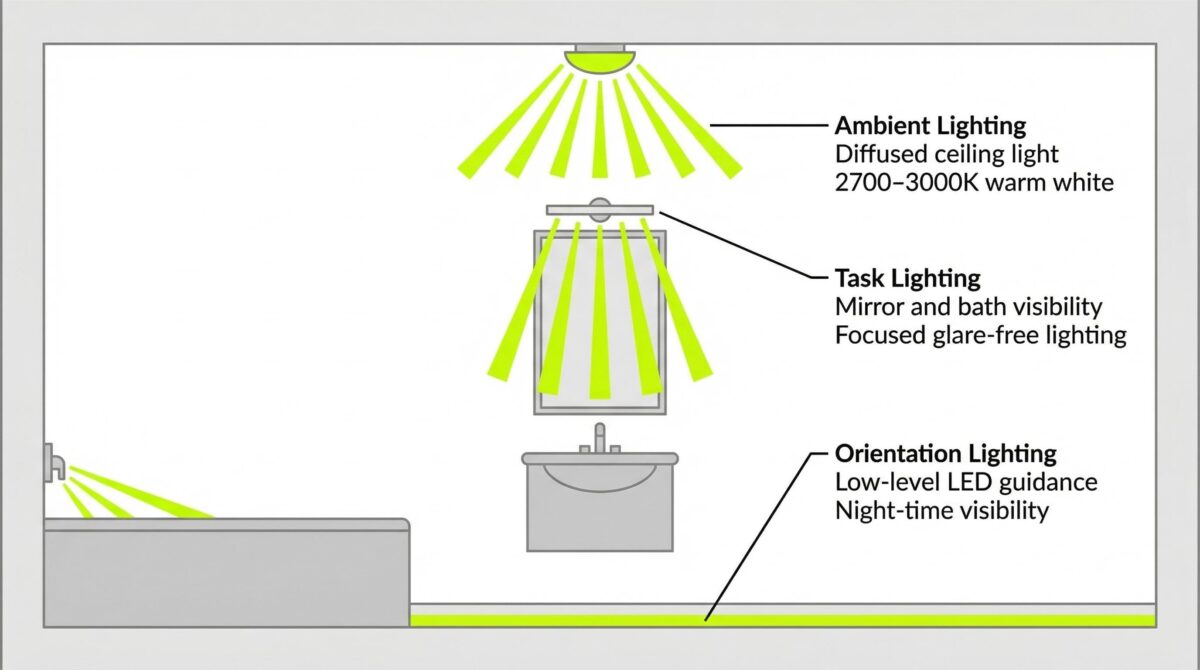
Once you understand why standard lighting fails, the fixes become straightforward.
1. Adjust colour temperature. Swap cool blue-white LEDs for warm white bulbs around 2700-3000K. Warmer light reduces the harsh scatter that ageing eyes struggle with.
2. Layer the lighting. A single ceiling fitting leaves shadows and dark patches. Use three layers: diffused ambient ceiling light, task lighting at the mirror and shower, and low-level orientation lighting near the floor.
3. Add low-level night lighting. Nighttime bathroom trips are where the real danger lies. Motion-activated LEDs along baseboards or under vanities provide just enough illumination to show the route without creating glare.
4. Maximise contrast between surfaces. An all-white bathroom is a visibility challenge for low vision. Different tones between floor, sanitaryware, and grab rails help the eye distinguish where one surface ends and another begins.
5. Eliminate glare at the source. Fit diffusers on all fittings. Choose matte finishes over glossy tiles. Indirect lighting – bounced off walls or ceilings – dramatically reduces the glare that makes bathrooms feel unsafe.
What to Look for in Bathroom Products
If you’re choosing fixtures for someone with limited eyesight, lighting improvements are only part of the picture. The best products address multiple risk factors at once.
Look for anti-slip surfaces built in as standard. A low step-in threshold or walk-in access removes the most dangerous moment – stepping over a high rim with compromised balance and poor visibility. Dual-waste outlets reduce drain time, which means less time sitting cold and waiting to exit.
Separately, consider the contrast of the bathroom environment itself. Different tones between the bath, floor, and grab rails help low-vision users distinguish surfaces – this is a general design principle worth applying to any bathroom, regardless of the products you choose.
The Vidalux Approach – Safety Engineered In, Not Added On
Vidalux walk-in baths were designed specifically for reduced mobility and elderly users. Safety is the founding principle – not a feature bolted on afterwards.
Every model includes anti-slip internal surfaces, an easy step-in threshold, a reinforced watertight door, and built-in seating optimised for stability. Reinforced acrylic on a steel support frame, engineered for long-term daily use.
Hi-flow mixer taps and dual-waste outlets work together to reduce fill and drain time – keeping time spent cold and waiting inside the bath to a minimum. Vidalux also maintains long-term spare-part stores, so a product installed today can be serviced years from now.
Let’s be clear: no single product eliminates fall risk entirely. But when lighting, access, grip, contrast, and drainage are all addressed together, the cumulative effect on safety and confidence is real.
A Calmer, Safer Routine Starts with Better Light
The bathroom doesn’t have to be the room your family worries about most.
Better lighting – layered, warm, glare-free, and positioned with purpose – is one of the simplest and most impactful changes you can make. When combined with products built around safe access, the difference is felt every single day.
See the quality. Explore the Vidalux walk-in bath range – engineered for safe, dignified bathing.
Frequently Asked Questions
Q: What is the best bathroom lighting for elderly people with poor eyesight?
The best bathroom lighting for elderly people with poor eyesight uses layered, glare-free illumination. Combine warm white ambient lighting (2700-3000K) with task lighting at the mirror and shower, plus low-level LED orientation lights near the floor for nighttime safety.
Q: How does bathroom lighting cause falls in older adults?
Bathroom lighting causes falls when harsh overhead bulbs create glare off tiles and mirrors, reducing visibility for people with cataracts or macular degeneration. Poor contrast between white floors and white sanitaryware also hides edges and steps.
Q: What colour light is best for elderly eyes?
Warm white light at approximately 2700-3000K is generally most comfortable for elderly eyes, reducing the harsh glare that cooler blue-white LEDs can cause. Brighter, cooler light can be useful for daytime task areas if diffused properly.
Q: How do I reduce glare in a bathroom for someone with cataracts?
Reducing glare for someone with cataracts involves fitting diffusers on all light fittings, choosing matte rather than glossy surfaces for tiles and floors, positioning lights so they never shine directly into the eyes, and using indirect lighting bounced off walls or ceilings.
Q: Are walk-in baths safer for elderly people with visual impairment?
Walk-in baths are safer for visually impaired elderly users because they eliminate the need to step over a high bath rim. Models with anti-slip surfaces, low step-in thresholds, and fast-drain engineering reduce the time spent vulnerable. Pair with better bathroom lighting for the strongest combined safety improvement.
Q: Does installing a walk-in bath mean I also need to change my bathroom lighting?
They work best together. A walk-in bath addresses physical access and grip – it removes the step-over risk and shortens time spent cold inside the bath. Improved lighting addresses visibility – it helps a low-vision user see edges, surfaces, and obstacles clearly. Neither fully replaces the other. For someone with visual impairment, addressing both gives the strongest overall reduction in fall risk.
- About the Author
- UK’s best-rated?

With over 22 years in the home spa industry, Andrew has overseen every stage of the journey—from initial product design and manufacturing to final installation. An author of multiple technical publications and scientific papers, he founded Vidalux to replace industry hype with engineering-led reliability. His focus remains on delivering gym-quality wellness through honest design and technical truth.
DISCLAIMER: All specifications, claims, and advice relating to any internal or external procedure, practise, product, or service were true at the time of writing. For more accurate and up-to-date details in relation to Vidalux services, please visit the relevant dedicated on-site page. For any product-related information, specifications, or guidance, the information on the product page should be considered the governing source.