Double Bath or Twin Steam Shower? The Water Usage Reality Check
There’s a particular kind of weekend fantasy that involves a long, hot, deep bath – ideally one big enough for two, candles optional. And then, somewhere around the third minute of running the taps, a smaller voice asks: ” How much water am I actually using here? ” Probably more than you’d want to admit on a meter reading.
If you’re researching a double bath as part of a bathroom upgrade, you’re likely caught between two genuine pulls. The aspiration is real. So is the rising water bill, the news about the UK drought, and the quiet calculation of whether luxury still feels guilt-free in 2026.
The honest answer is more interesting than you’d expect. And it changes how a luxury bathroom should be designed today.
Why “Double Bath” Searches Are Up (And What’s Really Driving Them)
Double-ended baths and large freestanding tubs remain one of the most aspirational purchases in any bathroom upgrade. But the buyer profile has shifted. The person searching now isn’t only thinking about size and design – they’re thinking about what it costs to fill, heat, and justify.
The numbers behind that shift are sobering.
The average person in England now uses around 139 litres of water per day, with the government and water industry working towards a target of 110 litres per person per day. According to the UK Government, England faces a 5 billion litre daily public water shortfall by 2055 without urgent action. The widespread drought across England in 2025 has been a sharp reminder that this isn’t a distant abstraction.
So what does this mean for the buyer?
It means the conversation has changed. We’ve watched it shift in real time over fifteen years of supplying UK homes. The questions used to be about colour, jet count, and how big a bath could realistically fit. They’re still asked – but they sit alongside something newer. Will this make me feel guilty every time I use it?
That’s a fair question. And the answer depends entirely on what you compare a double bath to.
The Numbers: Double Bath vs Twin Steam Shower
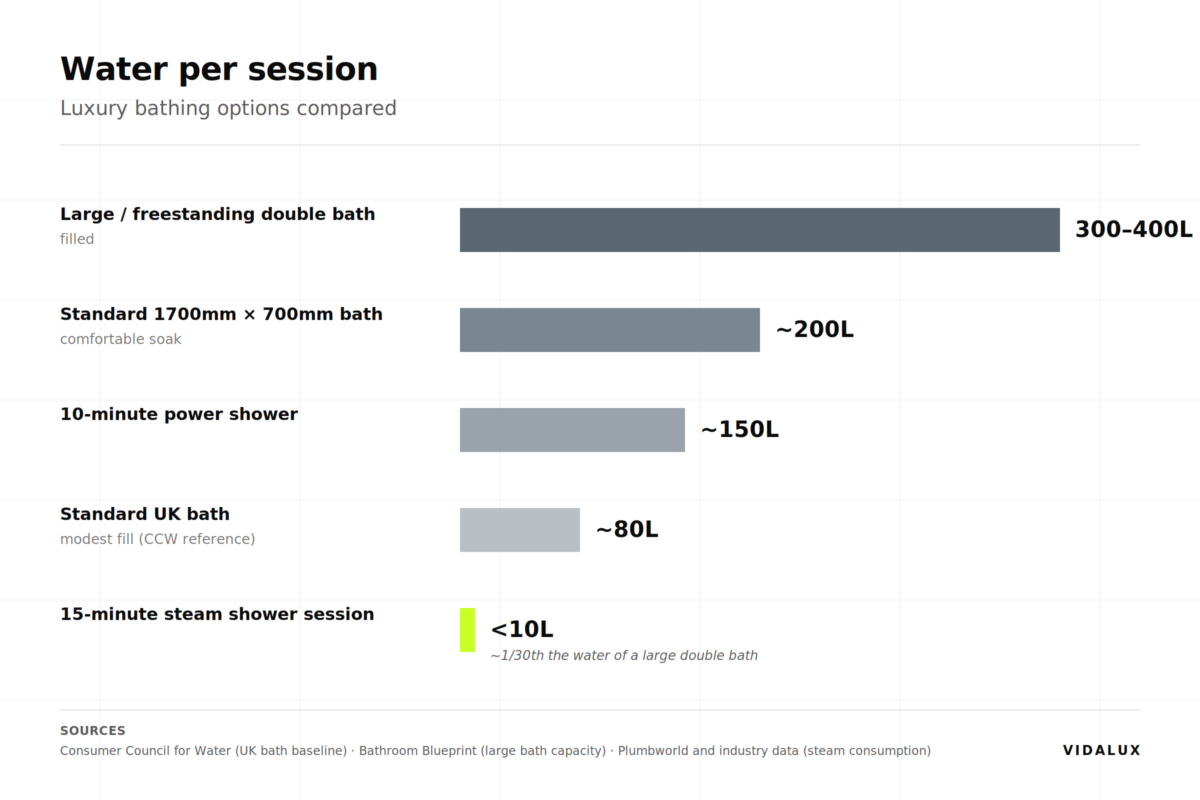
A typical 1700mm x 700mm bath uses around 200 litres for a comfortable soak. A larger double-ended or freestanding bath can hold 300 litres or more when filled. A 15-minute steam shower session uses under 10 litres of water – roughly thirty times less for a comparable shared luxury moment.
That’s the headline. The detail is worth a moment.
As the Consumer Council for Water notes, a typical full bath uses around 80 litres, and a power shower around 15 litres per minute. That figure of 80 litres is the standard UK reference – but it assumes a modest fill on a standard bath. Larger and double-ended baths are a different category entirely.
Here’s the realistic breakdown for a single bathing session:
- Standard UK bath, modest fill: approximately 80 litres
- Standard 1700mm x 700mm bath, comfortable soak: approximately 200 litres
- Large or freestanding double bath, filled: 300 to 400 litres
- 15-minute steam shower session: under 10 litres
- 10-minute power shower: approximately 150 litres
Put simply: a twin steam shower session uses roughly 1/30th the water of filling a large double bath. A regular shower comes nowhere close to that ratio – because a shower runs water continuously, while a steam generator only converts a small reservoir into vapour.
That’s a meaningful gap. Not marginal. Not a clever framing. A genuine, order-of-magnitude difference.
But is the comparison fair?
It’s fairer than it looks. A double bath is a shared luxury experience – two people, one indulgent moment. A twin steam shower is the same thing in a different form. We’ll come to whether the experience itself stacks up in the next section.
But Is a Twin Steam Shower Actually a “Two-Person” Experience?
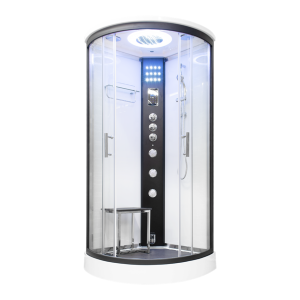
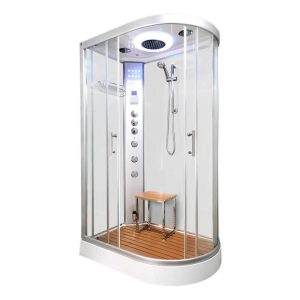
Yes – twin steam shower cabins like the Tempest Twin are designed for shared use, with an enclosed steam environment that envelops both users. Sessions are limited to 15 minutes for safety, and the practical advantage couples often describe is that there’s no waiting for a bath to fill – it’s a fifteen-minute decision rather than a planned event.
That last point matters more than it sounds.
A double bath is a planned event. You have to clear an evening, run the water for twenty minutes, get the temperature right, and synchronise. A twin steam shower is a fifteen-minute decision. No filling, no waiting, no guilt about the half-cold water at the end.
The experience itself is immersive in a different way. Steam wraps around you – it’s not water hitting your skin, it’s a warm, humid environment you sit or stand inside. Modern steam showers include controls for steam temperature, chromotherapy lighting, aromatherapy, and audio. The thermostatic valve on every Vidalux unit is factory-set with a 38°C safety stop, which keeps the showering side of the cabin within a safe operating range.
It’s not a compromise on a shared luxury moment. It’s a different shared luxury moment – and one that doesn’t ask you to fill 300 litres of water to enjoy it.
The Energy Side of the Equation (Honest Caveats)
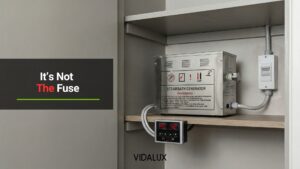
Steam isn’t water-free and energy-free. A typical residential steam generator runs at around 3kW, and a 15-minute session draws meaningful power while it’s operating.
That’s worth saying clearly, because the eco-luxury argument shouldn’t dodge it.
Here’s the thing. A steam generator is like a kettle – it only uses energy while it’s on. There’s no idle heat loss, no maintained temperature in standing pipework, no warm water sitting in pipes between sessions. The moment you finish, the energy draw stops.
Compare that to filling a 200-litre bath. You’re heating a substantial volume of water from approximately 10°C to roughly 40°C, which uses around 6 kWh of energy on a gas boiler. A 300-litre bath uses proportionally more. The water then sits and cools, transferring most of that heat into the room and the air – heat you’ve paid for and won’t recover.
So the honest comparison reads like this: steam wins on water consumption by a wide margin. On energy, the gap is closer and depends on whether you heat your bath water with gas or electricity. We describe a twin steam shower as eco-friendlier, not eco-perfect. That’s the language that holds up under scrutiny.
Worth noting: electricity is generally more expensive per unit than gas in the UK. But the volume of energy used in a 15-minute steam session is also far smaller than the energy needed to heat a full bath. The running cost per session sits comfortably under a pound at current UK rates.
The Vidalux Approach: Designing for Honest Luxury
Our range is built around a simple principle. Good engineering should also mean responsible engineering – not as a marketing angle, but as a quiet consequence of designing things properly.
Twin steam shower cabins in our steam shower range are designed for genuine shared use. The Tempest Twin includes 6mm safety glass and a Vernet thermostatic valve – the same valve used by high-end brands costing twice as much. The 15-minute operational maximum on every steam unit is there to protect the cabin seals, the acrylic, and the user. It’s not a limitation. It’s a designed-in safeguard.
A few things worth being clear about.
The water-efficiency argument isn’t a campaign for us. It’s a happy outcome of building products that do their job without excess.
If you’re weighing a luxury bathroom upgrade, the question isn’t really “bath or steam?” It’s the version of luxury that fits the home you actually live in. The water bill, the drought headlines, and your weekend energy all come into the answer.
The numbers above might shift it. Compare the options.
Frequently Asked Questions
Q: How much water does a double bath use compared to a steam shower? A: A double bath typically uses 200 to 300 litres or more to fill, depending on size, while a 15-minute steam session uses under 10 litres of water. That’s roughly thirty times less water for a comparable shared luxury wellness moment.
Q: Is a twin steam shower really a two-person experience? A: Yes – twin steam shower cabins like the Tempest Twin are designed for shared use, with an enclosed steam environment large enough for two. Sessions are limited to 15 minutes for safety, and the practical advantage is no waiting for a bath to fill before sharing the moment.
Q: How long can you safely use a steam shower? A: A steam shower session should be limited to a maximum of 15 minutes. This is an engineering safety limit on Vidalux units to protect the glass seals, acrylic, and your wellbeing – exceeding it is not recommended for any session.
Q: Is a steam shower more eco-friendly than a bath? A: On water consumption, yes – significantly so. A 15-minute steam session uses under 10 litres versus 80 to 300 litres or more for a bath. On energy, the comparison is closer because a steam generator runs on electricity, but only during the session itself, with no idle heat loss.
Q: Does a twin steam shower need special plumbing? A: A twin steam shower needs hot and cold water connections at standard residential pressure (1 to 3 bar) and a dedicated electrical supply for the generator. Installation should be completed by a qualified plumber – Vidalux is supply-only.
- About the Author
- UK’s best-rated?

With over 22 years in the home spa industry, Andrew has overseen every stage of the journey—from initial product design and manufacturing to final installation. An author of multiple technical publications and scientific papers, he founded Vidalux to replace industry hype with engineering-led reliability. His focus remains on delivering gym-quality wellness through honest design and technical truth.
DISCLAIMER: All specifications, claims, and advice relating to any internal or external procedure, practise, product, or service were true at the time of writing. For more accurate and up-to-date details in relation to Vidalux services, please visit the relevant dedicated on-site page. For any product-related information, specifications, or guidance, the information on the product page should be considered the governing source.