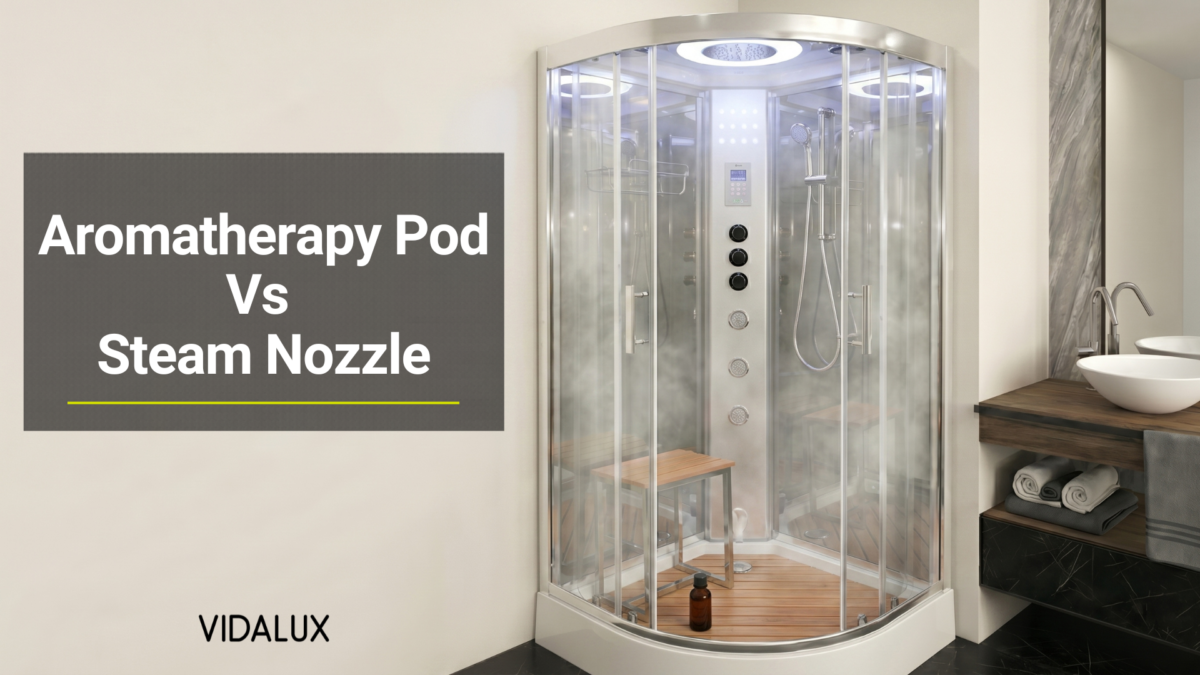
Want Aromatherapy in Your Steam Shower? Why How You Add the Oils Matters
If you’ve tried adding essential oils to your steam shower and something felt off – a sharp, acrid smell instead of something soothing, or no scent at all
The good news is that nothing is broken. The feature works. What usually hasn’t happened is a clear explanation of where the oil actually goes – and why that matters more than you might expect.
The aromatherapy pod vs. standard nozzle distinction is small in engineering terms. In practice, it’s the difference between a genuinely pleasant experience and a session that smells faintly of burnt chemicals.
Here’s what’s actually happening, and how to get it right.
Two Parts, One Steam Head – What Most People Confuse
The name causes the confusion.
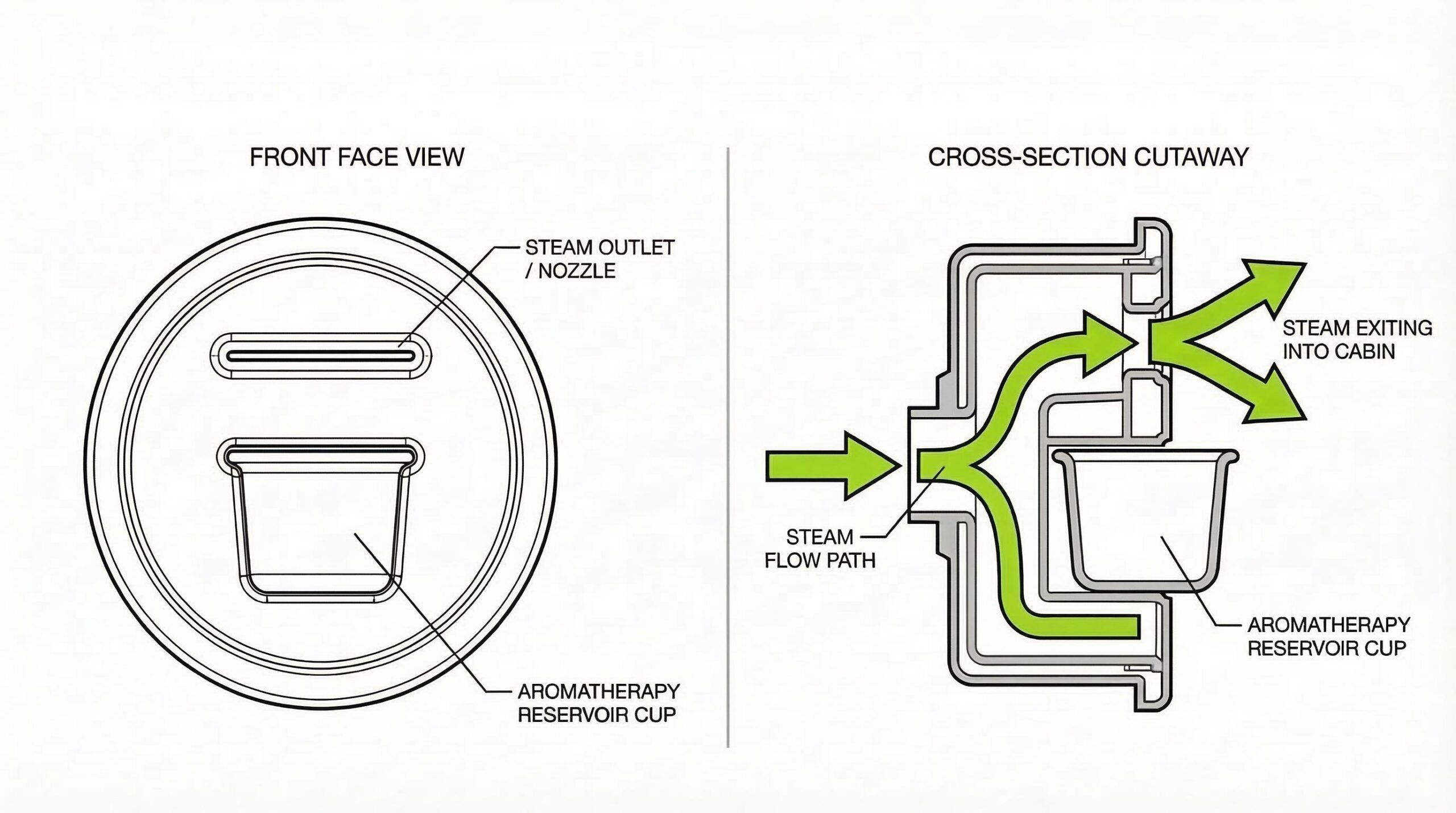
When people say “steam nozzle” or “steam pod,” they’re usually referring to the chrome fitting mounted in the corner or column of the cabin – the outlet through which steam enters the space. That much is correct.
What most people don’t know is that properly equipped steam outlets include a second, distinct component sitting within that same housing: the aromatherapy reservoir cup – a small, purpose-built, well-designed to hold a few drops of essential oil.
These are not the same thing. They look similar. They live in the same fitting. And that is the root of almost every problem with steam shower aromatherapy.
The steam nozzle is the opening through which hot steam exits the generator and enters the cabin. It operates at close to 100°C at the exit point. It is not a surface to add anything to, touch, or interact with during a session.
The aromatherapy cup is a shallow recess, integrated into or adjacent to the steam head, that holds oil when the unit is off and cool – before you start.
Worth noting: professional steam room installers repeatedly encounter this exact misidentification. Oil introduced through the wrong point – usually through what a homeowner has mistaken for a clean-out port or alternative fill point – leaves residue inside the steam line fittings, creating blockages that require professional attention to clear. It’s a predictable consequence of a fitting that looks deceptively uniform to an untrained eye.
A Vidalux steam shower includes an aromatherapy cup integrated into the heavy-duty chrome steam outlet as standard. No modification is required. But knowing it exists – and knowing exactly where it sits – is the first step.
What Happens When Oil Hits the Nozzle Directly
Most people work it out backwards.
They add oil near the steam outlet because that’s where the heat is. They reason, not unreasonably, that steam plus oil near a heat source should produce something aromatic. The result is usually a brief, sharp smell – and then nothing. Or something that smells more like burning than relaxation.
Here’s what’s actually happening.
Essential oils are volatile organic compounds. As the International Federation of Aromatherapists notes in its safety guidance, essential oils are highly concentrated and need to be diluted and applied correctly to be used safely. Heat them aggressively and they don’t diffuse gently – they flash-evaporate almost instantly. Think of it like alcohol on a hot pan.
The aromatic molecules you want dispersed through the steam cloud are gone in seconds, leaving behind residue that can affect steam flow and nozzle performance over time.
But isn’t the burnt smell just the oil itself?
Not entirely. When aromatic compounds break down at high temperature, they produce decomposition products with a sharp, acrid quality – noticeably different from the clean scent of the oil itself. What you’re smelling is decomposition, not diffusion.
Beyond the nozzle, there’s a slower and more costly problem. Essential oils are aggressive toward the rubbers and plastics used throughout a steam shower system when in direct contact. This isn’t a warning to handle lightly – it’s confirmed in Vidalux’s own installation guidance.
Damage caused by this kind of contact doesn’t always show up immediately. It can develop gradually and surface as a problem long after the original exposure, by which point most owners have completely forgotten the connection.
Some essential oils carry a particular risk for acrylic surfaces. The compounds they contain can affect the surface structure of shower trays and wall panels in ways that are difficult or impossible to reverse. Users who’ve experienced this describe trying everything before concluding there’s no straightforward fix. Professional resurfacing is sometimes possible, but it’s a poor outcome that’s entirely avoidable.
Let’s be clear on the warranty position too: any damage caused by oil applied outside the purpose-built reservoir falls outside warranty coverage.
How the Aromatherapy Reservoir Actually Works
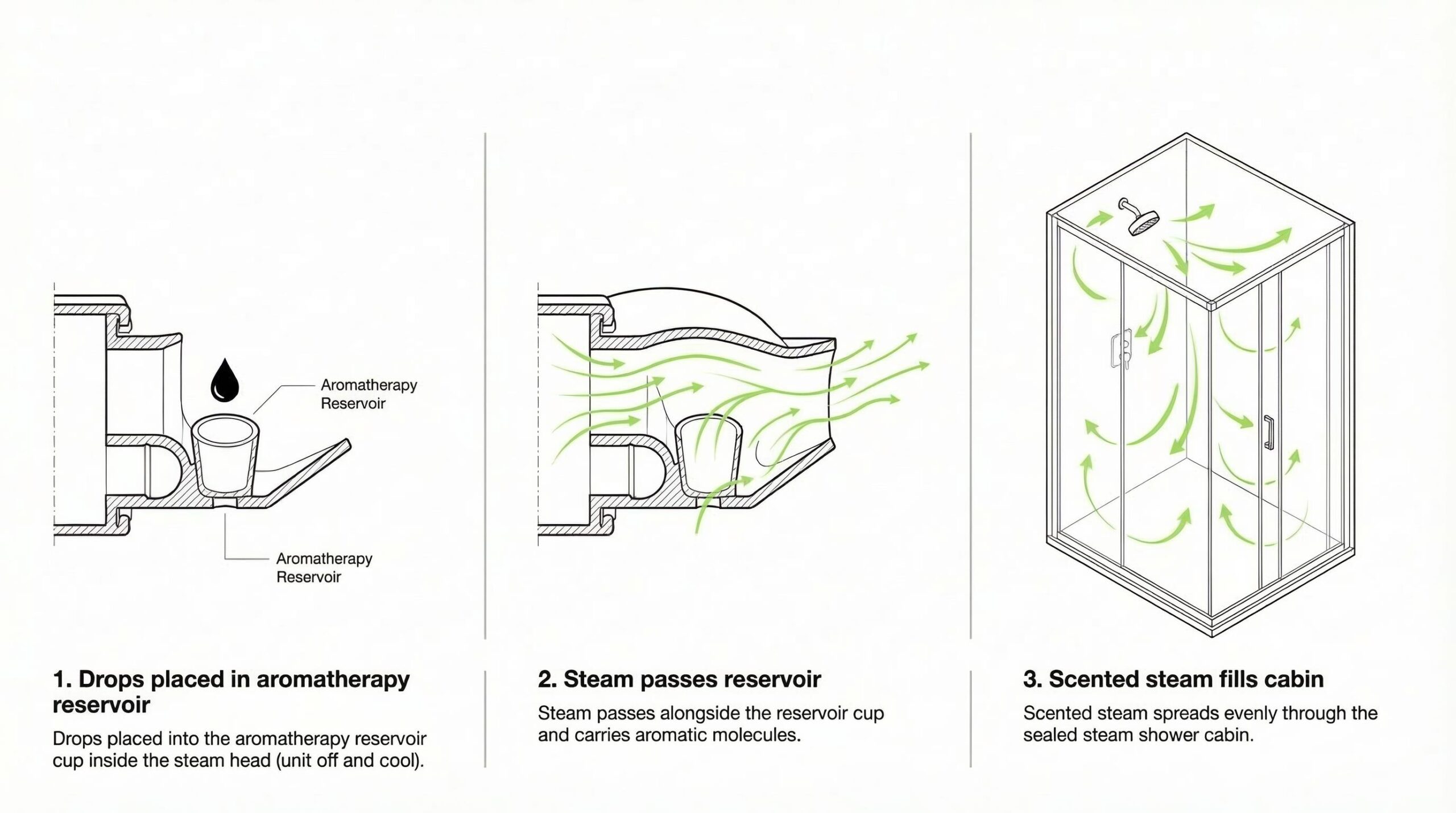
The principle is simple, and once you understand it, the design makes complete sense.
You place five to eight drops of diluted, steam-safe essential oil into the aromatherapy cup before your session, when the unit is off and the steam head is cool. As steam exits the generator and passes around and over the reservoir during your session, it gently picks up aromatic molecules from the oil’s surface.
The oil is never directly heated. It sits in a controlled diffusion zone, and the steam does the work of carrying the fragrance into the cabin.
Think of it like a cool breeze picking up the scent of flowers as it passes over them – not by burning the petals, but by simply moving through the aromatic compounds at the right temperature and pace. The steam cloud then distributes that fragrance evenly throughout the sealed cabin as it fills.
This is precisely how professional steam rooms and spa environments deliver aromatherapy. The same diffusion principle, scaled for home use, is built directly into the steam outlet as a standard feature.
The enclosed cabin environment matters here, too. Steam vapour is pure and disperses evenly, and because the space is sealed, aromatic compounds concentrate throughout the room rather than dissipating into open air. The result is noticeably closer to a spa than any open shower diffuser can produce.
Which Oils Work – and Which to Avoid
Not every oil labelled “aromatherapy” is suitable for a steam shower system. This is where many people make a second mistake after correcting the first.
Use only pure essential oils that are specifically designed for steam infusion – formulated for heat-based diffusion and verified as compatible with the materials in a steam environment.
Avoid Olbas Oil. In the UK, it’s the default reach for anything involving steam and congestion, and the misuse is widespread. Olbas Oil is formulated as an inhalant decongestant for use on tissues, handkerchiefs, or pillows – or for steam inhalation from a bowl of hot water.
It is NOT designed for steam shower use, and Vidalux’s own installation guidance specifically names it as a product that can cause discolouration to the pod, tray, or cabin walls. Its concentrations are far higher than appropriate for a sealed cabin. None of that appears on the packaging, because it was never intended for this application.
Avoid carrier oils – sweet almond, jojoba, coconut. These are fatty, non-volatile, and do not evaporate at steam temperatures. They don’t diffuse. They accumulate as residue, combine with mineral deposits, and eventually affect the oil channel’s performance.
Avoid synthetic fragrance oils from craft suppliers, regardless of the label. These typically contain compounds incompatible with the rubbers and plastics in a steam system.
One thing to consider: the enclosed steam environment amplifies scent concentration significantly. The recommendation of five to eight diluted drops is a considered range, not a conservative suggestion. More is not better here – overdosing produces irritation rather than relaxation, and often means cutting the session short.
Finally, dilute your oils before placing them in the reservoir. Direct contact between concentrated oil and the cup material reduces gradually over time – dilution extends scent release and reduces that contact risk.
Getting the Most from Your Aromatherapy Session
A few practical things that make a genuine difference.
Fill the cup before you start – always when the unit is off, and the steam head is cool. The outlet runs at close to 100°C during operation. This isn’t only a safety point – it’s about the diffusion process itself. Oil placed into a hot cup flash-evaporates immediately, before the steam session has properly built.
Make sure the cabin is fully sealed before you begin. The enclosed environment is what allows the scent cloud to establish and hold. Steam sessions typically run 15 to 20 minutes via the control panel timer – let the fragrance build in the first few minutes, and the session will carry it consistently throughout.
After use, run through the normal auto-drain cycle. Residual moisture left sitting in the system can become stale, and stale steam has a noticeably different quality from fresh. The auto-drain function exists for exactly this reason.
Clean the reservoir cup after each session. A brief wipe prevents residue from accumulating over repeated sessions, which can gradually affect the cup’s performance. It takes less than a minute and extends the life of the fitting considerably.
The Vidalux Approach
The aromatherapy cup is included as standard in every Vidalux steam generator – integrated into the heavy-duty chrome steam outlet, nothing extra required.
This is not universal across the industry. Many premium-branded steam systems list aromatherapy as a feature without building a dedicated reservoir into the steam head. The customer either buys a separate accessory, uses a wick holder near the outlet, or – most commonly – adds oil incorrectly and wonders why it doesn’t work.
The decision to include it as standard reflects how Vidalux approaches product design: from real installation and usage experience rather than a specification checklist. The cup exists because direct oil application simply doesn’t work, and that’s something you learn from knowing how these systems behave in real homes – not from a product brief.
Used correctly – five to eight diluted drops in the dedicated reservoir, steam-safe oil, sealed cabin – the feature is reliable, simple, and genuinely effective.
See the full Vidalux steam shower range at https://vidalux.co.uk/steam-showers/
The answer to most aromatherapy disappointments in a steam shower is the same: the oil went in the wrong place.
The cup, the right oil, the right dose, the sealed cabin. Four things. That’s the difference between a sharp smell that fades in thirty seconds and a scent experience that carries through an entire session.
The feature works. Now you know how to use it.
Frequently Asked Questions
Q: What is the aromatherapy pod on a steam shower?
A: The aromatherapy pod on a steam shower is a small reservoir built into the steam head that holds essential oil before a session. As steam passes around it, aromatic compounds are gently picked up and distributed through the cabin – the oil never contacts the hot outlet surface directly.
Q: Where do I put essential oils in a steam shower?
A: Essential oils in a steam shower go into the aromatherapy cup inside the steam head – not onto the nozzle or outlet surface. Add 5-8 diluted drops into the reservoir when the unit is off and cool; the steam will carry the scent evenly as the cabin fills.
Q: Why does my steam shower aromatherapy smell burnt?
A: A burnt smell in a steam shower usually means oil has contacted the hot steam outlet rather than the aromatherapy reservoir. At operating temperatures, aromatic compounds decompose rather than disperse. Using the dedicated cup allows steam to carry the scent without the oil ever touching a direct heat source.
Q: Can I use Olbas Oil in a steam shower?
A: Olbas Oil is not suitable for steam shower use. It is not designed for steam infusion – Vidalux’s own installation guidance notes it can cause discolouration to the pod, tray, or cabin walls, and that essential oils are aggressive toward rubbers and plastics on direct contact. Use only pure oils designed for steam diffusion.
Q: Will essential oils damage my steam shower?
A: Essential oils can damage a steam shower if applied incorrectly. Direct contact with the steam nozzle or the rubbers and plastics in the system causes residue build-up and material degradation. Some oils carry a particular risk for acrylic surfaces. Used correctly – diluted drops in the purpose-built reservoir – damage risk is minimal.
Q: Does misusing essential oils void a steam shower warranty?
A: Yes – Vidalux’s installation guidance is explicit that any damage from oil use is not covered by warranty. Damage to rubbers, plastics, acrylic surfaces, or other components caused by oil applied outside the designed aromatherapy reservoir is classified as misuse and falls outside warranty coverage.
Q: How many drops of essential oil should I use in a steam shower?
A: Five to eight drops of diluted essential oil is the recommended dose for a steam shower session. Place drops into the aromatherapy cup before starting, not during. The sealed cabin environment significantly amplifies scent concentration – overdosing produces irritation rather than a pleasant aromatic experience.
Q: What is the difference between an aromatherapy pod and a standard steam nozzle?
A: A standard steam nozzle delivers steam into the cabin only. An aromatherapy pod is a steam outlet with an integrated reservoir cup – a small recessed well designed to hold essential oil so passing steam can diffuse the fragrance gently and evenly. The two components are distinct, though they share the same fitting.
Q: Do Vidalux steam showers include an aromatherapy cup?
A: Yes – Vidalux steam generators include an aromatherapy cup integrated into the heavy-duty chrome steam outlet as standard. No additional accessory or modification is required. This is not universal across the industry; many premium-branded steam systems do not include dedicated aromatherapy delivery as a standard feature.
Q: Why is steam aromatherapy better than a room diffuser?
A: Steam aromatherapy in a sealed shower cabin delivers essential oil compounds more effectively than a room diffuser. Pure steam vapour disperses evenly, the enclosed environment concentrates aromatic compounds throughout the space, and the warm humidity supports deeper inhalation – producing an experience closer to a professional spa steam room.
- About the Author
- UK’s best-rated?

With over 22 years in the home spa industry, Andrew has overseen every stage of the journey—from initial product design and manufacturing to final installation. An author of multiple technical publications and scientific papers, he founded Vidalux to replace industry hype with engineering-led reliability. His focus remains on delivering gym-quality wellness through honest design and technical truth.
DISCLAIMER: All specifications, claims, and advice relating to any internal or external procedure, practise, product, or service were true at the time of writing. For more accurate and up-to-date details in relation to Vidalux services, please visit the relevant dedicated on-site page. For any product-related information, specifications, or guidance, the information on the product page should be considered the governing source.