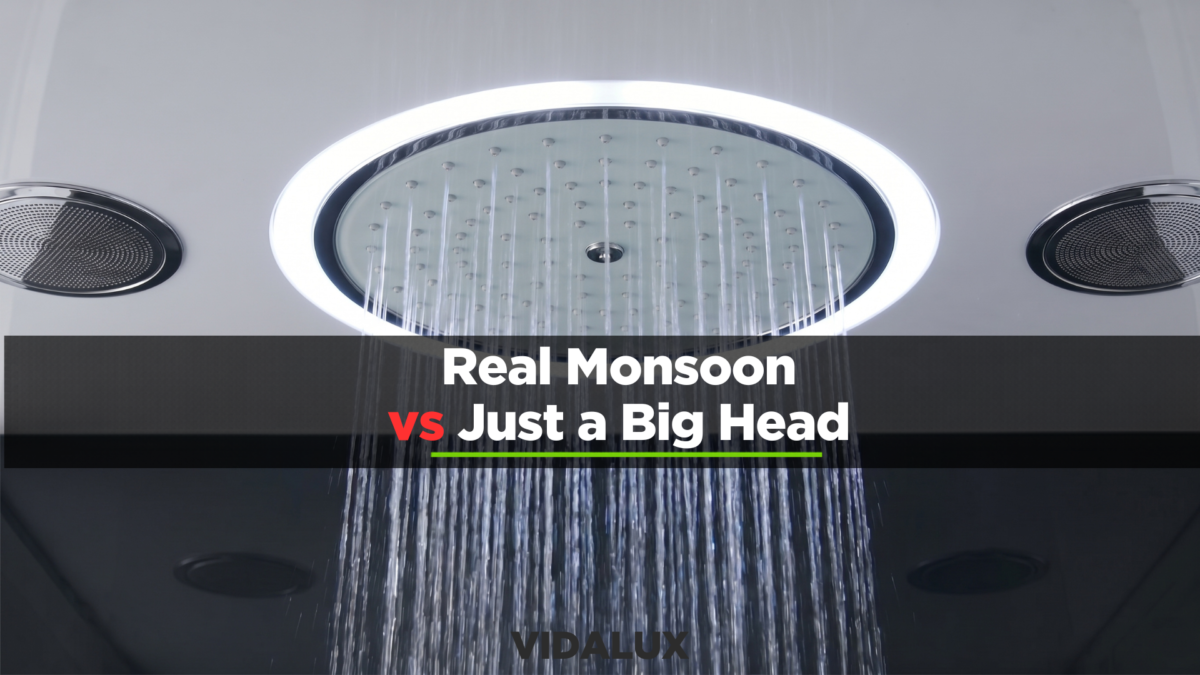
Real Monsoon vs Just a Big Head: Understanding Water Pressure Requirements
You’ve seen the photo. A wide, ceiling-mounted monsoon shower head pouring water down like warm rain. It’s the image that sells the bathroom.
Then it arrives, gets installed, and what comes out is… a polite trickle. A drizzle. Definitely not a monsoon.
Here’s the thing. The shower head isn’t lying, and the photo isn’t fake. The problem is almost always the same one, and it’s not the head: there isn’t enough pressure feeding it. A monsoon shower needs real water flow behind it, or it’s just a big disc on the ceiling.
This guide explains, in plain English, what water pressure actually means, what a monsoon shower genuinely needs, and how to know whether your home can deliver it. We’ll cover the bucket test, the difference between combi and gravity-fed systems, and when a pump is the honest answer. No jargon, no upsell, no hype. Just the engineering truth.
What “Water Pressure” Actually Means (And Why a Big Head Makes It Worse)
Most people use “pressure” and “flow” as if they’re the same thing. They aren’t, and the difference is the entire reason your monsoon shower might disappoint you.
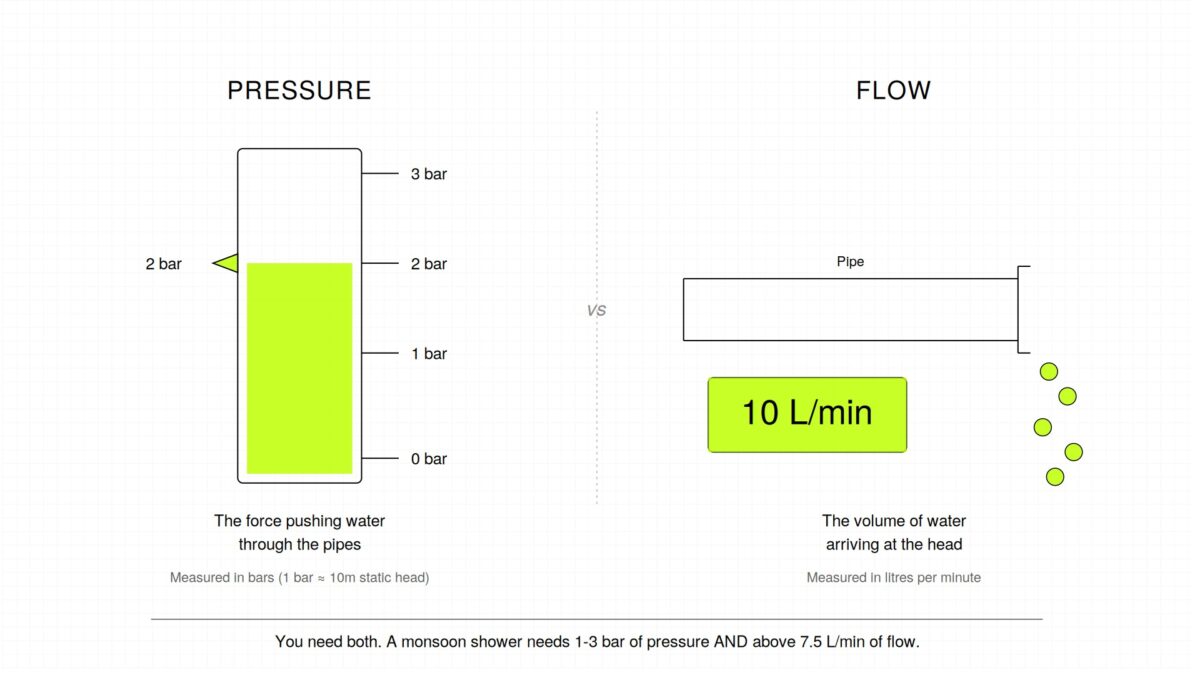
Water pressure is the force pushing water through your pipes. It’s measured in bars. One bar is roughly the pressure produced by a column of water 10 metres tall – so a cold water tank in your loft sitting 3 to 5 metres above your shower delivers, at best, around 0.3 to 0.5 bar.
Flow rate is something different. It’s the volume of water arriving at the head, measured in litres per minute. You can have decent pressure but poor flow if something narrows the pipework on the way – kinked hoses, partially closed isolation valves, limescale, or undersized pipes. You need both.
Now picture a 250mm monsoon shower head. It has dozens of nozzles spread across a much larger area than a standard handheld head. The same volume of water that produces a punchy stream from a small head has to spread itself across that whole disc. More surface area, same supply, lower force per square inch.
Put simply: a big shower head doesn’t create more water. It just spreads what you give it across a larger area. No pressure behind it, no monsoon in front of it.
Think of a pressure washer. The narrow zero-tip nozzle gives you a stream that could cut paint off a wall. Switch to a fan-tip, and the same water becomes a soft mist. Same supply. Same pump. Different feels entirely – and that’s exactly what’s happening between a small head and a wide monsoon head fed by the same supply.
What a Monsoon Shower Actually Needs
A monsoon shower needs water pressure between 1 and 3 bar with a flow rate above 7.5 litres per minute. Above 2 bar is recommended for optimum performance, and you should never exceed 3 bar at the shower (some manuals reference 3.4 bar as an absolute ceiling).
Those numbers are the operating window every Vidalux shower is designed and tested around. They’re not aspirational. Below 1 bar, the head simply can’t perform. Above 3 bars, you’ll damage internal components and invalidate the warranty – if your incoming pressure is that high, your installer needs to fit a pressure-reducing valve.
For our steam shower range, we recommend a minimum of 1.5 bar specifically. Below that, the steam generator may struggle to fill, and the massage jets feel weak. There’s a small spec divergence between our installation manuals and our customer FAQ on this minimum, so we’ll be transparent: 1 bar is the absolute floor for the shower head, 1.5 bar is the practical minimum for a steam shower running at full function. If in doubt, design for 2 bars and you’re inside the comfort zone.
Worth noting: the Fusion Steam 1200 wants a combined hot and cold supply of 14 to 16 litres per minute. Larger cabins with more outlets simply ask more of your water.
These aren’t aspirational specs. They’re the operating window that the engineering was designed around.
What’s Normal in UK Homes (And What the Law Actually Requires)
If you’ve never thought about your home’s water pressure before, the legal minimum will surprise you.
According to Ofwat, water companies are required to maintain a minimum of seven metres static head – around 0.7 bar – at the boundary stop valve where their main meets your property. That’s it. A third of what most modern showers need to perform comfortably. You can read Ofwat’s water pressure standards for the full guaranteed standards scheme.
The service standard most companies aim for is slightly better: 1 bar (10 metres head) at 9 litres per minute, measured at the external stop valve. That’s enough to fill a 4.5-litre container in 30 seconds. Above this baseline, the Water Industry Act 1991 requires water to reach the upper floors of your property constantly – but the exact pressure isn’t pinned down by law inside your home.
Most UK homes actually receive between 1.5 and 3 bar at the kitchen tap, depending on:
- Where you live and which network you’re on
- How high your property sits relative to the local reservoir or water tower
- Time of day (mornings dip when everyone’s using water)
- Whether your supply pipe is corroded, narrowed, or shared
- Distance from the water main
One thing to consider: in some urban areas, the network now runs deliberately low to reduce leakage from ageing pipework. Older neighbourhoods that historically saw 2 to 3 bar can now sit closer to 1 bar at the boundary. This isn’t a fault – it’s pressure management – but it absolutely changes what your shower will deliver.
The honest truth? Most homes in the UK fall into the “comfortable” range. But if you’re in an older property, on a hill, at the end of a long shared supply pipe, or upstairs in a flat, you may be running closer to the legal minimum than you realised.
How to Test Your Home in 60 Seconds (No Tools Needed)
You don’t need a pressure gauge tool to get a useful answer. There’s a quick test that takes about a minute and a kitchen jug.
The Bucket Test:
- Take a one-litre jug or measuring container
- Fully open the cold tap closest to where the shower will go
- Time how many seconds it takes to fill the litre
Six seconds or less means roughly 10 litres per minute – comfortably above the 7.5 litre minimum for a monsoon shower. Twelve seconds or more means around 5 litres per minute, and a monsoon head will feel underwhelming no matter what you spend on it.
For an exact pressure reading in bars, a water pressure gauge that screws onto an outside tap costs under £20 from any plumbing merchant. Run the cold tap or two while you read it for a dynamic figure rather than a static one.
Read this paragraph twice if you’ve ever quoted your boiler’s pressure gauge to an installer. Your boiler’s pressure gauge shows the pressure inside its sealed central heating circuit – typically 1.0 to 1.5 bar. This has nothing to do with your incoming water supply pressure. We’ve seen homeowners spend thousands replacing showers when the diagnosis would have taken thirty seconds with a jug. Two completely different gauges, two completely different systems.
If the bucket test shows a slow fill, work down a checklist before you assume the shower is the problem. Is the kitchen stopcock fully open? Has any recent plumbing work left an isolation valve partially closed? Are the hot and cold taps similarly weak (a system issue) or just one (a pipe or valve issue)?
Combi Boiler vs Gravity-Fed: Which Do You Have?
The single biggest factor determining whether your monsoon shower will work as designed is the type of water system feeding your home. There are two main types in the UK, and they behave very differently.
Combi Boiler Systems
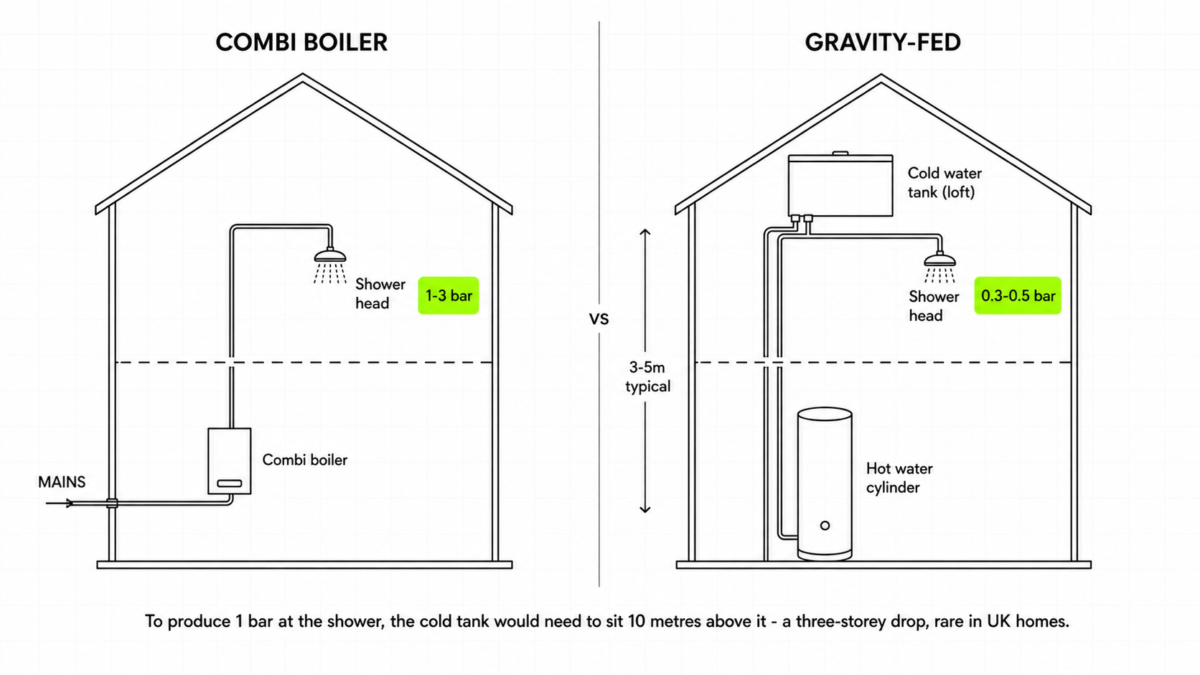
A combi boiler heats water on demand directly from the mains. There’s no header tank, no hot water cylinder, no stored water. Pressure at your shower is essentially the same as pressure coming into your home – typically 1 to 3 bar. That’s exactly the operating window a monsoon shower is designed for.
If you have a healthy combi setup, you can connect to a Vidalux shower without needing a Pressure Equalising Valve. Our thermostatic cartridge handles small pressure imbalances between hot and cold naturally.
Gravity-Fed Systems
A gravity-fed system uses a cold water tank (usually in the loft) and a hot water cylinder (usually in an airing cupboard). Hot water reaches the shower by gravity alone – which means pressure depends entirely on how high the tank sits above the shower head.
Most older properties have the cold tank 3 to 5 metres above the shower. That gives you 0.3 to 0.5 bar. Nowhere near enough for a monsoon experience. To produce 1 bar at the shower, you’d need the tank a full 10 metres above it – effectively a three-storey drop, rare in domestic UK homes.
Worth noting: if one of your supplies is mains-fed and the other is gravity-fed (a common situation in part-renovated homes), you’ll get pulsing or temperature swings through the thermostatic valve. The cure is balancing the supplies – usually with a pump on the gravity side.
If you’re not sure which system you have, look in the loft. If there’s a cold water tank, you’re gravity-fed. No tank, water heats on demand from a wall-mounted unit, you’re on a combi. Unvented cylinders (mains-pressure stored hot water) are a third option that behaves more like a combi for shower purposes.
When You Need a Pump (And What Kind)
If you’re on a gravity-fed system, you’ll almost certainly need a shower pump rated over 1.5 bar – ideally over 2 bar – to drive a monsoon shower properly. There’s no way around the physics, and no shower enclosure on the market – ours included – comes with a built-in pump.
Pump selection looks complicated from the outside, but it comes down to three questions.
Question 1: Positive head or negative head?
A positive head pump needs the cold water tank to sit at least 600mm above the shower. Gravity does the work of starting the impellers (they need 0.6 litres per minute of natural flow to kick in). Most loft-tank-to-bathroom installations qualify.
A negative head pump is required when the shower is at the same level as, or above, the cold water tank. Loft conversions, bungalows, top-floor flats – anywhere gravity isn’t doing you any favours. These pumps suck water through actively rather than waiting for gravity to start them. They’re more expensive, but they work in places a positive head pump can’t.
If you’re not sure which you have, a negative head pump will work in either situation. A positive head pump won’t.
Question 2: Single or twin impeller?
Twin impeller pumps boost hot and cold supplies separately, ensuring both arrive at the thermostatic valve at the same pressure. This matters – mismatched supplies cause the shower to run hot then cold, then hot through the cartridge as it tries to compensate. For mixer showers (which is what every Vidalux cabin uses), a twin impeller is the right answer.
Single impeller pumps boost only one supply. They’re useful where the cold is mains-fed and only the hot needs lifting, but for a gravity-fed mixer shower, twin is the standard.
Question 3: What bar rating?
A small flat or single-bathroom home does fine on 1.5 to 2.0 bar. A standard family home is usually 2.0 to 3.0 bar. Larger homes with multiple outlets running simultaneously may need 3.0 bar or higher. Stay within the 3-bar maximum at the shower itself – if your pump is rated higher, your installer will need to manage that with a pressure-reducing valve.
Here’s the honest truth. We’ve had customers ring up convinced our shower is faulty, only to find their gravity tank is 2 metres above the shower head and feeding a 300mm monsoon. The shower’s working perfectly – the supply was never going to drive it. Five minutes with a tape measure and a pump catalogue would have saved them a phone call and a lot of frustration.
One last note for combi households: combi boilers cannot be pumped directly from the mains. It’s not just unwise, it’s against water regulations. If a combi system genuinely needs boosting, a cold water break tank goes in first, and the pump works from that. Always installer territory.
When the Pressure Looks Fine But the Shower Still Dribbles
You’ve done the bucket test, the supply checks out, your system is healthy – and the shower is still weak. This happens, and the diagnosis is usually one of five things.
Trapped or kinked hoses. The flexible hoses behind the cabin can pinch during installation. They need to run cleanly with no compression points. This is the single most common fix and the easiest to miss. Pull the access panel, check the run, and straighten where needed.
Limescale and mineral deposits. Over months and years, scale builds up inside the thermostatic cartridge and across the rubber nozzles on the monsoon head. The temperature dial gets stiff, flow drops, and dead zones develop on the head. In hard water areas, a water softener is strongly recommended – limescale damage isn’t covered under warranty, and once a cartridge is scaled, the only fix is replacement.
Pump pulsing or hunting. If your pump surges, then drops, then surges again, it’s almost always back-pressure from the non-return valves at the rear of the shower. Disconnect the braided hoses at the back, locate the silver C-clip inside each valve connection, remove it, then pull out the white plastic NRV. Refit and retest. Pulsing usually stops immediately. We’ve watched dozens of installers pull pumps out as “faulty” when this 30-second part removal would have fixed it. Most installers know this fix on sight, but you can show them this paragraph if needed.
Hot/cold pressure imbalance. If one supply is mains-fed and one is gravity-fed, the thermostatic cartridge can’t keep up with the pressure difference, and you get intermittent hot-cold runs. The fix is balancing the supplies, usually by pumping the weaker side.
Partially closed isolation valves. After bathroom renovations, isolation valves sometimes get left half-open. Check the valves on both feeds at the back of the shower, plus any in-line valves added during the install. Fully open is fully open – 90 degrees, lever in line with the pipe.
Older properties. Pre-1970s pipework can be corroded inside, narrowed by mineral deposits, or partially blocked by debris dislodged during recent work. If everything else checks out and pressure is genuinely low at the kitchen tap (not just the shower), this is a plumber-and-pipework conversation, not a shower problem.
The Vidalux Approach
We publish the operating window – 1 to 3 bar, above 7.5 litres per minute, above 2 bar optimal – because that’s what every cabin is engineered and tested around. It’s the same window for our entire hydro shower cabins range, the same for our steam models, and the same for our whirlpool variants. Same head, same hand shower, same hi-flow mixer valve, same thermostatic Vernet cartridge. Sized to perform inside that window.
The mixer valve has no inherent flow restriction. If your inlet pressure is strong but the head feels weak, the cause is almost always the supply, the hoses, or limescale – not a deliberate flow limiter inside our valve.
We’d rather lose a sale than ship a cabin into a system that can’t drive it. If you’re on a gravity tank with a low head and no pump in the plan, we’ll tell you. If you’re on a combi with marginal mains pressure, we’ll tell you. The engineering is sound when the supply is sound. That’s not a sales pitch – it’s just physics.
Get the Supply Right First
A monsoon shower is one of the genuine pleasures of a well-designed bathroom – when it works. When it doesn’t, it’s a £1,000+ disappointment hanging from your ceiling.
Run the bucket test. Identify your system type. If you’re on a gravity-fed setup, plan the pump in from day one rather than as an afterthought. Talk to your installer about static and dynamic pressure measurements before any cabin is ordered. Get those four things right, and the shower head becomes the easy bit.
For more on the engineering behind our cabins, browse the steam shower range – or compare craftsmanship across the range and see what we build into every spec.
See the quality. Then choose the supply to match.
Frequently Asked Questions
Q: What is the minimum water pressure for a monsoon shower head?
A: The minimum water pressure for a monsoon shower head is 1 bar with a flow rate above 7.5 litres per minute. Above 2 bar is recommended for optimal performance, and steam shower models specifically benefit from a 1.5 bar minimum to drive the generator and jets reliably.
Q: Will a monsoon shower work on a gravity-fed system?
A: A monsoon shower will not work effectively on a gravity-fed system without a pump. Gravity-fed systems typically deliver 0.3 to 0.5 bar – well below the 1 bar minimum. A twin impeller pump rated over 1.5 bar will balance hot and cold and bring pressure into range.
Q: How do I test if my water pressure is high enough for a monsoon shower?
A: To test your water pressure for a monsoon shower, time how long a one-litre jug takes to fill from the cold tap nearest the planned shower. Six seconds or less indicates adequate flow (around 10 litres per minute); twelve seconds or more means you’ll need a pump or another fix.
Q: Can my water pressure be too high for a shower?
A: Yes, water pressure can be too high for a shower. Vidalux specifies a maximum of 3 bar (some manuals reference 3.4 bar as the absolute ceiling). Above this, fit a pressure-reducing valve – exceeding the limit damages internal components and voids the warranty.
Q: Why does my new monsoon shower have weak flow when my taps are fine?
A: Weak monsoon shower flow with strong taps usually means kinked hoses, a partially closed isolation valve, limescale in the cartridge, or back-pressure on non-return valves causing pump pulsing. Removing the white plastic NRVs at the rear of the shower often resolves pulsing immediately.
- About the Author
- UK’s best-rated?

With over 22 years in the home spa industry, Andrew has overseen every stage of the journey—from initial product design and manufacturing to final installation. An author of multiple technical publications and scientific papers, he founded Vidalux to replace industry hype with engineering-led reliability. His focus remains on delivering gym-quality wellness through honest design and technical truth.
DISCLAIMER: All specifications, claims, and advice relating to any internal or external procedure, practise, product, or service were true at the time of writing. For more accurate and up-to-date details in relation to Vidalux services, please visit the relevant dedicated on-site page. For any product-related information, specifications, or guidance, the information on the product page should be considered the governing source.