Bathroom Electrical Zones: What Goes Where – and Why It Matters
Bathroom electrics. Two words that make most homeowners pause.
You’ve probably come across terms like “Zone 1,” “Zone 2,” and “IP ratings” while researching a renovation. Maybe you’re planning a new light fitting, an extractor fan, or a steam shower – and someone mentioned bathroom electrical zones in passing.
It sounded important. It also sounded confusing.
Here’s the thing. The rules aren’t complicated once someone explains them plainly. By the end of this guide, you’ll understand exactly what each zone means, what can safely go where, and why your electrician needs to be involved from the start.
No jargon without explanation. No scare tactics. Just clarity.
Why Bathroom Electrical Zones Exist
Water and electricity don’t mix. That’s not news. But what many homeowners don’t realise is that UK regulations treat your bathroom differently from every other room in your home.
Under BS 7671 – the 18th Edition of the IET Wiring Regulations – bathrooms are classified as a “special location.” This means stricter rules apply to any electrical equipment installed inside them. The reasoning is straightforward: where water is present, the risk of electric shock increases significantly.
To manage that risk, BS 7671 divides your bathroom into defined electrical zones based on proximity to water sources like baths, showers, and basins. Each zone carries its own rules about what can be installed and what level of protection that equipment needs.
Does this apply to every bathroom?
Yes. Whether you have a compact ensuite or a large family bathroom, the same UK regulations apply. All bathroom electrical circuits must be protected by a 30mA residual current device (RCD), and under Part P of the Building Regulations, any new electrical work in a bathroom must be carried out or certified by a qualified, registered electrician.
The official guidance sits within the Building Regulations – the government’s Approved Documents collection includes Approved Document P, which covers electrical safety in dwellings.
These regulations exist to protect you – not to make renovations harder.
Zone by Zone – What Each One Means
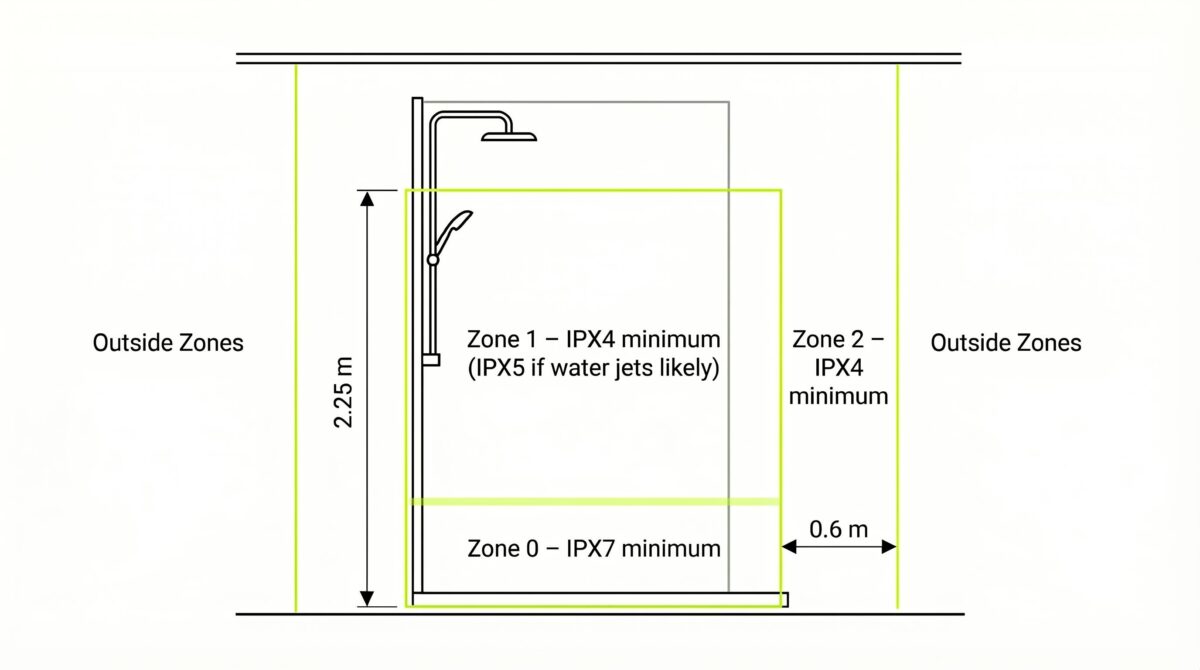
Think of bathroom zones like rings around a target. The closer to water, the higher the risk – and the stricter the rules. There are three main zones, plus an “outside zones” area beyond them.
Zone 0 – Inside the Bath or Shower Tray
This is the highest-risk area. Zone 0 covers the interior of the bath, basin, or shower tray itself – anywhere that holds water during use.
If there’s no shower tray (as in a wet room), Zone 0 extends 10cm above floor level and 1,200mm around the fixed shower head.
Only equipment running on separated extra low voltage (SELV) is permitted here – maximum 12V. The minimum IP rating is IPX7, meaning the fitting must withstand temporary water immersion.
Put simply: almost nothing electrical goes here unless it’s specifically designed for it.
Zone 1 – Directly Above the Bath or Shower
Zone 1 extends from the top of the bath or shower tray up to 2,250mm from floor level. This is where water spray is most likely.
Electrical equipment in this zone must carry a minimum IP rating of IPX4 (splash-proof). Where water jets are likely – during cleaning, for example – IPX5 is recommended. If 240V fittings are used, they must be protected by a 30mA RCD.
Common fittings you’ll find in Zone 1 include ceiling lights, extractor fans, and electric showers – all carrying the correct IP rating for the location.
Zone 2 – The Splash Zone
Zone 2 extends 0.6m horizontally beyond the outer edge of Zone 1, up to 2,250mm from floor level.
The minimum IP rating here is IPX4 – splash-proof. You’ll typically find light fittings, heated towel rails (if properly earthed and RCD-protected), and shaver sockets with built-in isolation transformers in this zone. Standard 13A sockets are not permitted.
What about the rest of the bathroom?
Everything beyond Zone 2 falls into what’s known as the “outside zones.” It’s less restrictive, but it’s still a bathroom. Standard plug sockets are only permitted if they sit more than three metres from the boundary of Zone 1. Pull-cord switches are preferred over wall-mounted switches inside the room. Shaver sockets with a transformer are allowed.
Worth noting: many bathrooms are small enough that the entire room falls within Zones 1 and 2. Don’t assume you have an “outside zone” without checking.
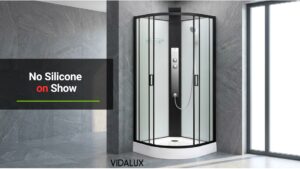
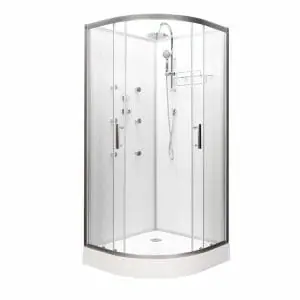
One thing that simplifies this considerably is choosing self-contained shower cabins where the electrical components are already housed within the unit’s sealed engineering. Vidalux steam showers and hydro showers, for example, use Leak-Seal technology with compression seals and tray return channels – so under normal use, water is returned to the tray rather than escaping into the surrounding bathroom. The electrical footprint on your surrounding bathroom is significantly reduced.
IP Ratings Explained – What the Numbers Actually Mean
You’ve seen “IPX4” and “IP65” mentioned throughout this guide. But what do those numbers actually tell you?
IP stands for ingress protection. It’s a two-digit code that describes how well a fitting resists solid particles and water.
The first digit (ranging from 0 to 6) covers protection against solids – dust, debris, and particles. Zero means no protection. Six means completely dust-tight.
The second digit (ranging from 0 to 8) covers protection against water. Zero means no protection. Eight means the fitting can handle prolonged submersion.
Think of it like a report card with two scores – one for dust, one for water. The higher each number, the tougher the protection.
Here’s how the most common bathroom ratings break down:
- IPX4 – splash-proof from any direction. The minimum for Zones 1 and 2.
- IPX5 – protected against low-pressure water jets. Recommended where direct spray is likely.
- IP65 – dust-tight and jet-proof. Common for ceiling lights in Zone 1.
- IPX7 – survives temporary immersion in water. Required for Zone 0.
One detail that catches people out: the “X” in IPX4 doesn’t mean zero protection against solids. It means the manufacturer didn’t test for solids – the fitting may still offer some resistance. But for bathroom purposes, the second digit (water protection) is the one that matters most.
So how do you check?
Look for the IP rating on the product specification or packaging. If it’s not listed, don’t install it in a bathroom zone. It’s that simple.
Common Mistakes Homeowners Make
Most bathroom electrical problems don’t come from ignorance – they come from assumptions.
What catches people out most often?
Assuming that “outside the shower” means outside all zones. It doesn’t. Zone 2 extends 0.6m beyond the shower perimeter, and in a small bathroom, that can cover most of the room.
Other common errors include installing a light fitting without checking its IP rating for the specific zone, using a standard plug socket inside the bathroom without understanding the three-metre rule, and attempting DIY electrical work that should be signed off by a registered electrician under the Building Regulations.
One less obvious mistake: assuming any electric shower can be fitted inside an enclosed, roofed cabin. It can’t. The IP rating on electric showers does not permit them in enclosed spaces where steam can gather – guidance echoed by electric shower manufacturers such as Triton. This is exactly why Vidalux electric shower cabins in the Pure E range are open-topped rather than roofed: the electric shower mounts on the column, in an open cabin, as the safety rules require.
Let’s be clear: understanding zones helps you plan better and ask better questions. The actual work belongs to a professional.
How Vidalux Designs for Bathroom Electrics
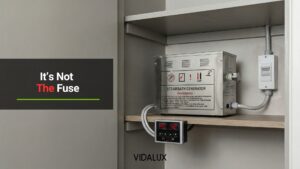
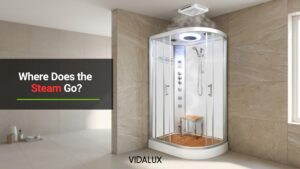
Vidalux steam showers and hydro shower cabins are self-contained cabin systems. The control panel, transformer, lighting, and steam generator are all housed within the sealed unit – not scattered across your bathroom walls.
This matters for zone compliance. Because the electrical components sit inside the cabin’s own engineering, they don’t create additional zone complexity in your wider bathroom.
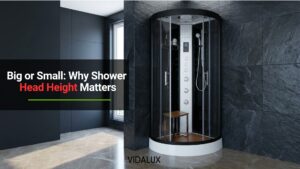
Steam shower control panels operate on 12V, with the transformer mounted behind the cabin – safely separated from the wet zone below. The cabins are built with 6mm safety glass and Leak-Seal technology that returns water to the tray rather than letting it escape the cabin perimeter.
Electric shower cabins in the Pure E range take a different approach. The cabin is open-topped, with the electric shower mounted on the column – because an electric shower cannot safely be enclosed under a roof. If you’re choosing between options, our steam showers and hydro cabins are the fully enclosed, self-contained designs, while the Pure E gives you a leak-free, tiling-free electric shower in an open cabin. You can compare the ranges here: steam showers, hydro shower cabins, and electric shower cabins.
Some Vidalux products with electrical components require connection by a registered electrician. That’s non-negotiable, and it’s clearly stated in all product literature. Understanding zones helps you plan your bathroom layout. Your electrician handles the rest.
What to Do Next
Before any bathroom electrical work begins, speak to a registered electrician. They’ll assess your specific layout, confirm which zones apply, and ensure every fitting meets the correct IP rating for its position.
When choosing fittings, check the product specification for the IP rating. Match it to the zone. If you’re unsure, ask your electrician – that’s exactly what they’re there for.
If you’re considering a steam shower, hydro shower, or electric shower cabin, look for self-contained designs where the electrical components are already engineered for the correct zones. It simplifies the process considerably.
Keep this guide handy for your installer conversation. The more you understand, the smoother the project runs.
Understanding bathroom zones protects your home and your family. It’s not about memorising regulations – it’s about knowing enough to make confident decisions and work effectively with the professionals who carry them out.
Vidalux products are designed with this thinking built in. Engineered for safety. Built for real bathrooms.
Review the standards. Choose with confidence.
Frequently Asked Questions
Q: What are the bathroom electrical zones in the UK?
A: Bathroom electrical zones in the UK are three defined areas – Zone 0, Zone 1, and Zone 2 – set out by BS 7671 wiring regulations. Each zone dictates which electrical fittings are permitted based on proximity to water sources like baths and showers.
Q: What IP rating do I need for a bathroom light?
A: The IP rating you need for a bathroom light depends on its zone. Zone 1 (directly above the bath or shower) requires a minimum of IPX4, while Zone 2 (the splash zone beyond) also requires at least IPX4 protection.
Q: Can I install a plug socket in my bathroom?
A: You can install a plug socket in a bathroom only if it sits more than three metres from the boundary of Zone 1. Shaver sockets with built-in isolation transformers are permitted in Zone 2. All work must be done by a registered electrician.
Q: What does IP44 mean on a bathroom fitting?
A: IP44 on a bathroom fitting means it is protected against solid objects larger than 1mm and splashing water from any direction. This is the minimum rating accepted for fittings installed in bathroom Zones 1 and 2 under UK regulations.
Q: Do I need an electrician for bathroom electrical work?
A: Most likely, you need an electrician for bathroom electrical work in the UK, not only for the legal side of it but also for your home insurance. Under the Building Regulations, bathroom wiring is notifiable work that must be carried out or certified by a registered professional.
- About the Author
- UK’s best-rated?

With over 22 years in the home spa industry, Andrew has overseen every stage of the journey—from initial product design and manufacturing to final installation. An author of multiple technical publications and scientific papers, he founded Vidalux to replace industry hype with engineering-led reliability. His focus remains on delivering gym-quality wellness through honest design and technical truth.
DISCLAIMER: All specifications, claims, and advice relating to any internal or external procedure, practise, product, or service were true at the time of writing. For more accurate and up-to-date details in relation to Vidalux services, please visit the relevant dedicated on-site page. For any product-related information, specifications, or guidance, the information on the product page should be considered the governing source.