The Cold Drip Problem: Why Your Steam Room Ceiling Needs a Slope (And How Much)
Your builder says flat looks cleaner. A forum post says half an inch per foot is fine for residential. A spec sheet references a minimum of 2 inches per foot – and now you’re not sure which figure to trust, or whether any of this really matters.
Here’s the honest truth. The steam room ceiling slope isn’t optional. And the confusion around it is costing homeowners real money to fix.
This article gives you the clear answer – what slope you need, why it matters, and how a qualified installer actually builds it before tiling begins.
What Actually Happens When a Steam Room Ceiling Is Flat
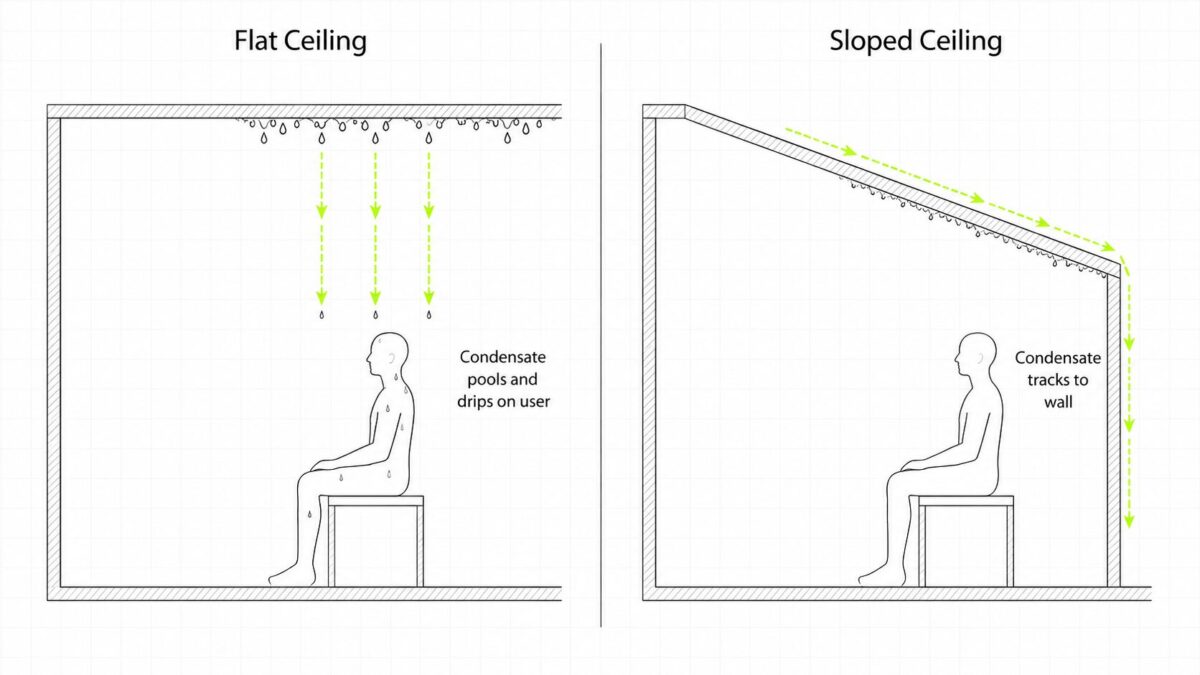
Steam rises. That’s the whole mechanism.
It fills the room, surrounds you, and creates the warmth and humidity that makes a steam session what it is. But steam also condenses. When rising steam meets a cooler ceiling surface, it turns back into water.
On a sloped ceiling, that water has a clear path – it tracks down toward the walls and drains away.
On a flat ceiling, it has nowhere to go. It pools. Then it drips.
Experienced installers describe it as a “rain-like effect” – cold water falling directly onto the person below. Not a minor annoyance. A fundamental failure of the room to do what it’s supposed to do.
But does it really get worse over time?
It does – and significantly. That pooling condensate doesn’t just land on you. It sits on the ceiling surface, works its way into grout joints, and begins migrating behind tiles. The conditions it creates – perpetually damp, warm, enclosed – are ideal for mould growth and tile bond failure.
The National Tile Contractors Association (NTCA) published a direct response to a contractor who’d built an under-sloped steam room ceiling. Their verdict left no room for interpretation: the only listed cure was to “re-design the steam room.” Not to add insulation. Not to apply a sealant. A full redesign. Forensic tile consultants estimate that remediation of a failed steam room installation typically costs two to three times the original build.
Worth noting: this isn’t a niche commercial problem. It happens in residential installations regularly.
The Slope Standard – And Why the Numbers Vary
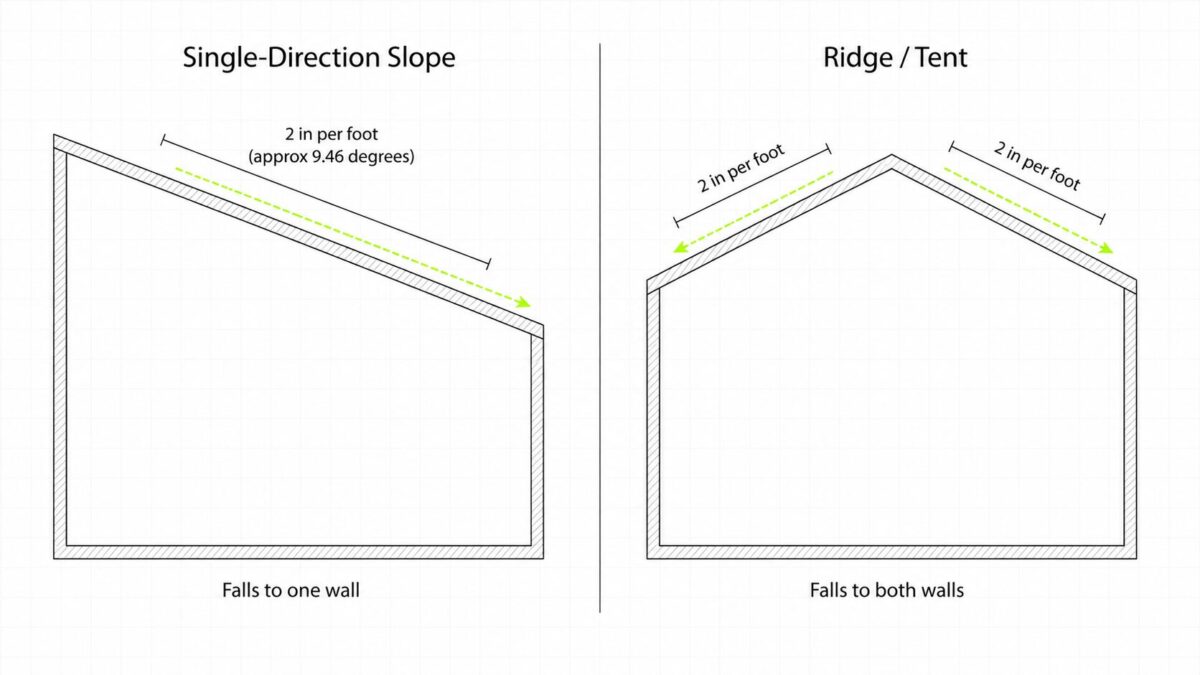
This is where the genuine confusion starts. Search online and you’ll find figures ranging from a quarter inch per foot to 2 inches per foot – and seemingly credible sources citing all of them.
Let’s be clear. There is a professional standard.
The Tile Council of North America (TCNA) Handbook – specifically methods SR613 and SR614 – mandates a minimum slope of 2 inches for every foot of ceiling run. That’s approximately 9.46 degrees. The NTCA references the same figure. So does the International Masonry Institute.
The UK picture is slightly different. Wedi, whose installation systems are widely used by wet room specialists here, specifies a gradient of between 5% and 10% – roughly 0.6 to 1.2 inches per foot. Lower than the TCNA figure, but still a meaningful slope.
So why do so many installs fall well short of either standard?
Because field practice varies considerably. Research across trade forums shows many contractors working at three-quarters of an inch per foot – sometimes less. Some cite ceiling height constraints. Some believe a flat ceiling will be fine in practice. The evidence consistently suggests otherwise: under-sloped ceilings still drip under sustained steam use, just less immediately obvious.
For a UK residential installation, the sensible target is 2 inches per foot where ceiling height allows. If that’s genuinely not achievable, 1 inch per foot is a realistic minimum – but it should be a considered compromise, not a default shortcut.
One configuration worth knowing about is the ridge or tent ceiling. Rather than sloping in a single direction, the ceiling peaks at a central point and slopes down to both side walls. Think of it like the roof of a house, scaled down – water finds its way to the edges from every point on the surface. The TCNA specifically notes that this approach also reduces how much condensate runs down the walls, provided the 2-inch-per-foot slope is maintained on both sides of the ridge.
How the Slope Is Built – A Pre-Tile Framing Step
Most of the anxiety about ceiling slope comes down to tiling. People assume it means cutting complex angles into every tile, managing difficult layouts, paying a specialist premium for an awkward job.
It doesn’t work like that.
The slope is created before a single tile is cut.
A qualified installer marks the desired slope on the ceiling joists, then fixes timber battens – sometimes called furring strips – at graded heights to build the angle into the structure. Cement backer board (not plasterboard, not moisture-resistant drywall) is then fixed to this angled frame. A continuous waterproof membrane follows, applied across every surface.
By the time tiling begins, the slope already exists in the frame. The tile installation above it follows standard practice.
The framing approach is well-established in manufacturer guidance – Wedi’s UK installation specifications detail it directly. It’s a pre-tile structural decision, not a tiling complication.
Movement joints matter here too. At the junction where the ceiling meets the walls, thermal expansion from steam cycling creates stress that has to go somewhere. Your installer should include movement joints at these points. Without them, even a correctly sloped, correctly tiled ceiling can develop cracking over time.
What Insulation Does – And What It Doesn’t Do
A reasonable assumption: if the ceiling stays warm enough, condensation won’t form – so good insulation should solve the problem without needing a slope.
It’s a logical thought. It’s also incorrect.
Insulation reduces the rate at which steam condenses by keeping surfaces warmer – but it doesn’t eliminate surface condensation. A vapour barrier and closed-cell foam insulation work to prevent steam from migrating into the wall cavity and structural elements behind the backer board. They protect the building fabric around the steam room.
Put simply: insulation protects the structure. Slope protects the user.
The TCNA and NTCA treat them as separate, non-negotiable requirements – listed independently in the same specification. Neither substitutes for the other. UK homeowners using insulation board across every surface have reported mould forming in grout within weeks of regular use, precisely because the ceiling was flat and condensate had nowhere to go.
Both are required. One does not replace the other.
The Vidalux Approach – Steam Rooms Built Right from the Start
Vidalux steam rooms and steam shower cabins are designed with the condensation challenge already considered. A sloped ceiling is recommended as standard across the Vidalux Steam Room Generator range – because preventing condensate drip is built into how the installation is approached from the start, not addressed after the fact.
For customers building a custom steam enclosure around a Vidalux steam generator, the team can advise on ceiling requirements at the planning stage. Getting the structure right before tiling begins costs nothing extra. Getting it wrong can cost considerably more to fix.
Explore the full Vidalux steam room range.
In Summary
The slope is non-negotiable. Two inches per foot is the professional standard – and it exists for a simple reason: without it, cold water drips onto users, grout fails, and mould follows.
The reassuring part is that the slope is a framing decision, not a tiling nightmare. A qualified installer builds it into the structure before tiling begins. If you’re at the planning stage, raise it now. It’s a simple question with a clear answer – and far easier to address before the backer board goes on than after.
See the full Vidalux steam room range.
Frequently Asked Questions
Q: How much slope does a steam room ceiling need?
A: A steam room ceiling needs a minimum slope of 2 inches for every foot of ceiling run. This is the standard set by the TCNA (Tile Council of North America) and referenced by professional tile contractors internationally to prevent condensate dripping onto users.
Q: Why is water dripping from my steam room ceiling?
A: Water dripping from a steam room ceiling is almost always caused by a flat or under-sloped ceiling. Steam condenses on the cooler surface overhead, and without a slope to direct that water to the walls, it pools and falls straight down.
Q: Do I really need to slope a steam room ceiling, or is it just for commercial use?
A: You do need to slope a steam room ceiling in a residential installation. The TCNA standard applies to both residential and commercial steam rooms – a flat ceiling will produce cold condensate drip regardless of how the space is used.
Q: What angle is a 2-inch-per-foot ceiling slope in degrees?
A: A 2-inch-per-foot slope is equivalent to approximately 9.46 degrees. In UK guidance, Wedi specifies a 5-10% gradient as the minimum – roughly 0.6 to 1.2 inches per foot – though the TCNA’s 2-inch standard is the more widely cited professional figure.
Q: Can I use insulation instead of sloping my steam room ceiling?
A: Insulation alone cannot replace a sloped ceiling in a steam room. Insulation reduces vapour migrating into wall cavities – but it does not prevent surface condensation from forming and dripping. The TCNA and NTCA list both insulation and ceiling slope as separate, mandatory requirements.
Q: How is a sloped steam room ceiling framed before tiling?
A: A sloped steam room ceiling is framed by fixing timber battens or furring strips to the ceiling joists at graded heights, creating the desired angle before backer board is applied. The slope is built into the structure – the tile installation above follows standard practice.
Q: What happens if a steam room ceiling is not sloped correctly?
A: An incorrectly sloped steam room ceiling will drip cold condensate onto users during sessions. Over time, pooling water saturates grout and tile adhesive, leading to tile bond failure and mould growth. Forensic tile consultants estimate remediation costs at two to three times the original installation cost.
Q: Can a ridge or tent ceiling work in a steam room instead of a single-direction slope?
A: Yes – a ridge or tent ceiling, where the slope runs from a central peak down to both side walls, is an approved alternative. The TCNA notes this configuration reduces condensate running down the walls, provided the minimum 2-inch-per-foot slope is maintained to each side.
- About the Author
- UK’s best-rated?

With over 22 years in the home spa industry, Andrew has overseen every stage of the journey—from initial product design and manufacturing to final installation. An author of multiple technical publications and scientific papers, he founded Vidalux to replace industry hype with engineering-led reliability. His focus remains on delivering gym-quality wellness through honest design and technical truth.
DISCLAIMER: All specifications, claims, and advice relating to any internal or external procedure, practise, product, or service were true at the time of writing. For more accurate and up-to-date details in relation to Vidalux services, please visit the relevant dedicated on-site page. For any product-related information, specifications, or guidance, the information on the product page should be considered the governing source.